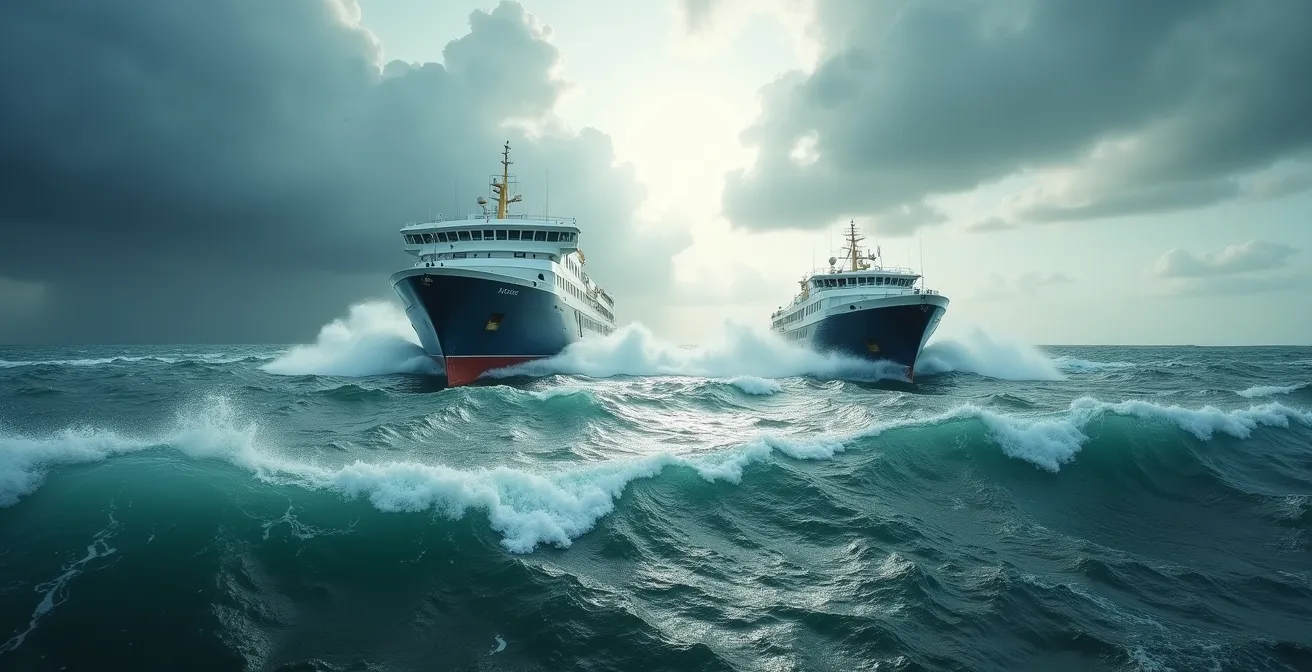
The best ferry choice in rough seas isn’t just about size; it’s about matching the vessel’s motion to your personal seasickness tolerance.
- Fast crafts have a quick, jarring motion (pitch and heave), while large ROROs have a slow, deep swing (roll).
- Your comfort depends on which type of movement affects you less, as both can be challenging in rough conditions.
Recommendation: For most people prone to seasickness, the slower, more predictable roll of a large RORO is more manageable than the sharp, high-frequency movements of a fast craft.
There’s a moment every island-hopping traveler in the Philippines knows well: standing at the pier, looking out at the choppy water, and wondering if you’ve made the right choice. You’ve heard the usual advice—”bigger is better,” “just take the fast one to get it over with.” But as a captain who has navigated these waters for years, I can tell you the decision is more nuanced, especially when the sea gets rough and your stomach is on the line.
The real choice isn’t about speed or size alone; it’s about the very character of the ship’s movement. It’s the critical difference between a sharp, high-frequency ‘jerk’ and a slow, deep ‘roll.’ Understanding how each vessel interacts with the waves is the true secret to not just surviving, but actually navigating your inter-island journey with confidence and comfort. Forget the simple platitudes; we’re going to look at this from the bridge.
This guide is your captain’s briefing. We’ll go beyond the RORO vs. fast craft debate and cover the essential, real-world knowledge you need for ferry travel in the Philippines—from booking your ticket without errors to performing a 30-second safety check on a local banca. Consider this your full tour, from the engine room to the top deck.
This article provides a comprehensive overview to help you navigate the Philippine seas like a seasoned traveler. Below is a summary of the key topics we will cover.
Summary: Your Complete Guide to Philippine Ferry Travel
- How to Book 2GO Travel Tickets Online Without System Errors?
- Why You Must Check the Weather Before Boarding a Ferry in Visayas?
- The Benefit of Taking Night Ferries to Save on Hotel Costs
- Bunk Bed vs. Tourist Seat: Is the Air-Con Difference Worth the Price?
- When to Arrive at Cebu Pier 1 to Avoid Missing Your Boat?
- Why Getting to the Most Beautiful Islands Takes More Than Just a Flight?
- The Safety Check You Must Do Before Boarding a Banca Boat
- How to Get to Batanes When Flights Are Limited and Expensive?
How to Book 2GO Travel Tickets Online Without System Errors?
The first leg of any sea journey begins long before you smell the salt air—it starts at the booking screen. For many travelers in the Philippines, that means navigating the 2GO Travel website. Unfortunately, system errors or timeouts can be a frustrating hurdle. From my experience, most issues stem not from the site itself, but from the user’s setup. A successful booking is about preparation, much like preparing a ship for a voyage.
Think of it as your pre-departure checklist. Ensuring your browser is up-to-date and free from interfering extensions like ad-blockers is like making sure your ship’s communication lines are clear. A stable internet connection is your engine; a weak one will leave you stranded. 2GO operates a modern fleet, with 18 modern vessels serving 20+ destinations, so successfully booking a ticket gives you access to a vast network connecting the archipelago. The key is to approach the process methodically to avoid digital “rough seas.”
Action Plan: Pre-Booking Checklist for 2GO Travel System Success
- Use updated Chrome or Firefox browser (avoid Internet Explorer).
- Disable all ad-blockers and popup blockers before accessing the site.
- Ensure a stable internet connection (minimum 10 Mbps recommended).
- Prepare valid government ID details and payment method in advance.
- Access the site during off-peak hours (avoid the 8-10 PM rush).
- Clear your browser cache if you experience loading issues.
Why You Must Check the Weather Before Boarding a Ferry in Visayas?
On land, a storm is an inconvenience. At sea, it’s a matter of safety and operational reality. In the Philippines, an archipelago nation where an immense 59 million maritime passengers traveled in 2022, the weather is not just small talk; it’s the most critical factor of your journey. The Philippine Atmospheric, Geophysical and Astronomical Services Administration (PAGASA) is the sailor’s best friend. Ignoring their warnings is the single biggest mistake a passenger can make.
The sea state dictates everything. A Public Storm Warning Signal (PSWS) isn’t a suggestion; it’s a command. Ferry operators are legally required to suspend operations when conditions become dangerous, typically at Signal #2. This isn’t about the shipping company being difficult; it’s about ensuring you don’t find yourself in a perilous situation. Learning to read these signals is as important as having your ticket. It gives you the power to make informed decisions and avoid being stranded at the port.
Understanding PAGASA’s Public Storm Warning Signals for Ferry Travel
The PAGASA monitoring system uses Public Storm Warning Signals (PSWS) rated 1-5, with Signal #2 (winds 62-88 kph) typically triggering ferry suspensions. The PANaHON visualization platform provides real-time weather data from automated stations, allowing travelers to track conditions 24 hours before departure. Critical thresholds include wave heights above 4.5 meters and wind speeds exceeding 61 kph, which make travel for most inter-island ferries unsafe.
The Benefit of Taking Night Ferries to Save on Hotel Costs
There’s a certain romance to a night voyage, watching the city lights fade into a horizon of stars. But beyond the romance, there’s a powerful, practical advantage: efficiency. A night ferry is one of the smartest travel hacks in the Philippines. You are essentially transforming dead travel time into your accommodation for the night, saving significant money and a full day of your precious itinerary.
Consider the alternative: a flight or a day ferry requires you to book a hotel for the night before, eat dinner, sleep, have breakfast, and then spend your daylight hours in transit. A night ferry consolidates all of this. You board in the evening, have dinner on the ship, sleep in a bunk or cabin while the vessel does the work, and wake up in your new destination. This simple shift in timing can effectively add an extra day to your vacation and cut your costs dramatically, a strategy that seasoned backpackers and budget-conscious locals have perfected.
As one expert from a leading travel publication notes, the value is clear. According to the Ultimate Guide to Ferry Routes 2025:
Night ferries offer a unique value proposition for budget travelers – you’re essentially getting transportation and accommodation rolled into one
– Guide to the Philippines Travel Expert
This table illustrates the financial logic. The night ferry isn’t just a mode of transport; it’s a strategic financial decision that frees up resources for the actual adventures.
| Option | Accommodation Cost | Additional Costs | Total Estimated Cost (PHP) | Time Efficiency |
|---|---|---|---|---|
| Night Ferry (Tourist Class) | 1,200 PHP | Onboard meals: 300 PHP | 1,500 PHP | Travel while sleeping |
| Hotel + Day Ferry | 2,500 PHP (budget hotel) | Dinner: 400 PHP Breakfast: 250 PHP Day ferry: 800 PHP |
3,950 PHP | Lost daytime for travel |
| Night Ferry (Economy) | 800 PHP | Onboard snacks: 150 PHP | 950 PHP | Basic comfort, maximum savings |
Bunk Bed vs. Tourist Seat: Is the Air-Con Difference Worth the Price?
On any ferry, the choice of accommodation is a balance of comfort, privacy, and budget. The most common decision travelers face is between a basic bunk bed in an open, naturally ventilated area and a seat in an enclosed, air-conditioned tourist class. The price difference may seem small, but the experiential gap is significant, and the “better” option depends entirely on you and the specific route.
The Super Value or Economy bunk is the most authentic way to travel. You’re with the locals, feeling the sea breeze (and humidity), and saving the most money. It’s perfect for short, daytime trips or for hardy travelers. However, on a long, overnight journey, the allure of Tourist Class becomes powerful. The air conditioning provides relief from the tropical heat, the reclining seat offers more personal space, and the environment is generally cleaner and quieter. For those sensitive to heat or needing to arrive well-rested, the upgrade is almost always worth the cost.
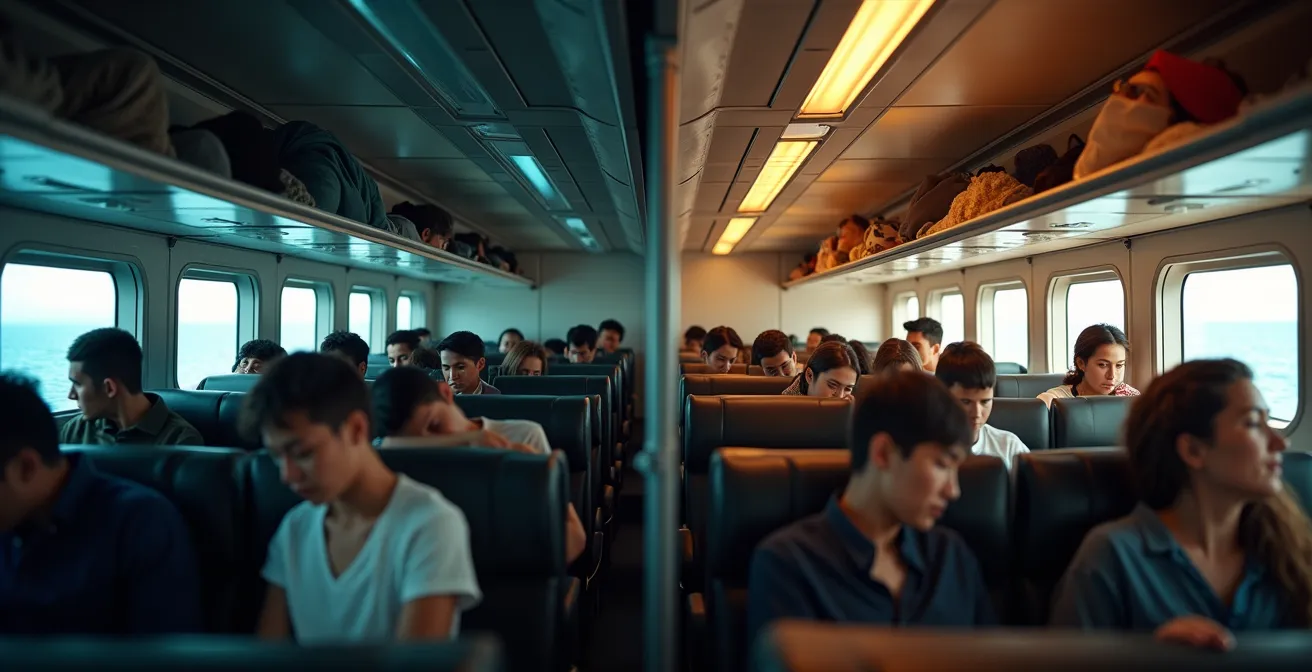
Beyond these, options scale up to private Cabin and Suite Classes, which offer hotel-like privacy and amenities at a much higher price point. Your choice should reflect your travel style and priorities for that specific leg of the journey.
| Class Type | Price Range (PHP) | Air Conditioning | Privacy Level | Amenities |
|---|---|---|---|---|
| Super Value (Bunk) | 800-1,000 | Natural ventilation | Shared open deck | Basic seating/bunks |
| Tourist Class | 1,200-1,500 | Full AC | Assigned seats | Reclining seats, cleaner facilities |
| Cabin Class | 2,500-3,500 | Private AC control | Private room (2-4 pax) | Beds, storage, power outlets |
| Suite Class | 4,000-6,000 | Premium AC | Full privacy | En-suite bathroom, TV, mini-fridge |
When to Arrive at Cebu Pier 1 to Avoid Missing Your Boat?
A ship waits for no one. This is a fundamental law of the sea, and nowhere is it more apparent than in the organized chaos of a major Philippine port like Cebu’s Pier 1. Missing your boat here isn’t usually about a single mistake, but a failure to account for a sequence of potential delays. Arriving “on time” for your departure is not enough; you must arrive with enough buffer to navigate the terminal itself.
Think of the pier as a multi-stage process: security check, terminal fee payment, check-in, and finally, finding your gate. Each stage is a queue, and the length of that queue is unpredictable. During regular days, a two-hour buffer is a safe bet. But during peak season, such as Holy Week, Christmas, or Cebu’s world-famous Sinulog Festival, this is dangerously insufficient. The port operates under immense strain during these times, and official port congestion data indicates that terminal processes can take 200% longer during Sinulog week. Your arrival time must reflect this reality. Being early isn’t just cautious; it’s necessary.
Action Plan: Cebu Pier 1 Arrival Timeline Guide
- Regular Days: Arrive 2 hours before departure for smooth check-in.
- Peak Season (Holy Week, Christmas): Arrive 4 hours early minimum.
- Sinulog Festival Period: Arrive 5 hours early due to extreme congestion.
- Account for the terminal fee payment queue (can take 15-30 minutes).
- Factor in security inspection time (can take 20-45 minutes during high alerts).
- Add a buffer for finding the correct boarding gate in the large pier complex.
Why Getting to the Most Beautiful Islands Takes More Than Just a Flight?
The fantasy of the Philippines is often a single image: a pristine, empty beach. The reality is that reaching that paradise often requires embracing the journey itself, a multi-modal tapestry of planes, taxis, ferries, and tricycles. This is where the RORO vs. Fast Craft discussion becomes most relevant. A RORO (Roll-on/Roll-off) is a large, stable vessel designed to carry vehicles. Its deep hull and wide beam give it immense stability. In rough seas, it exhibits a slow, predictable roll—a long, swinging motion. A fast craft, often a catamaran, is built for speed. It sits on top of the water and, in rough seas, can have a sharp, quick, jarring motion—more of a pitch and heave. For seasickness, you must choose your poison: the long swing or the sharp jab.
This multi-step travel is not a flaw in the system; it’s the very nature of an archipelago. The journey itself becomes an integral part of the adventure. As a representative for the Philippine Tourism Board once said:
The journey itself becomes part of the adventure – you see local life, meet fellow travelers, and experience the gradual transition from urban to paradise
– Philippine Tourism Board Representative
Attempting to fly everywhere is not only prohibitively expensive but often impossible. The real magic is found in the transitions—the ferry ride where you see flying fish, the tricycle driver who gives you a local tip, the shared meal on a RORO deck. Embracing this is key to truly experiencing the Philippines.
Multi-Modal Journey Analysis: Cebu to Siquijor
The Cebu to Siquijor route exemplifies this reality. A common path involves a flight from Manila to Cebu (1.5 hours, ₱2,500), a taxi to Cebu Pier (45 minutes, ₱300), a fast craft ferry to Siquijor (2 hours, ₱1,000), and finally a tricycle to your beach resort (30 minutes, ₱150). The total journey takes over 5 hours and costs around ₱3,950. A pure-flight alternative would be far more complex and expensive, likely involving multiple connections and costing upwards of ₱8,000, if available at all.
The Safety Check You Must Do Before Boarding a Banca Boat
From large ROROs, we scale down to the most iconic vessel in the Philippines: the banca. These wooden outrigger boats are the lifeblood of local transit and island hopping. While the Philippine ferry industry as a whole has made incredible strides, where a Lloyd’s Register Foundation study reveals ferry safety improved from world’s worst to near global average since 2016, the responsibility for safety on smaller, often informal banca trips partly falls to you, the passenger. You are the final inspector.
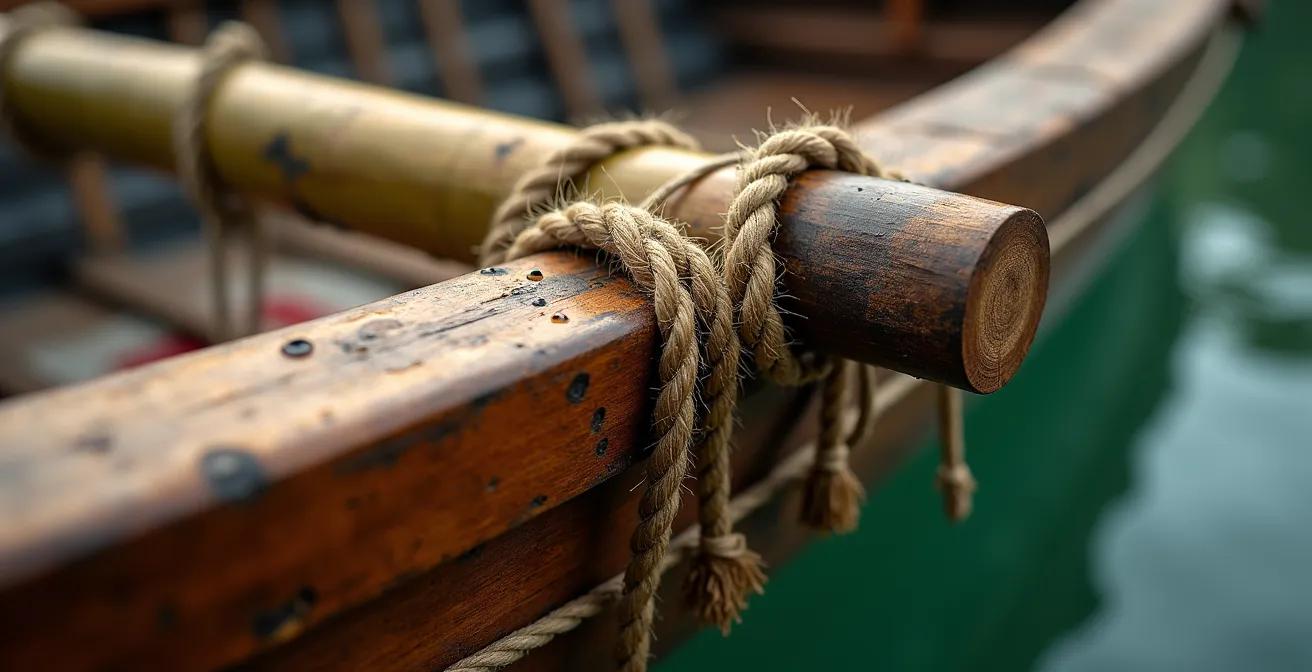
This doesn’t require an engineering degree. A simple, 30-second visual check before you step aboard can tell you almost everything you need to know. You are looking for signs of care and maintenance versus signs of neglect. A well-maintained boat is a source of pride for its operator, and it shows. Look at the outriggers (katig)—are they solid or cracked? Are life jackets present and in good condition? Does the boat sit level in the water? Trust your instincts. If something feels wrong, it probably is. There will always be another boat.
Action Plan: 30-Second Banca Boat Safety Inspection
- Hull Integrity: Look for visible cracks, significant patches, or water seeping in.
- Outriggers (Katig): Ensure the bamboo is not split or cracked and that the connections to the hull are secure.
- Life Jackets: Visually count the available vests. Do they look functional, without major tears or missing straps?
- Loading: The boat should sit level in the water, not overloaded or listing heavily to one side.
- Crew Behavior: The captain and crew should appear alert, sober, and professional.
- Engine Check: If possible, see if there are two engines—a main and a backup—which is a great sign of a safe operator.
Key takeaways
- Weather is non-negotiable: Always check PAGASA storm signals before any Visayas ferry trip, as suspensions are mandatory for safety.
- Night ferries are a dual-purpose tool: They combine transport and accommodation, saving you significant time and money compared to a hotel and day-trip combo.
- Pre-boarding diligence is vital: From preparing for online booking to performing a quick visual safety scan of a banca, your own preparation is key to a smooth journey.
How to Get to Batanes When Flights Are Limited and Expensive?
And then there is Batanes. The northernmost province of the Philippines is a destination unlike any other, and its isolation is part of its charm. This isolation also presents a significant travel challenge. Flights are few, notoriously expensive, and highly susceptible to weather-related cancellations, where Batanes weather statistics indicate flight cancellations increase by 40% during the monsoon season from June to October. So what does the intrepid traveler with more time than money do?
They look to the sea. While there are no luxury passenger liners, there is a lifeline that connects Batanes to Luzon: the cargo vessel. This is not a tourist cruise; it is a genuine, rustic, and deeply authentic travel experience. It’s an option for the true adventurer willing to trade comfort for an unforgettable story and a massive cost saving. Traveling this way, you are not a tourist; you are sharing passage with the very goods and people that keep the remote islands running.
Alternative Route to Batanes: The Cargo Ship Option
The MV Ivatan Princess cargo vessel operates the Currimao, Ilocos Norte to Basco, Batanes route. It typically departs on Wednesdays and Sundays at 8pm, arriving the next day around 4pm, making it an 18-hour journey. The fare is approximately ₱1,200, a stark contrast to the ₱10,000+ often quoted for a round-trip flight. Passengers must be prepared for the reality: you will be traveling alongside cargo that can include motorcycles, construction materials, and even livestock. This is not for comfort seekers, but for those who want to see how essentials are transported to one of the most remote provinces in the country.
Armed with this knowledge, you are no longer just a passenger, but an informed traveler. You understand the rhythms of the sea and the practicalities of the port. It’s time to plan your next inter-island journey with the confidence of a seasoned mariner.