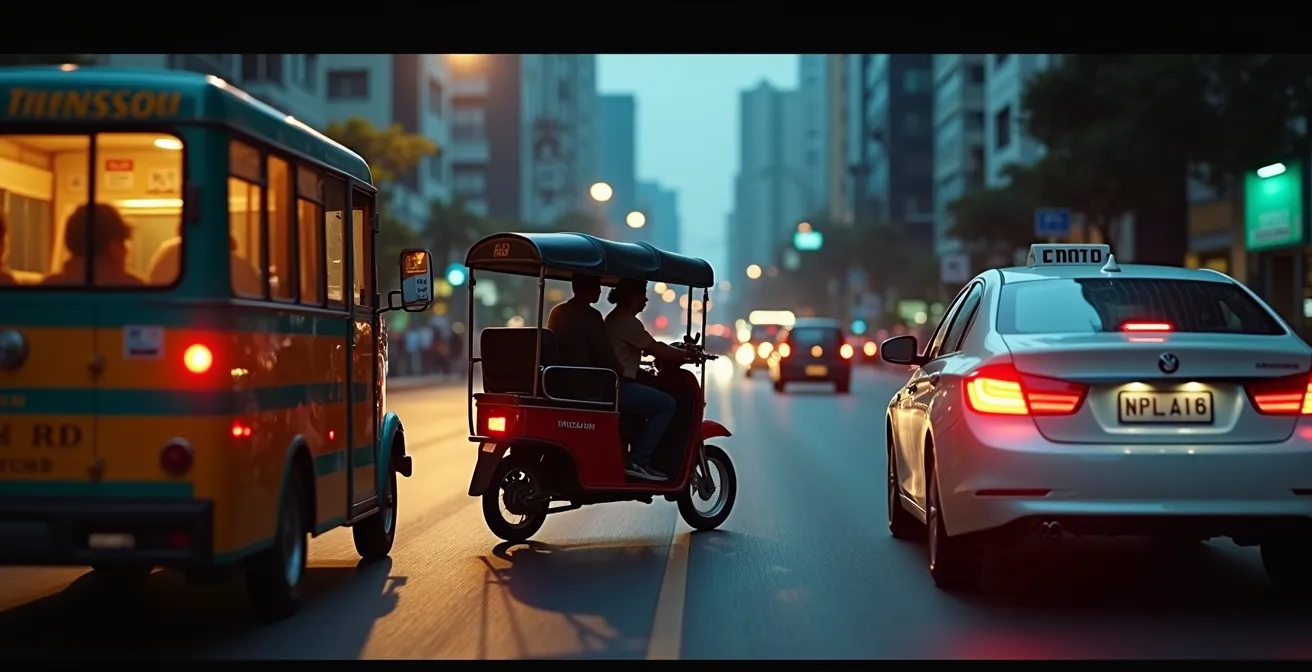
True night travel safety in the Philippines isn’t about choosing one “safest” option like Grab, but mastering the specific rules and risks of each local transport mode.
- Tricycle and taxi safety hinges on pre-negotiation and using specific local phrases to deter scams.
- Long-distance travel choices involve a trade-off between speed, comfort, and reliability, especially during adverse weather.
Recommendation: Instead of defaulting to a single app, learn the operational logic of 2-3 local transport options to navigate more efficiently, affordably, and safely after dark.
The vibrant energy of a Philippine city doesn’t fade when the sun goes down; it transforms. For a tourist, however, this transformation can bring a wave of uncertainty. The question of how to get back to your hotel safely becomes paramount. The default advice is often a simplistic “just use a ride-hailing app like Grab.” While convenient, this approach overlooks the rich, complex, and often more efficient tapestry of local transportation. It creates a bubble that prevents true immersion and can even be a disadvantage in areas with poor internet or high app demand.
Relying solely on one method means missing the nuances of the local transit ecosystem. You might pay more, wait longer, or miss out on experiences entirely. The common wisdom to “be aware of your surroundings” is true but insufficient. Real safety doesn’t come from avoidance; it comes from competence. It’s about understanding the unwritten rules of the road, the specific risks associated with each vehicle, and the cultural scripts that can turn a potentially hazardous situation into a smooth, predictable journey.
But what if the key to safe night travel wasn’t just choosing the right vehicle, but knowing how to operate within the system of each one? This guide moves beyond the generic advice. We will not just compare Jeepneys, tricycles, and taxis; we will dissect their operational logic. We will explore the specific conditions under which each is the superior choice, not just for safety, but for efficiency and experience. By understanding the underlying mechanics—from fare negotiation tactics to the impact of weather patterns—you can move through the city’s arteries not as a vulnerable tourist, but as an informed navigator.
This comprehensive analysis will equip you with the practical knowledge needed to make strategic transportation decisions after dark. Below, we break down the most common questions and scenarios you’ll face, providing expert insights for each.
Summary: Your Guide to Mastering Philippine Night Transit
- How to Negotiate a Tricycle Fare Like a Local in 3 Steps?
- Why Are Flights from Manila to Islands Often Delayed in the Afternoon?
- Victory Liner vs. Ceres Bus: Which Offers Better Comfort for 8-Hour Trips?
- The “Broken Meter” Taxi Scam That Targets Tourists at Airports
- When to Use the Pasig River Ferry to Skip Manila Traffic?
- How to Use the LRT/MRT Without Getting Crushed at Rush Hour?
- The Tricycle Fare Mistake That Costs Tourists Double the Price
- Fast Craft vs. RORO Ferry: Which Should You Choose for Rough Seas?
How to Negotiate a Tricycle Fare Like a Local in 3 Steps?
The tricycle is a quintessential part of the Philippine transport landscape, perfect for short distances where larger vehicles can’t go. However, its fare structure is often a source of confusion and overcharging for tourists. Unlike a metered taxi, the price is fluid and depends on your negotiation skills. Mastering this interaction is not about being confrontational; it’s about demonstrating local knowledge politely and confidently. A successful negotiation ensures a fair price and sets a respectful tone for the ride.
The first principle is to understand the two service types: ‘Pakyaw’ (a special, private trip) and ‘Pasahero’ (a shared ride with other passengers along a set route). Not clarifying this upfront is a common mistake. The second principle is to always let the driver state their price first. This gives you a baseline to negotiate from. A reasonable counter-offer is typically 20-30% lower than the initial quote, especially if it seems inflated. For context, most special trips within a town should fall in a reasonable range, while shared rides have a much lower, fixed fare per person.
To help you navigate this, here is a simple, three-step process. Using the local terms will immediately signal to the driver that you are not a clueless first-timer. This script is your key to unlocking fair fares and traveling with confidence.
- Master ‘Pakyaw’ vs ‘Pasahero’: Immediately specify if you want a ‘special trip’ (the whole tricycle) or a shared ride. Use the local phrases: say “Pakyaw po” for a special trip or “Pasahero lang po” if you’re open to sharing.
- Always ask ‘Magkano po?’ first: Before stating your destination, ask “How much?” This prompts the driver to give you a quote. After they do, you can state your destination and then make a polite counter-offer if needed. According to a guide on Philippine transportation, standard special trips often start from PHP 40-100 depending on the distance.
- Master the polite walk-away: If the price quoted is unreasonably high, simply say “Salamat po, mahal” (Thank you, it’s expensive) and begin walking toward the next available tricycle. This single action is often enough to have the driver call you back with a much more reasonable offer.
Why Are Flights from Manila to Islands Often Delayed in the Afternoon?
Booking a domestic flight from Manila to one of the Philippines’ stunning islands is an exciting step in any travel plan. However, seasoned travelers know to be wary of afternoon departures. These flights are notoriously prone to delays, turning a short hop into a lengthy wait at the airport. This isn’t just bad luck; it’s a predictable outcome of two converging factors: infrastructural limitations and meteorological patterns.
The primary infrastructural issue is airport capacity. Ninoy Aquino International Airport (NAIA), Manila’s main hub, operates under immense pressure. As transport experts note that NAIA operates at near-full capacity, even minor delays in the morning create a ripple effect. A single plane arriving late causes a cascading chain reaction, pushing back subsequent takeoffs and landings throughout the day. By the afternoon, the schedule is often significantly backlogged, and your 2 PM flight might not depart until 4 PM.

This congestion is compounded by the Philippines’ tropical climate. The afternoons, especially during the wet season (roughly June to November), are prime time for the development of sudden, intense thunderstorms. These localized weather events can halt all ground and air operations for safety reasons. An airport that is already struggling with a backlog is brought to a complete standstill, exacerbating delays even further. For a tourist, this means that an early morning flight is almost always a safer bet for an on-time departure.
Victory Liner vs. Ceres Bus: Which Offers Better Comfort for 8-Hour Trips?
For long-haul land travel across Luzon or between major islands, provincial buses are the backbone of the Philippine transport system. For a journey stretching over eight hours, comfort is not a luxury; it’s a necessity for arriving at your destination ready to explore. Two of the most prominent companies are Victory Liner and Ceres Bus, and while both will get you there, they offer distinctly different experiences, particularly concerning passenger comfort.
Your choice often depends on your route and personal priorities. Victory Liner has a strong reputation, especially on routes north of Manila. They are known for their well-maintained terminals and a tiered class system. Opting for their “Deluxe” or “First Class” services can provide significantly more legroom and seat recline, amenities that are invaluable on an overnight trip. However, their network is more concentrated in the Luzon region.
Ceres Bus, on the other hand, boasts one of the most extensive route networks in the country, dominating travel in the Visayas and parts of Mindanao. While they may not always offer the premium suite-style seating of Victory Liner, many of their long-distance buses are modern, air-conditioned, and equipped with onboard restrooms. The quality of rest stops can be more variable than Victory Liner’s dedicated terminals, but their sheer reach makes them an unavoidable and reliable choice for many inter-island routes.
This comparative table breaks down the key comfort factors to help you decide, based on a general analysis from sources like World Nomads’ guide to Philippine transport.
| Feature | Victory Liner | Ceres Bus |
|---|---|---|
| Seat Recline | Deluxe suites available | Standard recline |
| Legroom | More in first-class | Standard spacing |
| Onboard Restroom | Selected routes | Most long routes |
| Route Network | North Luzon focus | Wider coverage |
| Rest Stops | Dedicated terminals | Variable quality |
| Windows | Curtained | Larger viewing |
The “Broken Meter” Taxi Scam That Targets Tourists at Airports
Arriving at an airport, tired after a long flight, makes you a prime target for one of the most common transport scams in Manila: the “broken meter” tactic. This scam involves a taxi driver refusing to use the official meter and instead demanding a wildly inflated, fixed price at the end of the journey. The amounts can be astronomical; in one notorious case, a recent LTFRB investigation revealed Taiwanese tourists were charged P10,000 for a short ride that should have cost around P200. Knowing how to identify and defuse this situation from the outset is a critical safety skill.
The scam preys on the tourist’s unfamiliarity and unwillingness to cause a scene. The driver might agree to use the meter initially, only to “discover” it’s broken once you’re on the move and trapped in traffic. The best defense is a proactive offense, using a few key phrases in the local language *before* you even get in the car. This signals that you understand the rules and are not an easy mark. Always opt for official airport taxis from the designated queue, as they are more accountable.

Having a clear, calm, and firm script ready is your best protection. If a driver refuses your request to use the meter, do not negotiate. Your safety and financial well-being are best served by simply walking away and finding an honest driver. There is always another taxi.
Your Action Plan: Defusing the “Broken Meter” Scam
- Before entering the taxi: Firmly ask the driver, “Meter lang po?” (Meter only?). If the driver hesitates, says no, or tries to quote a fixed price, walk away immediately. This is a red flag.
- If the driver agrees but doesn’t start the meter: As soon as the car starts moving, point to the meter and say, “Boss, paki-on po ang metro” (Boss, please turn on the meter). This polite but direct request is hard to ignore.
- If they refuse either request: Do not argue. Exit the vehicle at the first safe opportunity, saying “Salamat nalang po” (No thank you), and report the taxi’s license plate to an airport official if possible.
When to Use the Pasig River Ferry to Skip Manila Traffic?
Manila’s traffic is legendary, capable of turning a few kilometers into an hour-long ordeal. While most tourists and locals resign themselves to the gridlock of EDSA, an underutilized transport artery flows right through the heart of the city: the Pasig River Ferry. This is not a tourist cruise but a functional commuter service that, when used strategically, can be the single fastest way to travel between certain points in the metropolis, especially during peak hours.
The ferry’s primary advantage is its complete bypass of road traffic. It is most effective when your journey’s start and end points are close to ferry stations. Key “sweet spots” for tourists include traveling from the modern business district of Guadalupe (near BGC and Makati) to the historic areas of Escolta or Plaza Mexico (near Intramuros). A trip that could take 90 minutes by car during rush hour can be completed in under 45 minutes by ferry, offering a breezy and scenic alternative.
However, the ferry is not a panacea. Its operational hours are limited, and it does not run late into the night. The “last mile”—getting from the ferry station to your final destination—still requires a short walk, tricycle, or jeepney ride. Therefore, the decision to use the ferry should be a calculated one. It is the perfect solution for a traveler whose itinerary aligns with the station locations and who wants to trade the stress of traffic for a unique perspective on the city during the busiest times of the day, typically from 7-10 AM and 4-8 PM.
How to Use the LRT/MRT Without Getting Crushed at Rush Hour?
Manila’s rail systems—the LRT-1, LRT-2, and MRT-3—are the fastest way to traverse long distances across the city, avoiding the snarled traffic below. For a tourist, they offer a cheap and efficient way to reach key districts. However, during peak rush hours (approximately 7-9 AM and 5-8 PM), the experience can be overwhelming. The sheer volume of commuters leads to packed platforms and dangerously crowded train cars. Navigating this requires more than just a Beep™ card; it demands a tactical approach to personal space and security.
The first strategy is car selection. The middle cars of the train are almost always the most crowded. By making a conscious effort to board at the very first or very last car, you can often find significantly more breathing room—sometimes as much as 30% less crowded. Another advanced tactic is to board one station *before* a major interchange hub like Taft Avenue or Araneta-Cubao. This may seem counterintuitive, but it guarantees you a spot on the train before the massive crowds at the hub attempt to board.
Personal security is also paramount. During rush hour, it is essential to wear your backpack on your front to prevent theft and to be more considerate of others’ space. Keep your phone and wallet in a secure front pocket or an inner pocket of a zipped bag. For female travelers, taking advantage of the women-only car, typically the first car of the train, is highly recommended. It is strictly enforced during peak hours and offers a substantially safer and less crowded environment.
The Tricycle Fare Mistake That Costs Tourists Double the Price
While knowing how to negotiate a tricycle fare is crucial, the biggest financial mistake often happens before a single word is spoken. Many tourists inadvertently signal their vulnerability through simple errors, leading drivers to quote an inflated “tourist price” from the very beginning. Avoiding these common traps is the first and most important step to securing a fair fare. The goal is to project the quiet confidence of someone who has been here before, even if it’s your first time.
The most common mistake is ambiguity. When you board with a group and simply state a destination, the driver may quote a price that they later claim was “per person,” not for the whole trip. Always clarify before you start moving: “Is that for the whole trip or per person?” This simple question removes all ambiguity and prevents a common scam. Another subtle error is using GPS-based distances (“I want to go 2 kilometers north”). This means nothing to most drivers. Instead, use local landmarks: “To the Jollibee near the church.” This shows you know the area.
Finally, always be prepared with small bills. Pulling out a large PHP 1,000 or PHP 500 bill to pay for a PHP 50 ride is a recipe for problems. It invites the classic “I have no change” situation, forcing you to overpay. It also signals that you have a lot of cash, which can lead to higher quotes on your next ride. Always carry a mix of PHP 20, 50, and 100 bills. This logistical foresight is a powerful non-verbal cue that you are a savvy traveler, not an easy target.
Key Takeaways
- True transport safety comes from mastering the specific operational rules of each vehicle, not just defaulting to one app.
- Learning a few key local phrases for negotiation and scam prevention is your most powerful tool for fair pricing and security.
- Every transport choice involves a trade-off; the “best” option depends entirely on time of day, weather, distance, and your personal comfort threshold.
Fast Craft vs. RORO Ferry: Which Should You Choose for Rough Seas?
Inter-island travel is the essence of exploring the Philippine archipelago. For many routes, your choice will come down to two types of vessels: the sleek, modern Fast Craft and the larger, slower Roll-on/Roll-off (RORO) ferry. While the Fast Craft promises a journey time of just a few hours, the RORO plods along for six to eight hours. In calm weather, the choice is a simple matter of speed versus cost. In rough seas, however, the decision becomes a critical calculation of comfort and stability.
It’s a common misconception that the faster vessel is better in all conditions. For passengers prone to seasickness, this is dangerously false. A Fast Craft’s design causes it to have quick, jarring, and unpredictable movements in choppy water. A RORO, due to its sheer size and displacement, exhibits a slow, heavy, and more predictable rolling motion. For many, this slower roll is far more tolerable than the sharp slams of a Fast Craft. Safety is also a consideration; while regulations have improved, ferry safety remains a concern, and larger vessels generally handle rough conditions with greater stability.
Indeed, despite some improvements in recent years, ferry accidents remain common in the Philippines and even in the dry season the open ocean can get surprisingly rough.
The optimal choice in rough seas, therefore, depends on your personal tolerance for motion. Fast Crafts are also more likely to have their trips canceled entirely due to weather, while ROROs will often still sail. The following table compares how each vessel type performs when the ocean is not cooperating.
| Factor | Fast Craft | RORO Ferry |
|---|---|---|
| Motion Type | Quick, jarring movements | Slow, predictable rolls |
| Seasickness Risk | High for sensitive passengers | Lower overall |
| Travel Time | 2-3 hours typical | 6-8 hours typical |
| Best Seat Location | Middle section, no windows | Lower deck, ship center |
| Weather Cancellation | Frequent in rough seas | Less frequent |
Ultimately, navigating the Philippines at night safely and efficiently is a skill. It requires moving beyond the mindset of a passive tourist and adopting the perspective of a strategic navigator. By understanding the operational logic behind each mode of transport—from the social script of a tricycle negotiation to the physics of a ferry in rough seas—you empower yourself. True confidence on the road comes not from an app, but from knowledge. Apply these principles not just as rules to follow, but as a framework for making intelligent, situation-specific decisions on your journey.