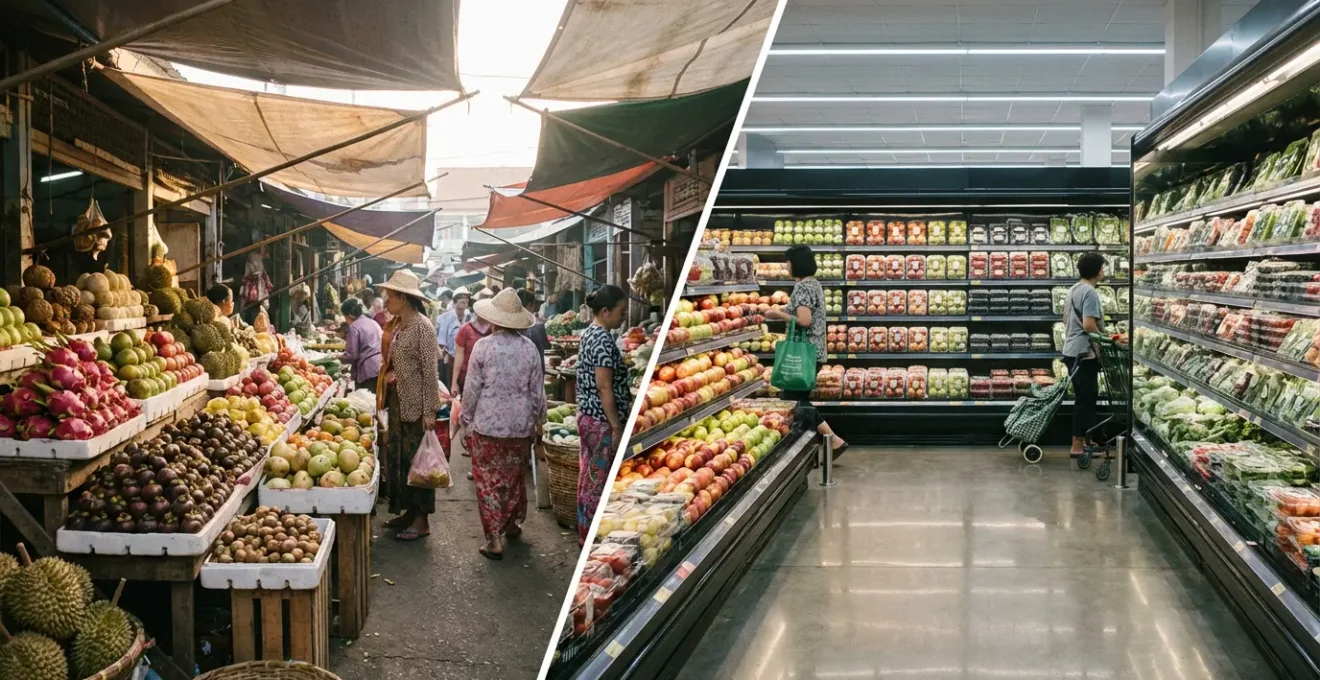
The choice between a Filipino supermarket and a ‘palengke’ (wet market) isn’t about convenience versus cost; it’s about unlocking a superior tier of freshness and value by mastering the market’s unwritten rules.
- Supermarkets offer convenience and standardized pricing, but at the cost of freshness and local economic support.
- The palengke provides access to peak-season produce and seafood, but requires specific skills in timing, negotiation, and quality assessment.
Recommendation: Dedicate one shopping trip per week to the palengke, focusing on fresh seafood and local fruits. Use it as a skill-building exercise to master the local food ecosystem, not just as a place to buy groceries.
For any expat or long-term traveler setting up a home in the Philippines, a fundamental question quickly arises: where do you buy your food? On one side stands the modern supermarket, with its air-conditioned aisles, fixed prices, and familiar layout. On the other, the vibrant, chaotic, and intensely local ‘palengke’ or wet market. The common wisdom frames this as a simple trade-off between convenience and cost. Supermarkets are clean but expensive; wet markets are cheap but intimidating. This view, however, misses the entire point.
The decision is not merely transactional. It’s about a fundamental difference in food philosophy and supply chain. While a supermarket presents a curated, predictable experience, the palengke offers a direct connection to the agricultural heartbeat of the country. It operates on a dynamic system of social commerce, sensory audits, and strategic timing. To treat it as just a cheaper supermarket is to misunderstand its power. The real key isn’t just saving a few pesos on mangoes; it’s about learning the system to access a level of quality and freshness that supermarkets, with their long-haul logistics, simply cannot match.
But what if the true value of the palengke isn’t its low prices, but the skills it teaches you? This guide moves beyond the surface-level comparison. We will deconstruct the unwritten rules of the market, from identifying the freshest catch with a glance to building the crucial ‘suki’ relationships that unlock better prices and the best-quality goods. We will explore how to confidently buy and eat fruits you’ve never seen, understand the strategic importance of a 5 AM visit, and even navigate the exhilarating world of street food safely. This is not just a shopping guide; it’s a roadmap to mastering a core part of Filipino culture.
This article breaks down the essential skills needed to transform your market runs from a chore into a rewarding strategic exercise. Below is a summary of the key areas we will cover, providing a step-by-step path from market novice to confident local shopper.
Summary: Your Guide to Mastering the Filipino Palengke
- How to Spot Fresh Fish by Looking at the Eyes and Gills?
- The “Suki” System: How to Build Relationships for Better Prices?
- Marang, Atis, and Rambutan: How to Eat Fruits You’ve Never Seen?
- Why You Must Visit the Palengke at 5 AM for the Best Catch?
- Kwek-Kwek and Fishball: Is It Safe to Eat from Market Carts?
- How to Haggle Prices in Divisoria Without Offending the Vendor?
- Bohol Bee Farm vs. Commercial Resort: Why Food Sourcing Matters?
- Balut: Is the Duck Embryo Experience Really Worth the Hype?
How to Spot Fresh Fish by Looking at the Eyes and Gills?
In a supermarket, fish is often pre-packaged, filleted, and presented under flattering lights. In the palengke, the fish is whole, fresh off the boat, and its quality is an open book—if you know how to read it. This is your first and most important sensory audit. Forgetting price and focusing on quality indicators is the primary skill that separates a savvy market shopper from a novice. The most reliable signs of freshness are not in the price tag but in the fish’s anatomy, specifically its eyes and gills.
Freshly caught fish will have eyes that are clear, plump, and dark, often with a metallic sheen. They should look vibrant and full of life. As a fish ages, its eyes will turn cloudy, become concave or sunken, and develop a grayish film. This is a non-negotiable red flag indicating the decomposition process has begun. The next step is to ask the vendor to lift the gill cover. The gills of a recently harvested fish are a bright, vibrant red or pink. This color shows that the blood is still oxygenated. Over time, this color fades to a dull brown, grey, or even green, signaling spoilage. A fishy or ammonia-like smell is a late-stage indicator; a truly fresh fish should smell neutral or like the clean ocean.
Finally, perform the ‘press test’. Gently press your finger into the flesh of the fish. If it’s fresh, the flesh will be firm and spring back immediately, leaving no indentation. If the indent lingers, the muscle tissue has started to break down, and the fish is old. Observing these signs is more reliable than any vendor’s claim and is the foundation of getting true value for your money.
The “Suki” System: How to Build Relationships for Better Prices?
The most significant difference between a supermarket and a palengke is the economic model. Supermarkets operate on anonymous, fixed-price transactions. The palengke thrives on social commerce, a system built on relationships, trust, and reciprocity. At the heart of this is the ‘suki’ system. A ‘suki’ is a regular, loyal customer who patronizes a specific vendor. In return for this loyalty, the customer receives benefits that go far beyond a simple discount.
Becoming a ‘suki’ is a deliberate process. It begins with consistency. Instead of flitting between stalls chasing the lowest price, choose a vendor who seems knowledgeable and has high-quality goods, and make a point to return. Start by making eye contact, asking their name, and requesting a recommendation—”Ano’ng maganda ngayon?” (What’s good today?). This shows respect for their expertise. On subsequent visits, even for small purchases, return to their stall. This demonstrates loyalty. Over time, the vendor will start to recognize you. They might offer a ‘pampadagdag’—a small extra like a few chilies or a piece of ginger—as a sign of goodwill. This is a crucial signal that the suki relationship is forming.
The true value of a suki relationship isn’t just haggling power. Your suki will become your market ally. They will reserve the best cuts of meat or the freshest catch for you before it even hits the main display. They’ll provide invaluable cooking tips, pre-order rare items upon request, and give you honest advice on what’s in season. This relationship transforms a simple shopping trip into a community interaction, instilling a sense of belonging that a commercialized shopping mall cannot replicate.
Marang, Atis, and Rambutan: How to Eat Fruits You’ve Never Seen?
The fruit section of a Filipino wet market can be an intimidating landscape for the uninitiated. Beyond the familiar bananas and mangoes lie a host of exotic fruits with strange textures and shapes: the spiky red rambutan, the bumpy green atis, and the pungent, formidable-looking marang. A supermarket might offer a small, sanitized selection, but the palengke provides an entire education in tropical botany. The key is to approach it with curiosity and a few basic principles.
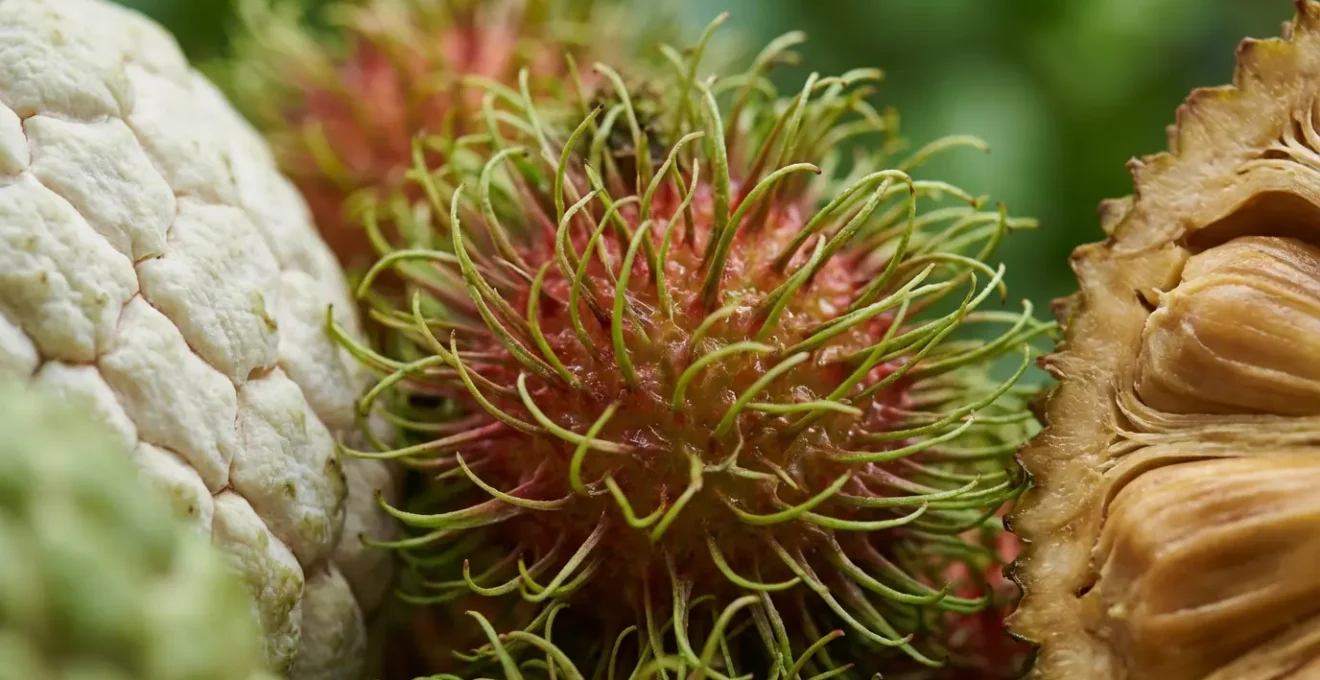
Don’t be afraid to ask the vendor for help. They are the experts and are usually happy to explain how to choose, open, and eat their produce. For many fruits, ripeness is indicated by softness and aroma. An atis (sugar apple) should be slightly soft, like a ripe avocado, and its green scales will begin to spread apart. A marang is ready when it yields to gentle pressure and emits a strong, sweet smell. For rambutan, look for vibrant, flexible red hairs; if they are dry, brittle, or black, the fruit is old. The following table provides a quick guide to get you started.
| Fruit | Ripeness Indicators | Opening Method | Local Consumption Secret |
|---|---|---|---|
| Rambutan | Vibrant hairs (not dry/brittle) | Pinch and split at seam | Chill first for refreshing taste |
| Atis (Sugar Apple) | Slightly soft like ripe avocado, scales spread apart | Twist and pull segments | Seeds used in home remedies (don’t eat) |
| Marang | Strong sweet aroma, yields to pressure | Press and tear along natural segments | Best consumed immediately after opening |
Embracing these unfamiliar fruits is a direct way to connect with the local palate. Each one offers a unique flavor profile that tells a story about the region’s agriculture and culinary traditions, a story you won’t find in a sterile supermarket aisle.
Why You Must Visit the Palengke at 5 AM for the Best Catch?
While a supermarket’s inventory is restocked on a corporate schedule, the palengke operates on the rhythm of the harvest. The single most impactful strategy for accessing the highest quality produce and seafood is timing your visit to coincide with this rhythm. For most wet markets, the magic hour is between 4 and 6 AM. This isn’t just about “beating the crowds”; it’s about being present for the ‘bagsakan’—the moment when wholesale trucks arrive directly from the provinces and fishing ports to deliver the day’s fresh supply.
Arriving during the bagsakan gives you access to what is essentially ‘A-stock’. This is the premium-grade produce that restaurant owners and other commercial buyers compete for. By 6 or 7 AM, this top-tier selection is often gone, leaving the ‘B-stock’ for the mid-morning shoppers. Furthermore, visiting early allows you to observe the initial price negotiations between wholesalers and vendors. This gives you a real-time understanding of the day’s true market price, providing a powerful baseline for your own haggling later on. Vendors also notice and remember their “early bird” customers, prioritizing them as serious buyers who value peak freshness.
Shopping at the palengke is a significant cultural activity; in fact, research indicates that 60-80% of the population in many Asian countries regularly shops at wet markets. By joining the 5 AM crowd, you are participating in this vital economic and social ritual at its most authentic peak. The trade-off for the early wake-up call is unparalleled access to the best the market has to offer, a strategic advantage that makes a profound difference in the quality of your cooking.
Kwek-Kwek and Fishball: Is It Safe to Eat from Market Carts?
No palengke experience is complete without sampling the street food. Carts selling sizzling fishballs, bright orange ‘kwek-kwek’ (battered quail eggs), and skewered squid are an integral part of the market’s atmosphere. For many newcomers, however, the question of safety looms large. While no street food is ever 100% risk-free, you can significantly mitigate risks by performing another quick sensory audit and learning to spot the signs of a safe, high-quality vendor.
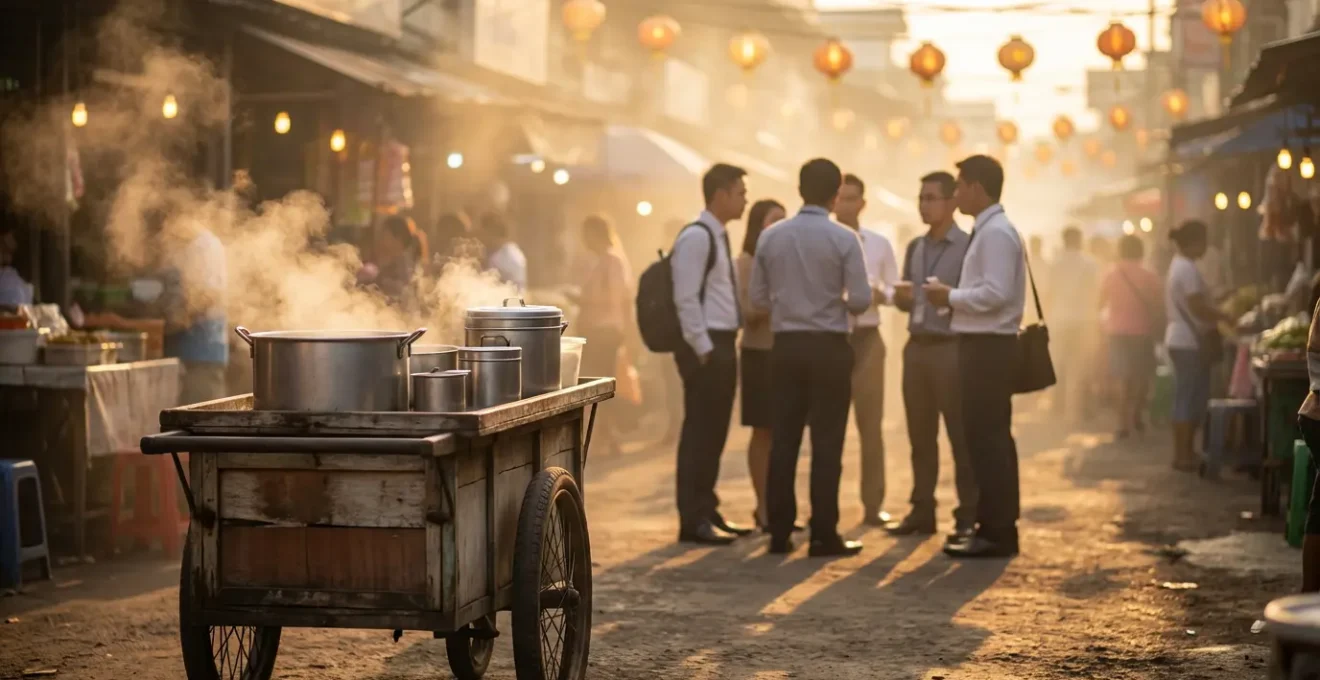
First, follow the local crowd. Carts that are consistently busy, especially with office workers or students on their breaks, are a reliable indicator of quality and safety. Locals know which vendors are trustworthy. Next, observe the vendor’s practices. Do they use separate tongs or gloves for handling money and food? A vendor who is mindful of cross-contamination is a good sign. The most revealing element, however, is often the sauce station. A safe vendor will typically have a system with separate containers: one large jar for clean dipping, and smaller personal bowls for customers to use, preventing the unsanitary practice of “double-dipping” into a communal pot.
Also, pay close attention to the cooking oil. The oil in the deep-fryer should be clear or light-golden. This suggests it’s changed frequently. If the oil is dark, murky, or has a rancid smell, it means it’s old and has been used to cook countless batches, which is both unhealthy and unappetizing. By applying these simple observational skills, you can transform a potentially risky venture into one of the most delicious and authentic parts of your market visit.
How to Haggle Prices in Divisoria Without Offending the Vendor?
Haggling, or ‘tawad’, is an expected and integral part of the palengke culture. It is not an adversarial conflict but a polite, ritualized negotiation. In large markets like Divisoria, it’s essential. However, there’s a fine line between effective bargaining and being disrespectful. The goal is a price that is fair to both you and the vendor, reinforcing a positive relationship rather than damaging it. Culturally, these interactions are more than just transactions; studies on traditional markets show they are social functions where face-to-face interactions foster trust and neighborhood cohesion.
The key is to approach haggling with a friendly and respectful demeanor. Always smile and maintain polite eye contact. Start by asking for the price (‘Magkano po?’). A good rule of thumb is to counter with an offer that is about 20-30% lower than the asking price. The vendor will then give you a counter-offer, and you’ll likely meet somewhere in the middle. A powerful strategy is to buy in volume. Asking “What’s your best price if I buy three?” signals you are a serious buyer and gives the vendor an incentive to lower the unit price.
If the price is still too high, you can employ the strategic walk-away. Politely thank the vendor and begin to leave. If they are able to go lower, they will often call you back with their final offer. The most direct way to end the negotiation is to ask, “Magkano na lang po, last price?”. This phrase politely signals that you are asking for their final, best, non-negotiable price. Respecting this process turns haggling from a stressful ordeal into a pleasant and financially rewarding part of the experience.
Action Plan: The Art of Respectful Haggling
- Start with the ‘Rule of Three’: Ask the price, counter 20-30% lower, and be ready for their counter-offer.
- Focus on volume purchases: Ask ‘What’s your best price if I buy three?’ to show serious buying intent.
- Master the strategic walk-away: Politely leave if the price is too high; vendors often call you back with their final offer.
- Learn the key phrase: Use ‘Magkano na lang po, last price?’ to request their final, non-negotiable offer.
- Show respect through body language: Maintain friendly eye contact, smile, and avoid aggressive gestures.
Bohol Bee Farm vs. Commercial Resort: Why Food Sourcing Matters?
The contrast between palengke and supermarket is a microcosm of a larger food philosophy, one best illustrated by comparing a place like Bohol Bee Farm to a standard commercial resort. Why does the food at a farm-to-table establishment often taste so much better? The answer lies in the concept of ‘Supply Chain Zero’. This is not just about ‘organic’ or ‘local’; it’s about the radical reduction of time and distance between harvest and consumption. Wet markets themselves are critical to this ecosystem; a 2019 food security study found wet markets to be ‘critical for ensuring urban food security’ in Asian cities by providing this direct link.
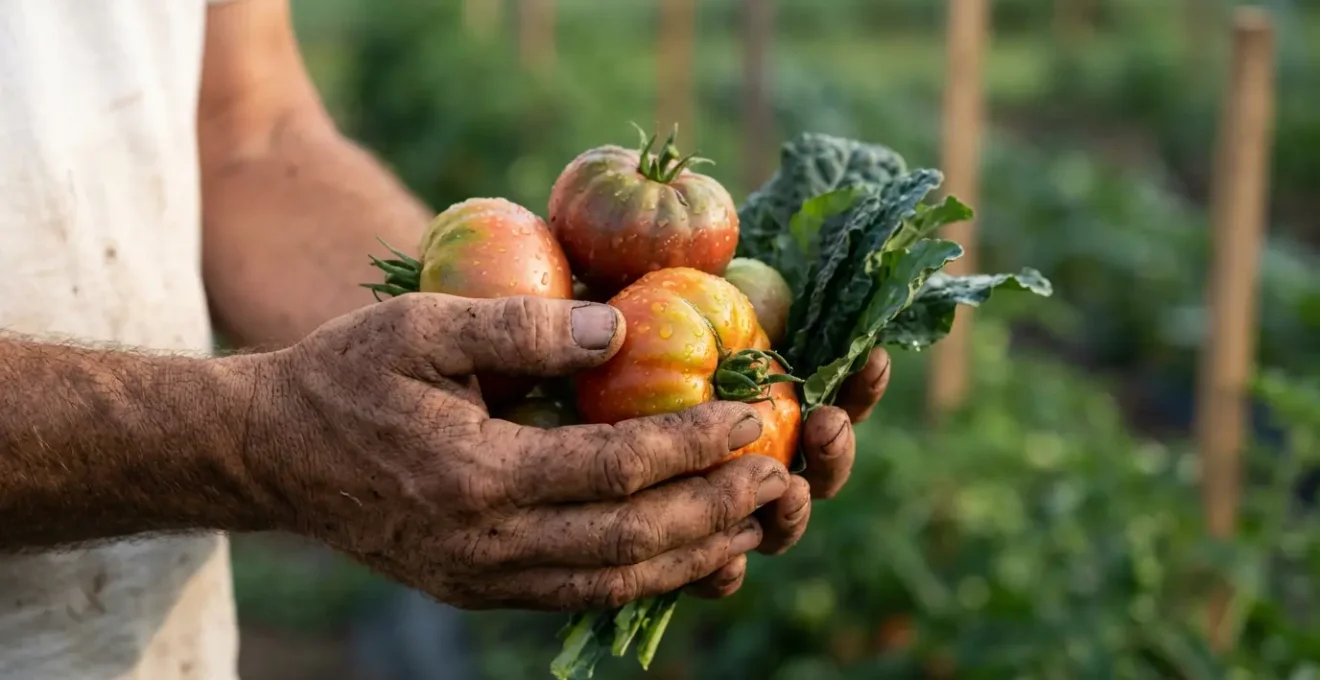
A commercial resort, like a supermarket, relies on a long, complex supply chain. Vegetables may be transported for hundreds of kilometers, stored in refrigerated trucks, and held in warehouses before reaching the kitchen. Each step in this process leads to a degradation of nutrients and, more importantly, flavor. At a place like Bohol Bee Farm, the ‘food miles’ are measured in meters. The salad you eat was likely picked from the garden that morning. This immediacy preserves the vibrant, subtle, and complex flavors that are the first casualties of industrial food logistics.
This difference has profound economic and qualitative impacts. Choosing a farm-to-table model directly supports local farmers and the local economy, whereas the commercial model benefits large, often distant, distributors. The table below starkly illustrates the trade-offs involved in food sourcing.
| Factor | Bohol Bee Farm Model | Commercial Resort Model |
|---|---|---|
| Food Miles | Meters from garden to plate | Hundreds of kilometers via supply chains |
| Nutrient Retention | Maximum – immediate consumption | Reduced through transport/storage |
| Economic Impact | Direct support to local farmers | Benefits large distributors |
| Flavor Profile | Vibrant, subtle flavors preserved | Standardized, may lose complexity |
| Story Value | Specific garden, soil, grower narrative | Generic logistics narrative |
Choosing the palengke over the supermarket is, in essence, choosing to shorten your own personal supply chain. It’s a vote for flavor, freshness, and direct community support.
Key Takeaways
- The palengke is an ecosystem governed by unwritten rules of social interaction, timing, and sensory assessment, not just price.
- Building a ‘suki’ (loyal customer) relationship with a vendor provides access to better quality and insider knowledge, outweighing simple haggling.
- The “5 AM rule” is a strategic move to access premium ‘bagsakan’ (wholesale delivery) stock before it’s picked over by commercial buyers.
Balut: Is the Duck Embryo Experience Really Worth the Hype?
Among the many unique culinary experiences in the Philippines, few are as notorious or misunderstood as ‘balut’. This fertilized duck embryo, boiled and eaten in the shell, is often presented to foreigners as a dare or an extreme food challenge. To view it this way is to miss its cultural significance. Balut is not a gimmick; it is a beloved, protein-rich snack, a cultural staple enjoyed for generations. For the adventurous expat, trying balut is a rite of passage, a true cultural entry point that moves beyond tasting to understanding.
The experience is far more nuanced than its reputation suggests. There is a specific ritual to eating it correctly. First, you tap the wider end of the egg and peel a small hole in the shell. Through this opening, you sip the savory, warm broth inside, which is rich and flavorful. After sipping the broth, you can season the contents with a pinch of salt or a splash of vinegar, then peel the rest of the shell to eat the yolk and the embryo. The yolk is rich and creamy, similar to a regular hard-boiled egg yolk but more intense. The texture of the embryo can be challenging for some, but its taste is mild, often compared to chicken or duck.
For beginners, it’s wise to start with ‘balut sa puti’. This is a younger, 16-day-old egg where the embryo is less developed, softer, and not yet fully formed with feathers or a beak. This offers the flavor experience with a less intimidating texture. The more common 18-day balut provides the full experience, with a more developed embryo. Is it worth the hype? Absolutely. Not for the shock value, but for the experience of participating in a genuine local tradition and understanding a flavor profile that is deeply woven into the fabric of Filipino life.
Ultimately, choosing to shop at the palengke is choosing to engage with the Philippines on a deeper, more meaningful level. It moves you from a passive consumer to an active participant in the local economy and culture. To take the next step, start by applying these skills on your next grocery run and discover the difference for yourself.