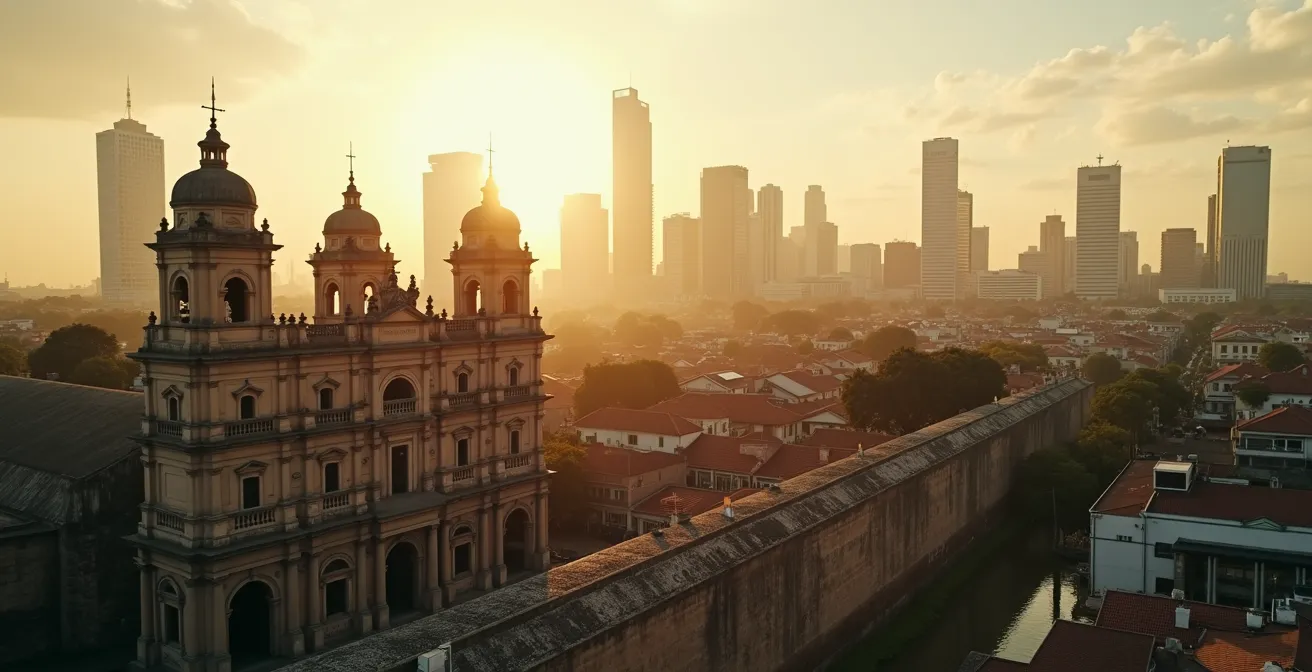
To ask why the Philippines is named after a Spanish king is to ask about the very nature of Filipino identity. The name is not merely a colonial label that stuck; it is the visible surface of a deep cultural palimpsest. This article argues that the name’s persistence reveals a history not of passive acceptance, but of active, selective assimilation and reinterpretation of Spanish, American, and indigenous influences that forged the modern Filipino nation.
For many curious travelers, a fundamental question arises upon studying a map of Southeast Asia: Why does one archipelago, nestled firmly in the continent’s maritime heart, bear the name of a 16th-century Spanish monarch? The simple answer is that the explorer Ruy López de Villalobos named the islands of Leyte and Samar “Las Islas Filipinas” in 1543 in honor of the then-Prince Philip of Asturias, who would later become King Philip II of Spain. But this simple fact barely scratches the surface of a far more complex and fascinating story.
This answer fails to explain *why* the name persisted through subsequent waves of colonization, a fervent nationalist revolution, and a modern assertion of a distinct Asian identity. The truth is far more intricate. The name is not a scar of colonialism but rather the first chapter in a long narrative of cultural synthesis. It represents the initial layer of a colonial scaffolding upon which Filipinos have constructed a unique and resilient identity, blending indigenous Austronesian roots with Hispanic Catholicism and American democratic ideals.
To truly understand the Philippines is to learn to read this cultural palimpsest, to see the layers of history that coexist in everyday life. It is to recognize the Spanish-era plaza, the American-introduced public school system, and the pre-Hispanic community spirit all functioning within a single, dynamic society. This exploration will guide you through these layers, revealing how a name given in tribute to a foreign king became the banner for a proud and sovereign nation.
To navigate this rich and layered history, this guide explores the tangible and intangible markers of the nation’s past. We will examine how different colonial legacies manifest today, how to respectfully engage with sacred historical sites, and what artifacts from a time before colonization can teach us about the archipelago’s foundational identity.
Summary: The Enduring Legacy of a Royal Name in a Republic
- Spanish vs. American Influence: Which Is More Visible in Modern Manila?
- How to Visit Corregidor Island to Understand the WWII Pacific Theatre?
- The Mistake of Taking ‘Fun’ Selfies at the Rizal Monument
- When to Visit the National Museum of Anthropology for Free Access?
- Gold of Ancestors: What Does It Reveal About Pre-Hispanic Philippines?
- How to Take Photos in Old Churches Without Disturbing Worshippers?
- Catálogo Alfabético: Why Do Many Filipinos Have Spanish Surnames Without Spanish Ancestry?
- Tangible vs. Intangible Heritage: Which Should You Prioritize in Ilocos?
Spanish vs. American Influence: Which Is More Visible in Modern Manila?
A walk through Manila is a conversation between empires. The Spanish influence, lasting over 300 years, is etched into the very soul of the city. You see it in the grand baroque churches that anchor every old town, the patriarchal family structures, and the countless Spanish loanwords that pepper Filipino languages. This was the era that laid down the nation’s religious and social foundations. However, the subsequent American period, though lasting only four decades, was arguably more transformative in shaping the country’s public face. The Americans introduced a new political language and civic structure that still defines the modern republic.
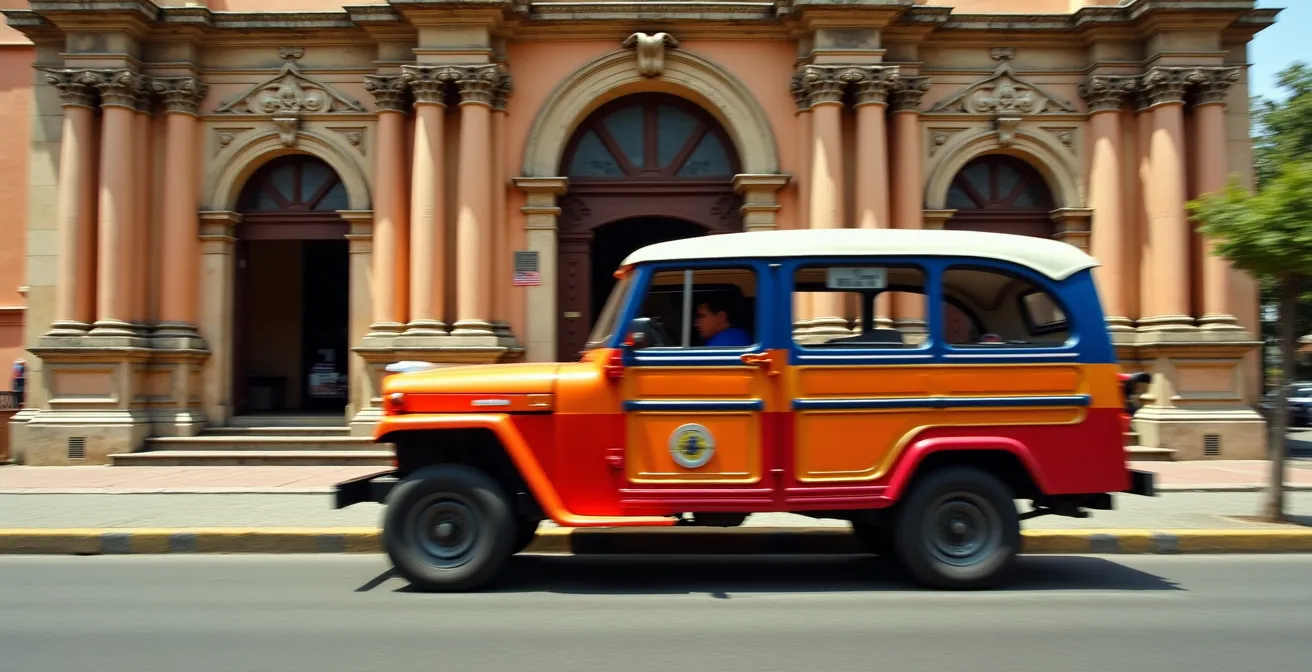
The iconic jeepney, a flamboyantly decorated bus evolved from U.S. military jeeps, is a perfect metaphor for this fusion—an American invention repurposed with Filipino artistry, often driving past a Spanish colonial church. This visual encapsulates the dynamic. As noted in a historical analysis, the legacy of these two powers is distinct. As Positively Filipino Magazine observes in its article on colonization’s impact, the Americans introduced universal public education and democratic institutions, but they did little to change the fundamental socio-economic hierarchy established by Spain. The Spanish built the house; the Americans renovated the facade and installed the electrical wiring.
The Americans introduced universal public education, the institutions of American democracy, modern amenities of urban living, and a system of popularly elected local officials; but they did little to alter the inequitable socio-economic structure that the Spaniards left behind.
– Positively Filipino Magazine, Colonization’s Impact on Manila
Thus, Spanish influence feels more deeply embedded in the culture’s ‘software’—faith, family, and tradition—while American influence is more visible in the ‘hardware’ of state—law, education, and popular culture. One is the rhythm of life, the other is the language of governance.
How to Visit Corregidor Island to Understand the WWII Pacific Theatre?
Corregidor Island, standing guard at the mouth of Manila Bay, is more than just a historical site; it is a profound memorial to a pivotal chapter in the Pacific War. While its strategic importance dates back to Spanish times, when it served as a customs and defense outpost, its global significance was cemented during World War II. A visit here is not a simple tour of ruins but an immersive lesson in valor, sacrifice, and the brutal realities of war. To truly comprehend its story, one must approach the island with intention and a plan.
The island was the last bastion of Filipino and American forces against the Japanese invasion in 1942, and its fall was a devastating blow to the Allied cause. The subsequent battle for its recapture in 1945 was equally fierce. Today, the skeletal remains of barracks, hospitals, and the powerful gun emplacements known as “batteries” stand as silent witnesses. A meaningful visit connects these physical remnants to the human stories behind them.
Your Action Plan: A Meaningful Visit to Corregidor
- Book the early morning ferry from Manila Bay to maximize your time on the island.
- Download archival WWII photos before your visit to compare the ruins of today with their pre-war state.
- Start at the Spanish-era fortifications to understand the island’s long defensive evolution before the American era.
- Visit the Filipino Heroes Memorial to learn about the crucial contributions of the Philippine Scouts.
- Allocate sufficient time for the Malinta Tunnel’s light and sound show, which provides essential historical context and an immersive experience of the siege.
- End your tour at Battery Way or Battery Hearn to quietly reflect on the perspectives of both the siege and the liberation.
By following a structured approach, you move beyond mere sightseeing. You begin to understand Corregidor as a layered historical document, appreciating its evolution from a Spanish lighthouse station to the “Gibraltar of the East” and a symbol of Filipino-American wartime alliance.
The Mistake of Taking ‘Fun’ Selfies at the Rizal Monument
In the heart of Manila lies a sprawling park, and at its center stands the Rizal Monument. For many tourists, it’s a picturesque backdrop for a holiday snapshot. However, treating this site as just another photo opportunity is a profound cultural misstep. The monument is not a landmark of celebration; it is a tomb and a cenotaph for the nation’s foremost national hero, Dr. José Rizal. It marks the approximate location of his execution by a Spanish colonial firing squad on December 30, 1896. This is hallowed ground, a place of solemn remembrance akin to a war memorial or a national cemetery.
Rizal was a brilliant intellectual, novelist, and physician whose writings exposed the injustices of Spanish rule and ignited the flames of revolution. His novels, *Noli Me Tángere* and *El filibusterismo*, were not just literary works but political catalysts that awakened a sense of national consciousness. He was arrested and imprisoned in Fort Santiago before his martyrdom. In fact, historical records confirm that Fort Santiago is most famous for being the final prison of Dr. Rizal before his public execution. His death galvanized the Filipino people, transforming a movement for reform into a full-blown revolution for independence.
The Spanish period saw the rise of national heroes, most notably Dr. José Rizal, whose writings and martyrdom inspired the Philippine Revolution. His novel Noli Me Tángere stirred nationalist sentiment, highlighting the struggle for independence and social justice.
– Khiri Travel, History and Culture of the Philippines
Therefore, taking a lighthearted, “fun” selfie at the monument is seen by many Filipinos as deeply disrespectful. It ignores the immense sacrifice the site represents. A respectful visitor approaches the monument with quiet contemplation, understanding that they are standing at the very spot where a national identity was forged in blood and sacrifice. The ever-present honor guard is not for show; they are guarding the remains of the man who gave the nation its intellectual and spiritual blueprint for freedom.
When to Visit the National Museum of Anthropology for Free Access?
The question of when to visit the National Museum of Anthropology for free access has a wonderfully simple answer: anytime. The Philippine government has made a commendable commitment to cultural education by making admission to the National Museum of the Philippines and its affiliate museums—including Anthropology, Fine Arts, and Natural History—permanently free of charge for all visitors, both Filipino and foreign. This policy removes any financial barrier to accessing the nation’s heritage.
This open-door policy is a direct invitation to explore the foundational layers of Filipino identity. The National Museum of Anthropology, in particular, is a crucial starting point. It houses artifacts that dismantle any notion of the archipelago as a primitive or isolated land before the arrival of the Spanish. The collections are a testament to sophisticated and interconnected pre-colonial societies. Here, you will find burial jars that speak of complex spiritual beliefs, intricate textiles that reveal advanced weaving techniques, and the remnants of ancient boats that testify to a thriving maritime culture.
The museum is open from Tuesdays to Sundays, typically from 9 AM to 6 PM, but it is always best to check their official website or social media pages for the most current operating hours, especially around public holidays. The best time to visit is often on a weekday morning to avoid the larger crowds that gather on weekends. This allows for a more contemplative experience, giving you the space and quiet to truly engage with the stories held within each artifact.
Visiting this museum is not just about seeing old objects. It is about understanding the deep historical bedrock upon which the Spanish and American layers were later built. It is an essential step in comprehending the full, layered story of the Filipino people.
Gold of Ancestors: What Does It Reveal About Pre-Hispanic Philippines?
Long before the Spanish galleons arrived in search of spices and converts, the archipelago that would become the Philippines was a land of remarkable wealth and complex societies. The “Gold of Ancestors” collection, housed within the National Museum, is the most dazzling proof of this. These intricate gold ornaments—from sashes and necklaces to funerary masks—reveal more than just material wealth; they are windows into a sophisticated, well-connected, and culturally rich pre-colonial world.
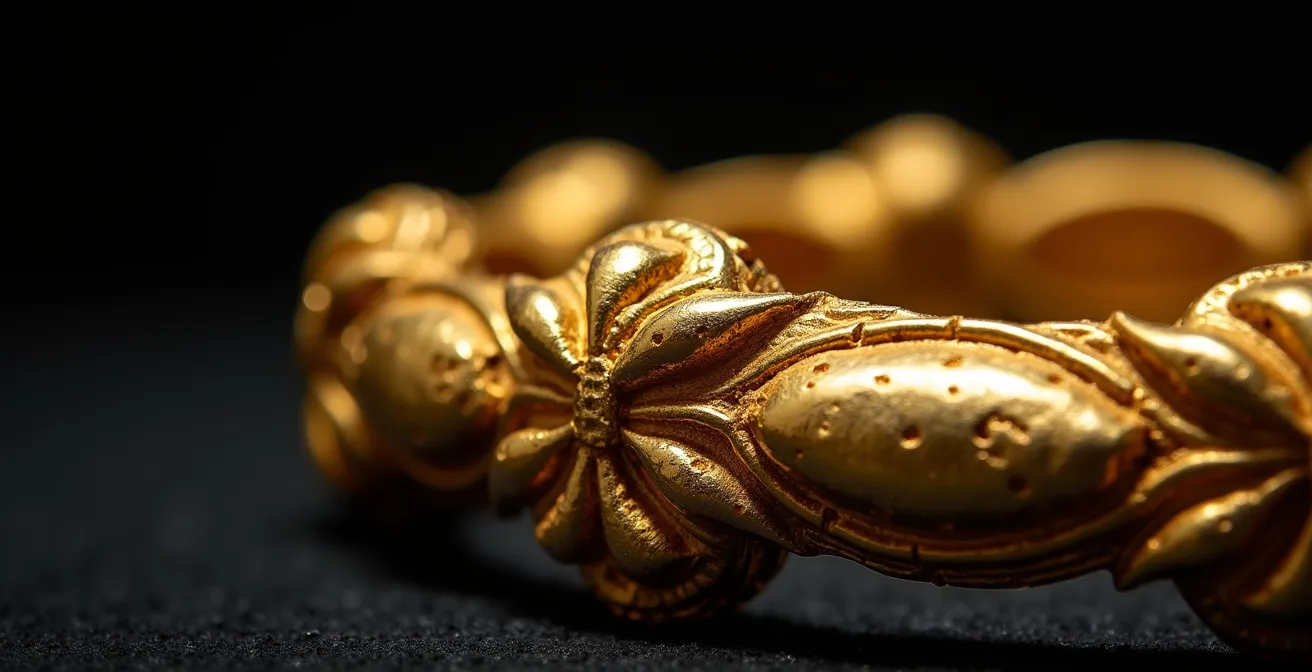
This was not a single, unified kingdom, but a vibrant network of polities. There was no “Philippines” then; instead, there were powerful maritime states like the Rajahnate of Butuan, the Rajahnate of Cebu, and the Kingdom of Tondo. As historical overviews from the Association for Asian Studies show, Chinese, Arabic, and Indian traders engaged in extensive commerce with these local populations as early as 1000 AD. This gold was not hidden in mines but was part of a dynamic trading system. The craftsmanship indicates advanced metallurgical skills and a defined social hierarchy where such items signified power and divine status.
The political landscape was a complex tapestry of alliances, trade agreements, and rivalries. Royal intermarriages connected the Islamized states of Maynila (modern Manila) to powerful Sultanates in Brunei and Malacca. Meanwhile, Hindu-Buddhist Rajahnates like Butuan in Mindanao waged wars and resisted raids from neighboring sultanates. This evidence of statecraft, diplomacy, and conflict completely refutes the colonial-era myth of a scattered, primitive people waiting to be “civilized.” The Spanish did not arrive in a vacuum; they entered a bustling and politically complex world.
The Gold of Ancestors, therefore, is a powerful rebuttal to any narrative that begins Philippine history in 1521. It stands as irrefutable evidence of a prosperous and autonomous past, the foundational layer of the cultural palimpsest that is the Filipino identity.
How to Take Photos in Old Churches Without Disturbing Worshippers?
The Spanish colonial churches of the Philippines are not museums. They are active, living houses of worship where faith has been practiced for centuries. While their stunning baroque architecture, a unique style known as Earthquake Baroque, makes them compelling subjects for photography, it is crucial to remember that they are sacred spaces first and tourist attractions second. A respectful photographer must act as a guest, not an intruder. The goal is to capture the beauty of the space without disrupting its primary function: prayer and worship.
The key is a shift in mindset. Instead of hunting for the “perfect shot” of a grand scene, focus on the details that tell the story of syncretism—the blending of Catholic iconography with indigenous motifs. Look for the local flora carved into stone pillars or the subtle geometric patterns of native art hidden in a retablo (altarpiece). This approach not only results in more unique photographs but also directs your lens away from people in prayer. As historical documentation shows, Spanish rule consolidated local communities (barangays) into towns centered around these very churches, making them the nucleus of community life to this day.
To ensure your presence is unobtrusive, a strict code of conduct is necessary. This involves both technical camera settings and personal behavior. The following protocol is essential for any photographer entering a Philippine church:
- Observe the 10-minute rule: Upon entering, sit quietly for ten minutes without your camera. Understand the rhythm of the space and observe who is there and what they are doing.
- Go silent and dark: Absolutely no flash photography. The sudden burst of light is highly disruptive. Equally important is to disable all camera sounds, including the shutter click and focus confirmation beeps.
- Focus on details, not people: Photograph architectural elements, natural light patterns, or syncretic details. Avoid aiming your camera directly at worshippers. If people are in your wide shot, wait for them to move or use a composition that renders them anonymous.
- Time your visit: The best time to photograph is during non-service hours, typically in the mid-afternoon on weekdays when the church is quiet. Never take photos during Mass.
- Capture light, not the altar: Focus on how natural light streams through stained glass windows or falls across empty pews, rather than making the main altar your primary subject, which is the focal point of worship.
By following these guidelines, you show respect for the living heritage you are documenting. Your photos will be richer for it, capturing not just stone and wood, but the spirit of the place.
Catálogo Alfabético: Why Do Many Filipinos Have Spanish Surnames Without Spanish Ancestry?
One of the most common sources of confusion for visitors is the prevalence of Spanish surnames—Garcia, Reyes, Cruz, Santos—in a population that is overwhelmingly of Austronesian descent. This leads many to assume a direct line of Spanish ancestry, but the reality is a fascinating story of colonial administration. The widespread adoption of these surnames is largely the result of a single decree: the Clavería Decree of 1849.
Prior to this, many Filipinos used no surname at all, or had indigenous-language surnames that the Spanish found difficult to track for taxation and administrative purposes. To solve this, Governor-General Narciso Clavería issued a decree requiring all families to adopt a surname from a master list called the *Catálogo alfabético de apellidos*. This catalogue contained thousands of Spanish words, from common surnames to nouns, adjectives, and even plants and animals. Local officials would go from town to town, assigning surnames from the list. A family might become “Mercado” (market) or “Roca” (rock) overnight, with no connection to a Spanish ancestor of that name.
This act was a powerful tool of social engineering, part of a broader Spanish strategy to “amalgamate” the population into a more governable whole. It was about administrative control, not a reflection of widespread intermarriage. The following table, based on historical demographic data, illustrates how unevenly the actual Spanish-Filipino mestizo population was distributed, proving that surnames are not a reliable indicator of Spanish blood. For instance, a province like Ilocos had a very low mestizo population but adopted Spanish surnames just like the rest of the country.
| Province/Region | Spanish-Filipino Population % | Notable Characteristics |
|---|---|---|
| Manila/Tondo | 19% | Highest concentration, capital city |
| Zamboanga | 40% | Military garrison town |
| Bicol | 20% | Galleon trade route |
| Bataan | 16.72% | Strategic coastal location |
| Ilocos | 1.38% | Agricultural region |
| Cebu | 2.17% | First settlement site |
Therefore, having a Spanish surname in the Philippines is more likely a sign that one’s ancestors were subject to an administrative decree in the 19th century than it is evidence of a Spanish great-grandparent. It is a layer of the colonial scaffolding, not a genetic marker.
Key Takeaways
- The name “Philippines” is not just a colonial label but the first layer of a complex identity forged through assimilation and resistance.
- Modern Filipino culture is a palimpsest, a blend of pre-Hispanic foundations, a Spanish Catholic social structure, and American civic and educational systems.
- Understanding the Philippines requires looking beyond tangible monuments to the intangible heritage of stories, syncretic beliefs, and resilience.
Tangible vs. Intangible Heritage: Which Should You Prioritize in Ilocos?
When visiting a region as historically rich as Ilocos, with its UNESCO World Heritage City of Vigan, it is easy to become mesmerized by the tangible heritage. The cobblestone streets of Calle Crisologo, the imposing baroque churches, and the ancestral stone houses (*bahay na bato*) are magnificent testaments to a bygone era. They are the physical “parchment” of history. However, to truly understand Ilocos, one must learn to prioritize the intangible heritage—the stories, traditions, and living culture that are the “ink” written upon that parchment.
The tangible is the what; the intangible is the why. A stone house is beautiful, but the knowledge that its ground floor was a storeroom for goods in the galleon trade gives it meaning. A church is impressive, but the story of how its bell tower was used as a lookout post by revolutionaries gives it a soul. This focus on authenticity and stories is what separates a tourist from a true traveler. As one cultural guide eloquently puts it, authenticity is about embracing the real history, not just the aesthetics.
Authenticity means using traditional materials, resisting air conditioning in stone chapels, telling real stories. That old convent housed revolutionary rebels disguised as choirboys.
– Ocarra Media, Time Travel in the Tropics: Spanish-Era Towns
So, which should you prioritize? The answer is not to choose one over the other, but to use the tangible as a gateway to the intangible. When you walk down Calle Crisologo, don’t just take photos. Hire a local guide and ask about the families who lived there. When you visit the Paoay Church, look for the unique buttresses that make it “Earthquake Baroque” and ask about the local building techniques that were blended with European designs. Engage with the living culture: try the local empanada, watch the potters at work, and listen to the distinct Ilocano dialect. The spirit of Vigan is not just in its stone, but in the enduring life that flows through its streets.
Ultimately, the stones and walls are merely a stage. The real story of Ilocos—and of the Philippines as a whole—is the human drama that has unfolded upon it for centuries. Prioritizing the intangible means you leave not just with beautiful pictures, but with a genuine understanding.
By seeking out these layers—from the pre-colonial gold to the revolutionary stories hidden in a church convent—a traveler can begin to grasp the profound answer to why this nation proudly carries the name of a Spanish king. It is a name that has been claimed, reinterpreted, and woven into a uniquely Filipino narrative of resilience and cultural synthesis.