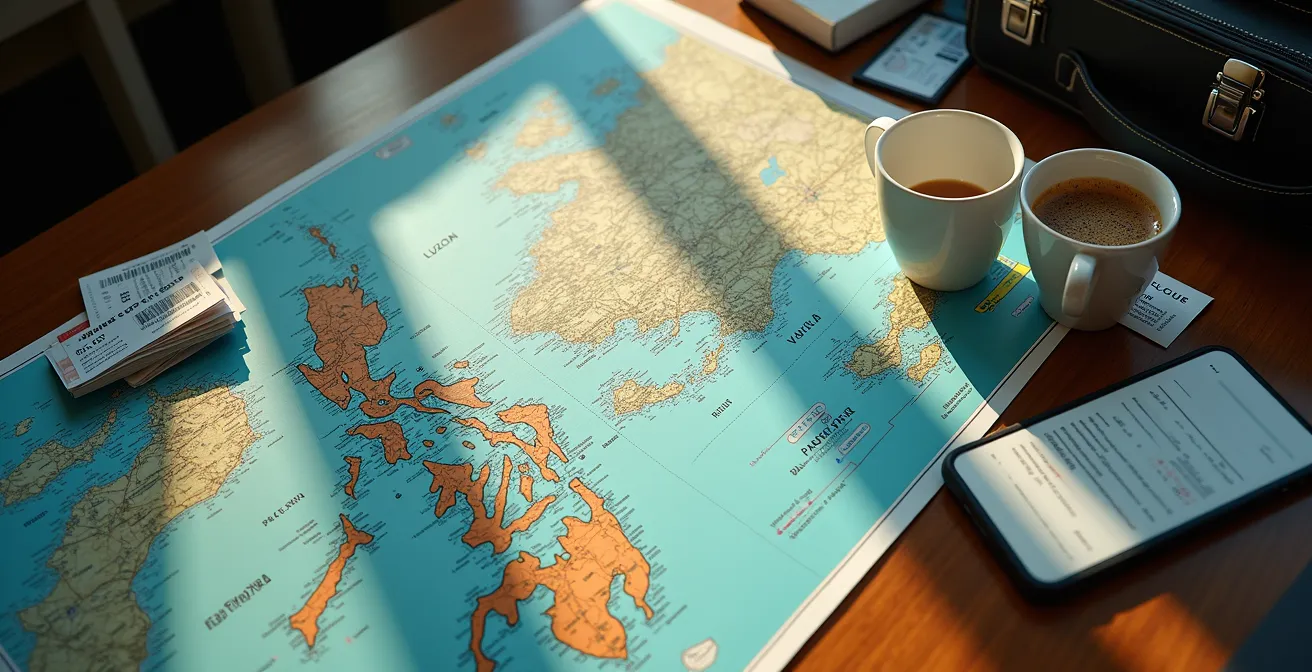
The biggest mistake in planning a 10-day Philippine trip isn’t what you miss, but how much you try to include.
- Chasing multiple, disconnected islands means losing up to 40% of your vacation to a hidden “transit tax” of travel, waiting, and recovery time.
- The most rewarding itineraries practice “geographic discipline” by choosing a single, well-connected region to explore deeply.
Recommendation: Prioritize one island group (like the Cebu-Bohol-Siquijor triangle) and build in recovery days to transform your trip from a frantic checklist into a deep, immersive experience.
The initial thrill of planning a trip to the Philippines is intoxicating. With over 7,000 islands, the possibilities seem endless: the emerald rice terraces of Luzon, the pristine white beaches of the Visayas, the dramatic lagoons of Palawan. The temptation for an over-enthusiastic planner is to create a “greatest hits” itinerary, a whirlwind tour hopping from one major airport to another, trying to tick off every postcard-perfect spot in just 10 days.
The common advice found in many guides often feeds this frenzy, presenting lists of must-see destinations without fully accounting for the logistical reality that connects them. The result is an itinerary that looks spectacular on paper but quickly unravels into a stressful marathon of pre-dawn flights, long ferry queues, and constant packing and unpacking. This approach fundamentally misunderstands the nature of Philippine travel.
But what if the secret to a perfect 10-day trip wasn’t about seeing more, but experiencing more by doing less? The true cost of island hopping isn’t measured in pesos, but in lost hours—a “transit tax” that consumes your most valuable resource: time. The most successful itineraries are not additions, but strategic subtractions.
This guide reframes the planning process. We will move away from the “how much can I see?” mindset to “how much can I truly experience?”. By dissecting the most common logistical fallacies and embracing a philosophy of geographic discipline, you will learn to design a balanced, logical travel flow that maximizes enjoyment and minimizes the drain of transit, ensuring your 10 days are an investment, not an expense.
To help you craft a truly exceptional journey, this article breaks down the crucial decisions and common pitfalls of Philippine itinerary planning. We will explore efficient routes, the importance of recovery time, and how to choose destinations that match your travel style, not just a checklist.
Summary: The Art of Subtraction: Crafting a Superior 10-Day Philippines Itinerary
- How to Link Cebu, Bohol, and Siquijor in the Most Efficient Order?
- Why You Need a “Do Nothing” Day After Visiting Kawasan Falls?
- Boracay vs. Siargao: Which Island Vibe Suits Your Group?
- When to Visit Intramuros to Avoid the Midday Heat?
- Moalboal or Oslob: Where Should You Base Yourself for South Cebu?
- Luzon, Visayas, or Mindanao: Which Region Should You Prioritize for a First Trip?
- Manila Prices vs. Provincial Prices: How to budget for different regions?
- Why Does Mass Tourism Threaten the Philippine Ecosystems More Than You Think?
How to Link Cebu, Bohol, and Siquijor in the Most Efficient Order?
The Central Visayas region, with its cluster of Cebu, Bohol, and Siquijor, is a perfect microcosm for applying smart itinerary design. The fatal error planners make is viewing these as separate destinations to be “hopped” between at random. This leads to backtracking and wasted days. The correct approach is to treat them as a single, interconnected system and follow the logical flow: the “Visayan Triangle” route.
This route minimizes your transit tax by creating a continuous loop, never crossing your own path. Starting in Cebu, you move to Bohol, then to Siquijor, and finally loop back to Cebu via the nearby port of Dumaguete. This strategy recognizes that ferry days are essentially write-offs for major activities, so minimizing their disruption is paramount. Following this logical path turns transit from a chaotic burden into a predictable part of the journey.
Efficient Visayas Island Route: Real Traveler’s 10-Day Journey
A travel blogger demonstrated the power of this strategy by covering the Cebu-Bohol-Siquijor triangle efficiently in just 8 days. By treating ferry days as “write-offs,” they eliminated the stress of trying to squeeze in activities. Starting from Cebu City, they took the 2-hour ferry to Tagbilaran (Bohol) for 4 nights, exploring the Chocolate Hills and Panglao. They then ferried to Siquijor for 3 nights before returning via the logical Dumaguete-Cebu route. Their total transport time was a manageable 12 hours over the trip, a stark contrast to the 20+ hours that inefficient backtracking would have cost.
Your 5-Step Ferry Planning Strategy
- Book morning ferries (7-9 AM) to maximize your arrival day. This gives you the afternoon for check-in and light exploration.
- Follow the triangle route: Cebu → Bohol (2hr ferry) → Siquijor (1.5hr) → back to Cebu via Dumaguete to avoid backtracking.
- Allocate a minimum of 3 nights per island. This accounts for one travel day and provides two full days for activities.
- Pre-book ferry tickets online during peak season (December to May) to avoid sold-out situations and long queues.
- Choose accommodation near your arrival/departure ferry ports to minimize land transfer time and costs.
By imposing this discipline, you convert three separate, stressful trips into one fluid, efficient journey.
Why You Need a “Do Nothing” Day After Visiting Kawasan Falls?
The allure of Kawasan Falls canyoneering is powerful, but it’s a classic tourist trap for over-enthusiastic planners. The mistake isn’t visiting; it’s underestimating the true time and energy cost of the adventure. Planners pencil in “Kawasan” as a half-day activity, expecting to be exploring another part of Cebu by the afternoon. This is a severe miscalculation that can derail the next 48 hours of your trip.
A full canyoneering expedition is an all-day affair. Research shows that a full canyoneering expedition requires 7-8 hours total, factoring in a 5 AM start, round-trip transport, safety briefings, the activity itself, and the return journey. It is physically demanding, involving hours of swimming, scrambling, and jumping. Scheduling another significant activity or a long-distance transfer the following day is a recipe for exhaustion and burnout. This is where you must schedule a “Recovery Dividend”—a planned day of minimal activity that pays back in energy and enjoyment for the rest of your trip.
This isn’t a “wasted” day; it’s a strategic investment. This is the day to lounge by the resort pool, get a massage, read a book, or take a leisurely stroll on a local beach. It allows your body to recover and your mind to process the intense experience you just had.

As shown in the tranquil scene above, a recovery day transforms your trip from a frantic rush into a genuine vacation. By deliberately slowing down, you absorb the experience and recharge for the next adventure, rather than simply surviving a checklist of activities. Ignoring the need for recovery is a rookie mistake that costs you the quality of your later experiences.
Treat high-exertion activities like the full-day commitments they are and plan your recovery accordingly.
Boracay vs. Siargao: Which Island Vibe Suits Your Group?
Choosing between Boracay and Siargao is a classic itinerary crossroads, and the wrong choice can lead to significant friction within a travel group. The common error is deciding based on photos and hype—”Boracay’s white beach” versus “Siargao’s surf vibe.” An expert planner, however, makes this decision based on a far more critical factor for a 10-day trip: logistical complexity and group travel style. The question isn’t just “which island is better?” but “which island is better *for us, right now*?”
Boracay is the definition of “plug-and-play” tourism. With a dedicated airport and a 10-minute transfer, you can be on the beach within an hour of landing. Its high density of hotels, restaurants, and tour operators offers convenience and variety, making it ideal for first-timers, families, or groups with mixed interests and energy levels. Siargao, by contrast, rewards effort. It typically requires a connecting flight or a long ferry ride, eating up a significant portion of a short trip. Its infrastructure is more spread out, demanding a self-guided, exploratory mindset. It’s perfect for adventurous travelers who see the journey as part of the destination, but it can be frustrating for those seeking convenience.
The following matrix breaks down the core differences, focusing on the practical aspects that should drive your decision.
| Factor | Boracay | Siargao |
|---|---|---|
| Accessibility | Direct flights + 10min transfer | Connecting flight or long ferry |
| Tourist Infrastructure | High density, plug-and-play tours | Spread out, self-guided exploration |
| Best For Groups | Convenience-seekers, first-timers | Adventure-seekers, experienced travelers |
| Evening Scene | Vibrant beachfront bars & restaurants | Laid-back surf bars, local spots |
| Price Point | Higher (tourist economy) | Moderate (mix of tourist/local) |
Group Travel Decision: How 4 Friends Chose Their Island
A group of four friends with mixed travel experience correctly chose Boracay over Siargao for their 5-day trip. Their initial excitement for Siargao’s surf culture faded when they calculated the logistics. The required Manila → Cebu → Siargao flights would consume two full days of their limited vacation time. Boracay’s direct flight and immediate beach access guaranteed more actual holiday time. The decision was further validated as the wide variety of organized activities catered to their different energy levels; two could go parasailing while the other two relaxed at a beachfront cafe, something far more difficult to coordinate in Siargao’s spread-out environment.
For a short trip, prioritizing logistical ease is often the smartest, albeit less glamorous, decision for ensuring group harmony and maximizing vacation time.
When to Visit Intramuros to Avoid the Midday Heat?
Intramuros, Manila’s historic walled city, is a mandatory stop for any cultural itinerary. However, most tourists make the critical mistake of treating it like a European old town, planning to wander its streets from mid-morning to mid-afternoon. In Manila’s tropical climate, this is a recipe for heatstroke and a miserable experience. The sun and humidity between 11 AM and 3 PM are oppressive, turning cobblestone streets into ovens and making exploration unbearable.
The expert strategy is not to skip Intramuros, but to conquer it by employing a “Split-Visit Strategy.” This involves breaking your exploration into two distinct, cooler parts of the day and planning a deliberate escape during the peak heat. This approach transforms a potential ordeal into a pleasant and much richer cultural experience. You work *with* the climate, not against it.
By scheduling a long, air-conditioned lunch or a museum visit during the hottest hours, you not only escape the heat but also turn that “downtime” into another cultural activity. Returning in the late afternoon allows you to enjoy the magical “golden hour” light, which is perfect for photography and soaking in the atmosphere as the city cools down.
Your Split-Visit Strategy for Intramuros
- Morning Session (7-10 AM): Start at Fort Santiago when it opens to enjoy the quiet courtyards. The cool morning light is ideal for photography, and you’ll beat the tour bus crowds.
- Midday Escape (11 AM-3 PM): Actively retreat from the heat. Plan a long, leisurely lunch at an air-conditioned restaurant like Ilustrado or immerse yourself in the Casa Manila Museum.
- Golden Hour Return (4-7 PM): As temperatures begin to drop, head to the magnificent San Agustin Church. Afterwards, take a calesa (horse-drawn carriage) ride and catch the sunset from the top of the city walls.
- Rainy Season Flex Plan: If visiting from June to October, keep the museum visits as your flexible backup plan for the sudden, heavy afternoon downpours that are common during this period.
This tactical approach to timing is a non-negotiable for enjoying one of Manila’s greatest treasures.
Moalboal or Oslob: Where Should You Base Yourself for South Cebu?
The choice of a base in South Cebu is one of the most consequential decisions an itinerary planner can make, and it’s where many go wrong. Lured by the promise of swimming with whale sharks, travelers mistakenly choose Oslob as their base for multi-day exploration. This is a fundamental error of confusing a single-activity destination with a strategic touring base. Oslob is a place you visit for 90 minutes; Moalboal is a place you stay for 3 days.
Oslob’s geography makes it a logistical nightmare for anything other than the whale shark experience itself. It’s relatively isolated, requiring long, winding, and time-consuming drives to reach other key attractions like Kawasan Falls or the sardine run. Basing yourself here means committing to hours of daily transit, a massive drain on your limited vacation time.
Moalboal, on the other hand, is the superior strategic base. It is centrally located relative to the region’s main attractions. More importantly, it offers a world-class activity right on its shoreline: the famous sardine run. This allows for incredible experiences without even needing to hire transport. From Moalboal, a day trip to Kawasan Falls is short and easy, leaving the rest of your day free.
Travel Time Analysis: The Real Cost of Choosing Oslob as a Base
A couple who based themselves in Oslob for the whale shark watching learned this lesson the hard way. Their day trip to Kawasan Falls required a 5 AM departure and a grueling 2.5-hour drive each way on difficult roads, getting them back after dark at 8 PM. Had they stayed in Moalboal, the same trip would have been a simple 45 minutes each way. They spent 5 hours in transit versus a potential 1.5 hours, effectively losing an entire afternoon of their vacation. They realized that the whale shark swim, which lasted less than an hour, made Oslob a ‘one-trick’ destination that ended up consuming multiple days due to its inefficiency as a base.

The correct strategy is to base yourself in Moalboal, where you can enjoy the incredible sardine run at your leisure. From there, you can undertake an efficient day trip to Oslob for the whale sharks if you choose, minimizing your time in transit and maximizing your experience.
Choose your base for its strategic value, not just its most famous attraction.
Luzon, Visayas, or Mindanao: Which Region Should You Prioritize for a First Trip?
For any trip under 14 days, the single most important decision you will make is to practice “Geographic Discipline.” The biggest mistake a first-time visitor can make is attempting to combine regions, such as seeing the rice terraces of Luzon *and* the beaches of the Visayas. This spreads your itinerary too thin and inflates your transit tax beyond reason. You must choose ONE region and commit to it.
For the first-time, 10-day traveler, the Visayas region is almost always the most efficient and rewarding choice. The reason is transport topology. Transportation analysis reveals that Visayas island ferries average 2-3 hours between major destinations, creating a connected, water-based network. In contrast, reaching the highlights of Luzon often requires punishing 10-hour overnight bus journeys. While epic, these long-haul land trips are a poor investment of time on a short itinerary.
Palawan (technically part of Luzon but functionally its own region) offers a compelling alternative with its world-famous lagoons, but it also demands a choice: you either do the El Nido area or the Coron area in a short time; trying for both is a classic planning error. The decision matrix below helps clarify which regional personality best fits your travel goals, but for efficiency, the Visayas is the clear winner.
| Factor | Luzon | Visayas | Palawan |
|---|---|---|---|
| Traveler Type | Cultural Trekker | Tropical Sybarite | Lagoon Chaser |
| Main Activities | Rice terraces, history, mountains | Island hopping, diving, beaches | Lagoons, dramatic landscapes |
| 10-Day Coverage | 2-3 major stops max | 4-5 islands possible | 2 areas (El Nido + Coron) |
| Gateway Airport | Manila (MNL) | Cebu (CEB) | Puerto Princesa (PPS) |
| Transport Mode | Long bus journeys | Short ferries | Boats + scenic drives |
The “Rule of One” is your guiding principle: choose one region. Factor in your international arrival airport—if you fly into Cebu (CEB), don’t fight geography by trying to get to Luzon. Accept that you cannot see everything. The Philippines rewards depth over breadth, and a fantastic 10-day trip in one region is infinitely better than a stressful, rushed 10-day tour of three.
Resist the urge to be everywhere; instead, be fully present somewhere.
Key takeaways
- The “Transit Tax” (time lost to travel, waiting, and transfers) is the biggest hidden cost of a Philippines trip; minimizing it is your primary goal.
- For trips under 14 days, commit to the “Rule of One”: choose a single geographic region (e.g., Visayas, Palawan, or North Luzon) and explore it deeply.
- Strategic planning means choosing bases for their logistical convenience (like Moalboal), not just their famous attractions (like Oslob).
Manila Prices vs. Provincial Prices: How to budget for different regions?
A common budgeting error for the Philippines is creating a single, flat daily budget. This fails to account for the significant economic variations between the major metropolitan hubs and the provincial islands. Assuming that a meal or hotel room will cost the same in Makati as it does in Siquijor will lead to a budget that is either unnecessarily inflated or dangerously underestimated. Your budget must be as flexible and region-aware as your itinerary.
As a rule, you are dealing with two distinct economies: the “Tourist/Metro Economy” and the “Provincial Economy.” The first applies to major business districts like Manila’s Bonifacio Global City (BGC) and hyper-developed tourist islands like Boracay. Here, prices for food, accommodation, and transport are significantly higher. Recent travel cost analysis shows Manila/Makati prices run 40% higher than Cebu City, which can serve as a mid-range baseline. The Provincial Economy, found on less-developed islands like Siquijor or parts of Siargao, offers costs that can be 15-20% lower than the Cebu baseline, especially for local food and transport.
Understanding this disparity is crucial for realistic planning. A ₱3,000/night hotel budget might get you a quality mid-range room in Manila but could secure you premium beachfront accommodation in Siquijor. The table below provides a general guide to these price differences.
| Expense Category | Manila/BGC | Boracay/El Nido | Siquijor/Siargao |
|---|---|---|---|
| Meal (local eatery) | ₱200-300 | ₱300-400 | ₱150-200 |
| Hotel (mid-range) | ₱2,500-3,500 | ₱3,000-4,000 | ₱1,500-2,500 |
| Transport (per day) | ₱500-800 | ₱400-600 | ₱300-400 |
| Tour/Activity | ₱2,000-3,000 | ₱2,500-3,500 | ₱1,500-2,000 |
When building your 10-day budget, allocate higher daily spending for your time in Manila or Boracay and adjust it downwards for your days in the provinces. This dynamic approach ensures you don’t run out of funds or needlessly over-budget.
Budget dynamically, allocating funds based on the economic reality of each specific location in your itinerary.
Why Does Mass Tourism Threaten the Philippine Ecosystems More Than You Think?
The itinerary design philosophy championed throughout this guide—favoring fewer stops, longer stays, and geographic discipline—is not merely about creating a more relaxing vacation. It is intrinsically linked to a more sustainable and responsible way of traveling. The “too many airports” mistake, characterized by frantic, fast-paced tourism, places a disproportionately high strain on the Philippines’ fragile ecosystems.
This “fast travel” approach prioritizes checking boxes over genuine connection. It encourages a pattern of behavior that is inherently more wasteful. Fast travelers are more likely to rely on single-use plastics from convenience stores and packed tour lunches. Their packed schedules mean they contribute more to carbon emissions through frequent flights and rushed land transfers. Conversely, “slow travel,” defined by staying in one location for 3-5 days, naturally fosters more sustainable habits.
Slow travelers have the time to find local restaurants instead of pre-packaged meals, use refillable water bottles, and contribute more directly to small, family-run businesses rather than large, impersonal tour operators. This shift from a high-volume, low-impact-per-day model to a lower-volume, higher-impact-per-day model is crucial for the long-term health of destinations like El Nido and Boracay.
El Nido Tourism Impact: Fast vs. Slow Travel Comparison
The lagoons of El Nido’s Tour A can see over 500 visitors daily in peak season. A study observed that “fast” tourists, who spend just a few hours in the area before flying to their next destination, contribute to 30% more single-use plastic waste (water bottles, food wrappers) compared to “slow” travelers staying 4-5 days. The study also found that tourists spending 5 or more days in one location generate 40% less carbon emissions per day and contribute 2.5 times more money to local family-run businesses, directly supporting the community they are visiting.
By choosing to slow down, you are not just improving your own experience; you are casting an economic and environmental vote for a more sustainable tourism model. You are signaling that the value of a destination lies in its preservation, not its rapid consumption.
Plan your trip as a thoughtful investment in a place, not a frantic extraction of experiences. The best itinerary for you is also the best itinerary for the future of the Philippines.