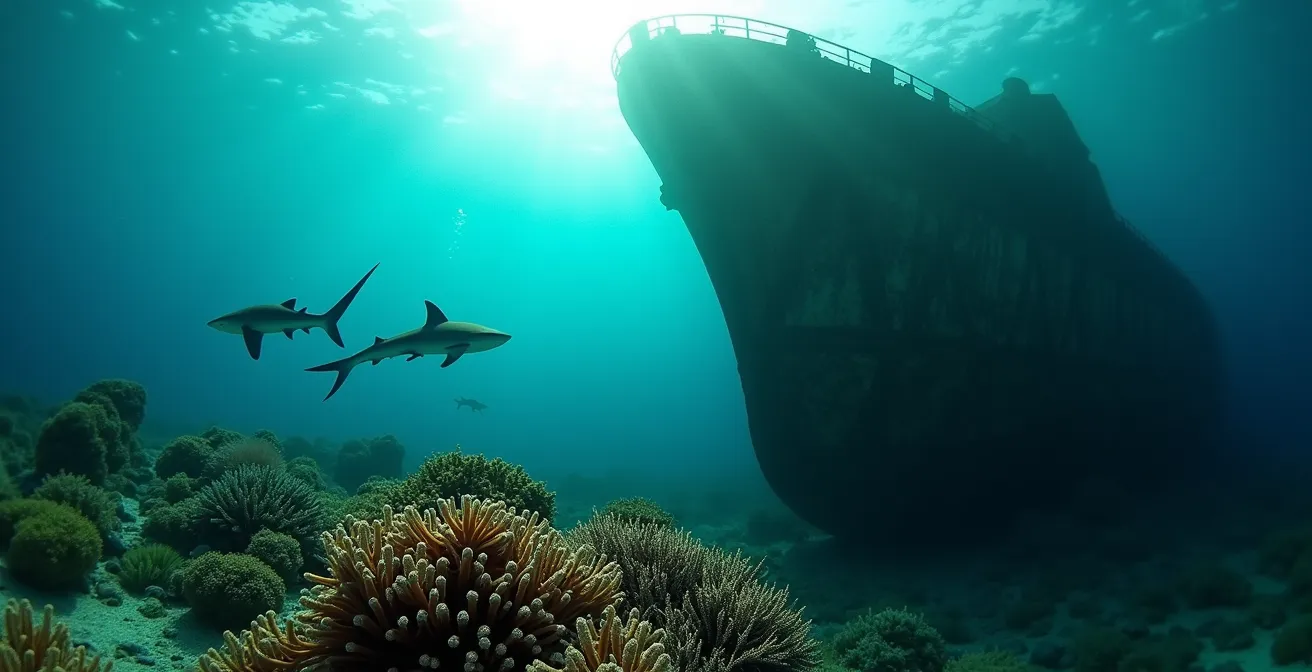
For the advanced diver, the choice between Tubbataha and Coron is not about coral vs. wreck; it’s a decision between investing in unparalleled ecological purity or profound historical immersion.
- Tubbataha’s premium price buys you access to a resilient, isolated ecosystem with portfolio-grade wide-angle opportunities and a pure, technically demanding dive experience.
- Coron offers a more accessible, budget-flexible trip focused on the atmospheric storytelling of world-class WWII wrecks, with high value for wreck-certified divers.
Recommendation: Evaluate your primary motivation. Choose Tubbataha for a pinnacle of biological perfection and technical challenge. Choose Coron for the haunting poetry of history and the art of wreck penetration.
For any serious diver, the Philippines presents a paradox of choice. The archipelago offers a staggering menu of world-class dive experiences, but two names often rise to the top of the list for advanced divers: the Tubbataha Reefs and the wrecks of Coron Bay. The immediate comparison seems simple: pristine biodiversity versus historic iron giants. But this surface-level analysis misses the real question that keeps experienced divers up at night: is Tubbataha’s significantly higher price tag genuinely worth the investment compared to the world-class experience Coron offers?
Most guides will list the marine life and tell you one is a liveaboard and the other is resort-based. That’s the “what.” As a dive master, I can tell you that understanding the “why” behind the price and experience is far more critical. The decision isn’t just about your budget; it’s about your philosophy as a diver. It’s about what you value most: ecological resilience, technical purity, historical immersion, or photographic return on investment. The cost difference isn’t just a fee; it’s a direct reflection of logistics, conservation, exclusivity, and the very nature of the underwater environment you’re paying to enter.
This guide moves beyond the platitudes. We’re going to break down the true value proposition of each destination. We’ll analyze why Tubbataha’s isolation is its greatest asset, how Coron’s wrecks offer a different kind of profound experience, and what the “premium” price of a Tubbataha trip actually buys you in terms of safety, dive quality, and ecological peace of mind. By the end, you won’t just know which trip costs more; you’ll understand which investment is right for your logbook, your skills, and your soul.
To help you navigate this complex decision, this article breaks down the key factors that define the value of each destination. We will explore the skill requirements, the environmental realities, the logistical differences, and the ultimate return on investment for you as a diver.
Summary: A Dive Master’s Guide to Choosing Your Ultimate Philippine Dive Trip
- How to Complete Your Open Water Course in 3 Days in Boracay?
- Why Is Coral Bleaching Increasing in Popular Spots Like Moalboal?
- The Risk of Diving Without a Nearby Decompression Chamber
- Liveaboard vs. Resort-Based Diving: Which Maximizes Your Bottom Time?
- When to Dive in Malapascua to See Thresher Sharks Clearly?
- Why Do Dive Fees Vary So Much Between Palawan and Visayas?
- Tour A, B, C, or D: Which El Nido Circuit Has the Best Lagoons?
- Anilao vs. Dauin: Which Muck Diving Capital Should Macro Photographers Choose?
How to Complete Your Open Water Course in 3 Days in Boracay?
Let’s be direct. The question isn’t “how” to get your Open Water in three days in a tourist hub like Boracay; the real question is why that certification is fundamentally insufficient for destinations like Tubbataha or Coron. An entry-level course teaches you to not die underwater. A premium dive trip demands that you know how to truly live and perform there. The skill gap is not a crack; it’s a chasm. These are not destinations for freshly certified divers, and the price of admission is paid in experience long before you book a flight. For Tubbataha’s wall dives and unpredictable currents, or Coron’s overhead environments, a basic certification is merely a starting point. Your logbook needs to show a deep understanding of advanced principles.
Tubbataha, with its vertical walls dropping into the abyss and its notorious “washing machine” currents, demands impeccable buoyancy and gas management. You’re not just hovering; you’re holding your position against moving water to watch sharks or manta rays, all while protecting a reef system of global importance. Coron demands a different but equally advanced skillset. Penetrating a 150-meter-long shipwreck is a mental game as much as a technical one. It requires wreck-specific training, the ability to navigate in low-light and potential silt-out conditions, and an unwavering calm when you are inside a steel behemoth. In either location, a mistake doesn’t just ruin a dive; it can have severe consequences, especially given the remote nature. In fact, a single emergency evacuation in the Philippines can cost upwards of $20,000 USD, a stark reminder that preparation is paramount.
Are You Ready for a Premium Dive Trip? An Honest Self-Audit
- Master peak performance buoyancy: This is critical for navigating Tubbataha’s strong currents and protecting pristine coral walls at 20-40m depths without even thinking about it.
- Develop advanced gas management: Can you confidently calculate your air consumption for deep drift dives where mandatory safety stops are a given, not a suggestion?
- Practice deep diving techniques: You need real-world experience with narcosis management and planning for extended bottom times, ideally with Nitrox certification and use.
- Train wreck penetration skills: This is non-negotiable for getting the most out of Coron. It’s about safely exploring the 100-200m long shipwrecks with their multiple deck levels and cargo holds.
- Perfect current diving: Have you experienced drift diving in challenging, controlled environments before attempting to tackle Tubbataha’s unpredictable oceanic currents?
Why Is Coral Bleaching Increasing in Popular Spots Like Moalboal?
The tragic reality of modern diving is that many beautiful, accessible reefs are paying the price for their popularity and proximity to shore. Coastal runoff, warming shallow waters, and sheer visitor numbers contribute to stress and bleaching events in places like Moalboal. This is where Tubbataha’s premium price begins to reveal its first layer of value: it buys you access to one of the most ecologically resilient coral ecosystems on the planet. Tubbataha isn’t just a dive site; it’s a fortress of biodiversity, and its defenses are what you’re investing in.
The reef’s resilience stems from three key factors: isolation, depth, and currents. Located 150km offshore, it’s insulated from the direct impact of coastal pollution and agricultural runoff. Its reef structures often begin deeper and are constantly flushed by strong, cool, nutrient-rich oceanic currents. These currents act as the reef’s lifeblood, washing away sediment, regulating temperature, and feeding a level of coral and fish biomass that is simply unimaginable in more accessible locations. In contrast, while Coron’s wrecks have become incredible artificial reefs, their health is still tied to the surrounding bay’s ecosystem, which is more susceptible to local pressures. You go to Coron to see history; you go to Tubbataha to see a pristine ecological baseline of what a reef should be.
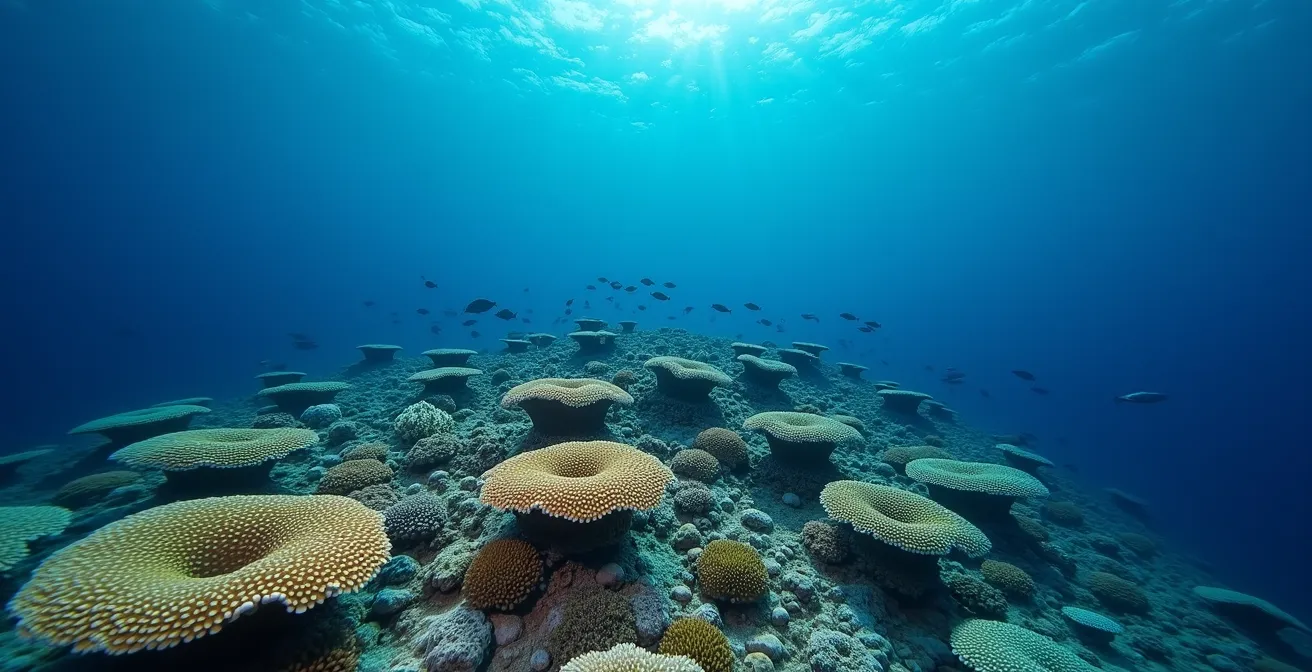
The table below, based on data from park authorities and dive operators, starkly illustrates these differences. This isn’t just a choice between two dive spots; it’s a choice between a fragile coastal system and a robust oceanic one. The higher visitor numbers and coastal proximity of Moalboal directly correlate with its lower resilience compared to Tubbataha’s isolation. Coron’s wrecks, as artificial structures, stand apart but still exist within a more impacted coastal zone.
| Factor | Tubbataha Reefs | Coron Wrecks | Moalboal Reefs |
|---|---|---|---|
| Average Depth | 20-40m walls | 12-36m structures | 5-25m slopes |
| Distance from Shore | 150km offshore | Bay locations | Coastal access |
| Current Strength | Strong oceanic | Moderate tidal | Mild coastal |
| Visitor Numbers | ~2,000/year | ~15,000/year | ~100,000/year |
| Climate Resilience | High (depth/isolation) | N/A (artificial reefs) | Low (shallow/accessible) |
The Risk of Diving Without a Nearby Decompression Chamber
No diver wants to think about it, but the risk of decompression sickness (DCS) is an inherent part of our sport. In easily accessible dive locations, a hyperbaric chamber might be a short boat or car ride away. In the middle of the Sulu Sea, 150km from the nearest landmass, the logistics of safety take on a whole new dimension of seriousness. The premium price of a Tubbataha liveaboard is a direct investment in mitigating this risk. You are paying for the highest standards of preparation, equipment, and emergency protocol in one of the world’s most remote diving environments. Reputable operators don’t just have a first aid kit; they have a comprehensive emergency action plan, extensive oxygen supplies, and staff trained to manage a dive incident for hours, or even days, until evacuation is possible.
This level of readiness is a non-negotiable operational cost. While Coron is also remote by some standards, its proximity to a town and airport changes the risk calculation. However, the nearest reliable chamber is still a significant distance away, making comprehensive dive insurance and choosing a safety-conscious operator equally critical. The financial reality is sobering. According to DAN (Divers Alert Network), a single session in a hyperbaric chamber can cost anywhere from $330 to $1,000 per hour. This doesn’t even account for the astronomical cost of an emergency evacuation. A real-world case documented by DAN involved a paralyzed diver in the Solomon Islands where the evacuation alone cost approximately AUD$90,000, with treatment costs exceeding US$30,000. These figures underscore that the price of a trip is trivial compared to the cost of an accident.

The professional setup on a top-tier liveaboard is a testament to this commitment. It’s not just about comfort; it’s about having the tools and training to handle a worst-case scenario. When you choose a reputable operator in a remote location, you’re not just buying a dive trip; you’re buying into a professional safety infrastructure that you hope you’ll never need, but you’re profoundly grateful is there.
Liveaboard vs. Resort-Based Diving: Which Maximizes Your Bottom Time?
The debate between a liveaboard (Tubbataha’s only option) and resort-based diving (Coron’s standard model) is at the core of this decision. This isn’t just about where you sleep; it’s about the entire philosophy of your trip and how you maximize your precious bottom time. A Tubbataha liveaboard is a purpose-built machine for one thing: maximum, efficient diving. You wake up on the dive site. Your surface intervals are spent sailing to the next one. Travel time is measured in minutes. The result is an impressive 4-5 dives per day, allowing you to fully immerse yourself in the rhythm of the reef: sunrise, daytime, sunset, and night.
Coron’s resort-based model offers a different kind of value: flexibility and cultural immersion. You can choose to dive two or three times a day, then spend your afternoon kayaking through lagoons, hiking to viewpoints, or exploring Coron town. The trade-off is travel time; day trips to the wrecks can take 30 to 90 minutes each way, cutting into potential dive or relaxation time. As one analysis of diving patterns in the region puts it:
The liveaboard model is for the ‘dive-eat-sleep-repeat’ purist who values efficiency. The resort-based model is for the ‘diver-explorer’ who wants to mix world-class diving with topside adventure
– Analysis based on diving patterns, Philippines Diving Community Insights
This fundamental difference is reflected in the total experience. The table below breaks down what a typical week looks like in each location. A Tubbataha trip will almost certainly add more dives to your logbook and expose you to a wider variety of sites within its atolls. A Coron trip offers fewer dives but a richer topside experience. The “price per dive” can be misleading; it’s the “value per day” that truly matters, and that value is entirely personal.
| Aspect | Tubbataha Liveaboard | Coron Resort-Based |
|---|---|---|
| Daily Dives | 4-5 dives | 2-3 dives |
| Total Week Dives | 20-25 dives | 12-18 dives |
| Site Variety | 20 sites across 3 atolls | 10-12 wrecks + reefs |
| Travel Time to Sites | 5-15 minutes | 30-90 minutes |
| Cultural Experience | Limited (at sea) | High (town access) |
| Photography Workshops | Often included | Rarely available |
| Night Diving | Every night possible | Limited by boat schedule |
| Price per Dive | €280-500 per day | €80-150 per day |
When to Dive in Malapascua to See Thresher Sharks Clearly?
Timing is everything in diving. Divers plan their lives around the best seasons to see thresher sharks in Malapascua, hammerheads in the Galapagos, or mantas in Indonesia. This principle of seasonality is the next critical piece of Tubbataha’s value proposition: its premium price is intrinsically linked to its extreme exclusivity and a painfully short season. The dive season at Tubbataha lasts just 3 months only (mid-March to mid-June). This is the only window when the sea is calm enough for liveaboards to safely make the 10-hour open-ocean crossing. This limited window creates immense demand for a very small number of spots, naturally driving up the price.
What do you get for that price? You get the best possible conditions, period. During these three months, the visibility in Tubbataha is legendary, typically ranging from 20 to 40 meters. You are paying for the high probability of experiencing the reef in its most majestic, crystal-clear state. This contrasts sharply with other destinations that, while fantastic, have more variable conditions. Coron’s visibility, for instance, typically sits between 12-25m due to the plankton-rich waters of the bay—which is great for creating that spooky, atmospheric wreck-diving feel but doesn’t offer the same wide-open vistas. Even a top-tier destination like Malapascua has its seasonal fluctuations. You can dive Coron or Malapascua almost year-round, but you might have to compromise on visibility or weather. With Tubbataha, the trip only happens if the conditions are expected to be optimal. You’re not just booking a dive; you’re booking a guarantee of peak-season conditions.
Why Do Dive Fees Vary So Much Between Palawan and Visayas?
A significant, and often overlooked, part of a premium dive trip’s cost is the conservation fee. These fees are not optional extras; they are a vital contribution to the protection of the marine environments we love. The dramatic difference in these fees between destinations like Tubbataha in Palawan and sites in the Visayas is a direct reflection of the cost of active, effective conservation. Tubbataha Reefs Natural Park is a UNESCO World Heritage site, and its protection is a serious, year-round operation. The park fees you pay are not just for a piece of paper; they are a tangible contribution to the infrastructure that keeps this pristine ecosystem safe.
These fees directly fund the salaries of the marine park rangers who live on-site, the maintenance of their patrol boats, surveillance equipment to monitor for illegal fishing, and ongoing scientific research. Protecting an isolated, 97,000-hectare area in the middle of the ocean is a logistically complex and expensive undertaking. A comparison of park fees shows this clearly: a 7-night trip to Tubbataha might include a park fee of around $120, whereas a similar duration of diving in the Visayas could be closer to $80. While both contribute to conservation, the higher fee for Tubbataha reflects the much larger operational scale required for its protection. When you pay the Tubbataha fee, you are directly funding the rangers who patrol for poachers and the scientists who monitor the reef’s health. It’s one of the most direct and impactful ways a diver can vote with their wallet for conservation. The cost of your dive trip becomes a direct investment in the future of the reef itself.
Tour A, B, C, or D: Which El Nido Circuit Has the Best Lagoons?
For many, the idea of a trip to Palawan includes the iconic lagoons of El Nido. But the experience of queuing up with dozens of other boats to enter Big Lagoon or Small Lagoon highlights another, more intangible value that Tubbataha’s premium price buys: solitude. In a world of over-tourism, the chance to experience a world-class natural wonder without the crowds is becoming the ultimate luxury. A sharp analysis on the topic puts it perfectly: “If the thought of Tour A’s ‘Big Lagoon’ at midday with 30 other boats gives you anxiety, then the solitude of a Tubbataha liveaboard is precisely what its premium price is buying.”
This is not to denigrate El Nido or Coron’s topside attractions—they are stunning. But the experience is fundamentally a shared one. A Tubbataha liveaboard, by its very nature, limits the number of people in the entire park at any given time. With only a handful of boats operating, each carrying 16-24 guests, you might see another dive boat on the horizon, but you will often feel like you have the entire reef to yourself. There is no jockeying for position at the dive site, no waiting for other groups to finish. The silence on the surface, broken only by the sound of the wind and waves, is as profound as the biodiversity below. This sense of exclusive access and raw, untamed nature is a massive part of Tubbataha’s appeal and a core component of its value. For many seasoned divers, escaping the crowds is worth more than any specific marine life encounter.
Even for the diver who chooses Coron and wants to add an El Nido extension, achieving solitude requires strategic planning. You can’t just show up. You must actively work to beat the crowds, often by chartering private boats for sunrise departures or staying at exclusive island resorts. The “price” of solitude in popular areas is paid in meticulous planning and extra costs, whereas in Tubbataha, it’s already built into the fabric of the experience.
Key Takeaways
- Tubbataha’s premium price is a direct investment in ecological resilience, unparalleled safety logistics, and the priceless commodity of solitude.
- Coron offers an exceptional return on investment for wreck enthusiasts, providing deep historical immersion and greater travel flexibility at a more accessible price point.
- The “better” trip is not defined by cost, but by your personal diving philosophy: do you seek technical purity and biological perfection (Tubbataha) or atmospheric storytelling and topside adventure (Coron)?
Anilao vs. Dauin: Which Muck Diving Capital Should Macro Photographers Choose?
While the Tubbataha vs. Coron debate is often framed as wide-angle (reefs and sharks) vs. wide-angle (massive wrecks), the ultimate return on investment for a diver, especially a photographer, is about the portfolio. Different destinations offer different returns. A trip to the muck diving capitals of Anilao or Dauin is an investment in award-winning macro shots. A trip to Tubbataha is an investment in epic, portfolio-grade wide-angle scenes: pristine coral walls, massive schools of fish, and reliable shark encounters. A trip to Coron is an investment in atmospheric, narrative-driven images that tell a story of war and rebirth.
The financial investment directly correlates with the photographic return. As the analysis below shows, the highest-cost trip (Tubbataha) offers the chance for those “once in a lifetime” wide-angle shots that define a portfolio. Coron provides a unique niche in historical wreck photography, while the macro destinations offer the highest potential for competition-winning critter shots at a lower cost. However, the beauty of these premium destinations is that they often hold surprising value. While known for grand scenes, keen-eyed macro photographers at Tubbataha have found ornate ghost pipefish, seahorses, and frogfish. Similarly, Coron’s wrecks, now encrusted with decades of coral growth, host a surprising diversity of nudibranchs and other macro life. This means a trip to a “wide-angle” destination can still offer a fantastic ROI for the photographer willing to switch lenses and look closer.
Ultimately, your choice depends on the story you want to tell with your images and your diving. Is it a story of overwhelming biodiversity, of haunting history, or of the tiny, intricate wonders of the reef?
| Photography Type | Best Destination | Cost/Week | Key Subjects | ROI for Photographers |
|---|---|---|---|---|
| Wide-Angle Reef | Tubbataha | €2,000-3,500 | Walls, sharks, schools | Portfolio-grade shots |
| Wide-Angle Wreck | Coron | €800-1,500 | WWII ships, atmosphere | Historical narrative |
| Macro/Muck | Anilao/Dauin | €600-1,200 | Nudibranchs, frogfish | Competition winners |
| Mixed Portfolio | Visayas Circuit | €1,200-2,000 | Threshers + macro | Diverse collection |
The choice between Tubbataha and Coron is a rite of passage for the advanced diver exploring the Philippines. There is no wrong answer, only a choice that is more or less aligned with your personal goals, skills, and diving philosophy. Tubbataha is an uncompromising pilgrimage to a bastion of marine purity. Coron is an evocative journey into history. Both are world-class. So, which investment will you make for your next logbook entry?