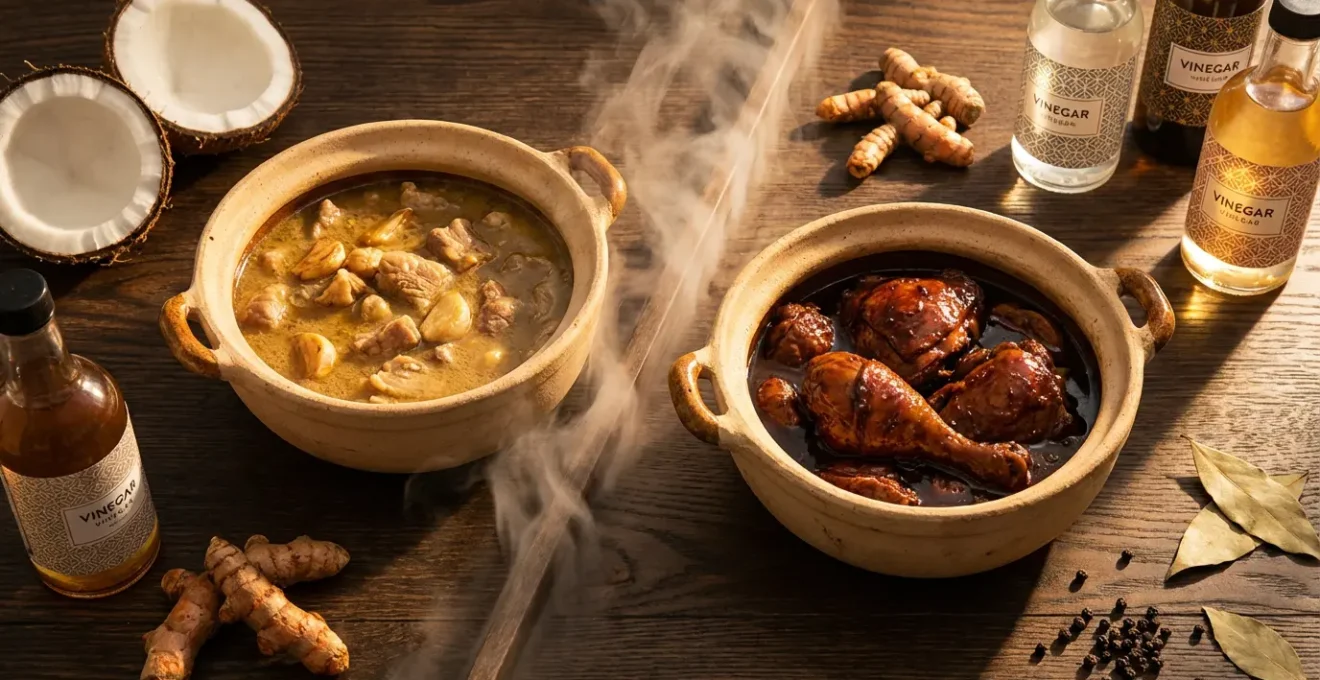
The endless variations of Filipino adobo aren’t random; they follow a logical “culinary grammar” dictated by regional history, agriculture, and science.
- The core principle of adobo is acid-based preservation, a pre-colonial technique essential in a tropical climate. Soy sauce is a later addition, not a requirement.
- Regional ingredients like coconut milk in Bicol or turmeric in Batangas are not arbitrary choices but reflections of the local “environmental terroir.”
- Modern interpretations like adobo flakes are not inauthentic but a form of “gastronomic darwinism,” evolving the dish for new contexts.
Recommendation: Stop searching for the single “authentic” adobo. Instead, learn to read the story each regional variation tells about its home.
For any food lover exploring the Philippines, adobo presents a delicious paradox. Hailed as the national dish, it lacks a single, standard recipe. Travel from one province to the next, sometimes just one town over, and the adobo transforms. The dark, savory stew from Manila gives way to a pale, intensely tart version in the Visayas, or a creamy, coconut-infused braise in Bicol. This culinary shapeshifting can be confusing, leading many to ask: which one is the *real* adobo?
The common answer is that every family has its own recipe, a tradition passed down through generations. While true, this explanation barely scratches the surface. It positions adobo as a matter of infinite personal preference, obscuring the deeper, more fascinating logic at play. To truly understand this dish, one must move beyond simply collecting recipes and instead adopt the lens of a culinary anthropologist.
The key is to realize that adobo is not a static dish but a dynamic culinary grammar—a set of foundational principles shaped by geography, history, and science. The variations aren’t random deviations from a central text; they are distinct, logical dialects that tell the story of their specific place of origin. The absence or presence of soy sauce, the addition of coconut milk, or the use of turmeric are not whimsical choices. They are intelligent responses to the local environment and historical influences.
This guide decodes that grammar. We will explore the scientific basis of its preservation method, the agricultural logic behind its regional ingredients, and the cultural forces that continue to evolve it. By the end, you will no longer see a confusing mess of recipes, but a coherent and brilliant culinary system.
This article explores the fundamental principles and regional expressions of this complex dish. The following summary outlines the key aspects we will delve into to understand adobo’s incredible diversity.
Summary: Understanding Adobo’s Culinary Grammar
- Why Braising in Vinegar Preserves Meat in Tropical Heat?
- Adobo sa Gata: Why Bicolanos Add Coconut Milk to Everything?
- Adobong Kangkong: Is It a Safe Bet for Vegetarians in Local Eateries?
- Adobo Flakes: Why Is Yesterday’s Adobo Better Than Today’s?
- How Long Should You Marinate Chicken to Get the Authentic Taste?
- Where to Find US Grocery Brands When You Are Homesick?
- Sawsawan Guide: How to Mix Vinegar, Soy Sauce, and Chili Like a Local?
- Why Is Authentic Kapampangan Sisig Never Served With Mayonnaise?
Why Braising in Vinegar Preserves Meat in Tropical Heat?
Before refrigeration, survival in a tropical climate depended on ingenious methods of food preservation. Adobo is the ultimate expression of this ingenuity. At its core, it is not a flavor profile but a pre-colonial cooking technique: braising in vinegar. The word itself, from the Spanish `adobar` (“to marinate”), was applied by colonizers to an existing indigenous practice. The primary purpose of the vinegar was not taste, but to create an environment hostile to the bacteria that cause spoilage.
The science is straightforward. The acetic acid in vinegar lowers the pH of the meat and its sauce. In fact, research from the American Society for Microbiology confirms that a pH below 4.6 effectively halts the growth of most foodborne pathogens, including Clostridium botulinum. This is the foundational principle of the entire adobo grammar. By simmering meat in a high-acid liquid, early Filipinos could safely keep cooked food for days without it spoiling, a crucial advantage in a hot and humid environment.
This explains the existence of `adobong puti` (white adobo), common in the Visayas region. Made with just vinegar, garlic, peppercorns, and salt, it represents the dish in its most elemental, pre-Chinese-influence form. The intense, clean tartness is not a flaw; it is the pure expression of adobo’s original function as a method of acid preservation. The addition of soy sauce, which brings the characteristic dark color and umami depth, came much later with the influence of Chinese traders and is not fundamental to the dish’s identity.
Adobo sa Gata: Why Bicolanos Add Coconut Milk to Everything?
If vinegar is adobo’s scientific foundation, the local landscape provides its poetic variation. Nowhere is this more evident than in the Bicol region, where `adobo sa gata` (adobo with coconut milk) reigns supreme. To an outsider, adding creamy coconut milk to an acidic, savory stew might seem counterintuitive. But for a Bicolano, it is the most natural thing in the world. This is a direct reflection of the region’s environmental terroir.
The Bicol Peninsula is the coconut heartland of the Philippines. According to 2023 data from the Philippine Statistics Authority, the country produced 14.89 million metric tons of coconuts, with Bicol being one of the key producing regions. Vast plantations dominate the landscape, and coconut, in all its forms—milk (`gata`), meat (`niyog`), and oil (`langis`)—is woven into the fabric of daily life and cuisine. Adding `gata` to adobo isn’t a stylistic flourish; it’s a logical use of an abundant local resource.
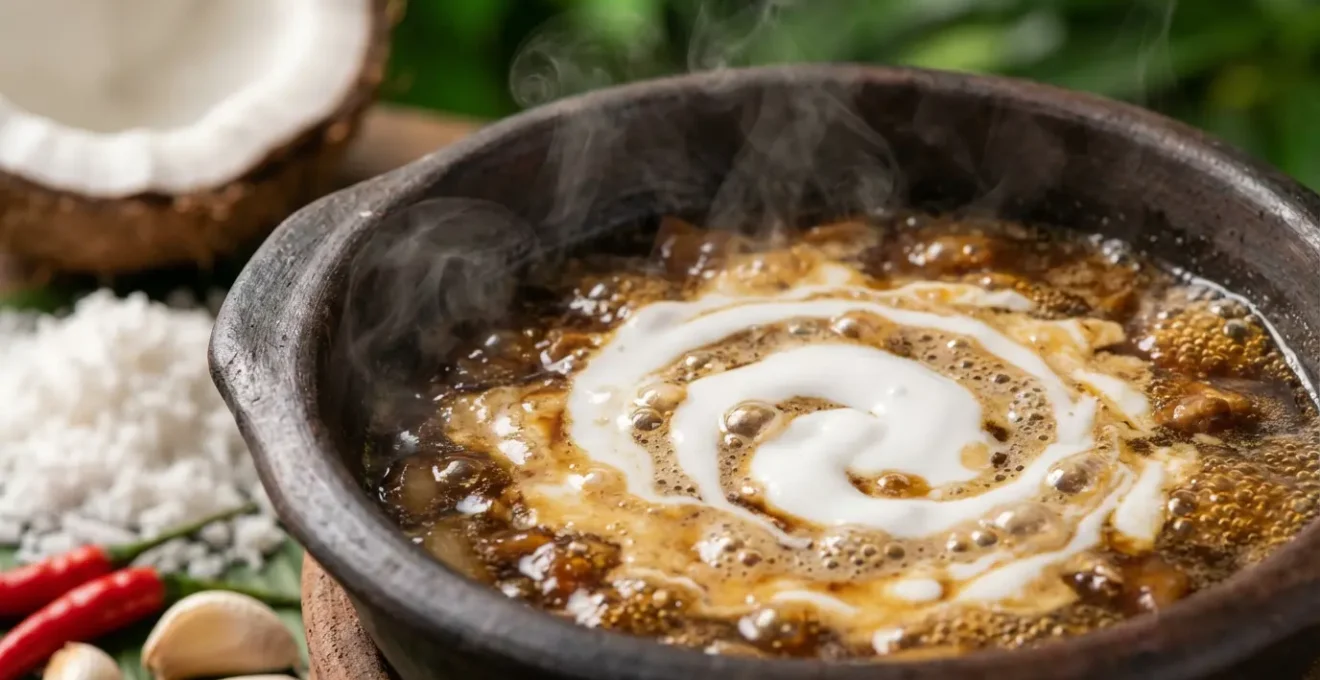
The coconut milk completely transforms the dish. It mellows the sharp acidity of the vinegar, creating a richer, more unctuous sauce with a gentle sweetness that balances the saltiness of the soy sauce or fish sauce (`patis`). Often, fiery `siling labuyo` (bird’s eye chilies) are also added, another Bicolano signature. The resulting dish is a complex tapestry of flavors—creamy, tangy, spicy, and savory—that perfectly encapsulates the agricultural identity of its home. It is a delicious lesson in how a region’s pantry dictates its palate.
Adobong Kangkong: Is It a Safe Bet for Vegetarians in Local Eateries?
The adobo cooking method is so versatile that it extends beyond meat and poultry. `Adobong kangkong` (water spinach adobo) is a common and beloved vegetable dish found throughout the Philippines. Sautéed with the classic adobo flavors of garlic, vinegar, and soy sauce, it seems like a perfect, readily available option for vegetarians visiting the country. However, navigating local eateries, or `carinderias`, requires a bit of insider knowledge.
While the dish itself is plant-based, the sauce used to cook it might not be. Many `carinderias` maintain a “master sauce” for their adobo. This base liquid, already simmered with pork or chicken, is used throughout the day to cook different batches. This means that even a vegetable-only adobo could contain meat drippings, fat, or broth, making it unsuitable for strict vegetarians or vegans. The intense flavor of this master sauce is a source of pride for many cooks, but it creates a hidden hazard for those avoiding meat products.
To ensure a truly vegetarian dish, it’s best to communicate clearly. Politely asking, “Puro gulay lang po, walang kasamang karne o sabaw ng karne?” (“Just vegetables, with no meat or meat broth included?”) can clarify your needs. This simple question shows respect for the cook while ensuring your dietary requirements are met. When prepared from scratch, `adobong kangkong` is a brilliant showcase of how the adobo grammar can elevate simple greens into a flavor-packed meal.
Adobo Flakes: Why Is Yesterday’s Adobo Better Than Today’s?
There’s a widely held belief in the Philippines that adobo tastes better the next day, or even several days after it’s cooked. This isn’t just folk wisdom; it’s a result of basic food science. As the adobo rests in the refrigerator, the flavors continue to meld and deepen. The acids break down the proteins further, making the meat more tender, while the garlic, soy, and vinegar permeate every fiber. This process of aging is a key part of the adobo experience, and it has led to a brilliant culinary innovation: adobo flakes.
This concept of “gastronomic darwinism”—where a dish evolves to fit a new purpose—is perfectly embodied by this crunchy, addictive creation. Leftover adobo, which has already benefited from a day or two of flavor development, is shredded by hand, then fried in oil until golden and crispy. As noted by PhilSTAR Life, it was Glenda Rosales-Barretto of Via Mare Restaurant who first introduced this novelty as an appetizer in 1975, and its popularity soared. It takes the best part of aged adobo—its concentrated flavor—and transforms its texture into something entirely new.
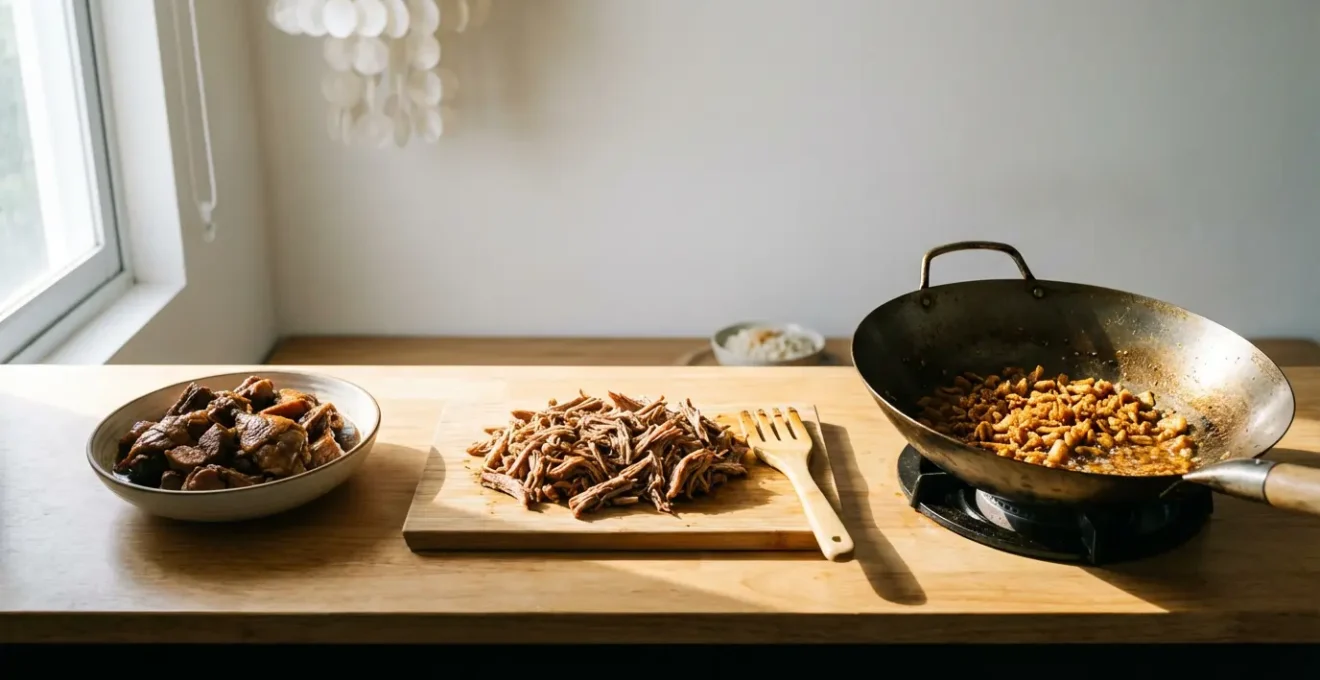
The longevity of the original dish makes this possible. Because of its high acidity and salt content, culinary experts confirm that adobo can keep in the fridge for up to 5 days, getting more flavorful each day. Adobo flakes are the ultimate tribute to this quality. They are a testament to Filipino resourcefulness, turning leftovers into a gourmet product served for breakfast with garlic fried rice and eggs (`adsilog`), as a crunchy topping, or as a standalone snack. It proves that in the world of adobo, nothing goes to waste, and yesterday’s meal can become today’s delicacy.
How Long Should You Marinate Chicken to Get the Authentic Taste?
Within the adobo grammar, one of the most significant points of divergence is the question of marination. This debate splits cooks into two main camps: the “Marinators” and the “One-Pot Braisers.” Both methods can produce an exceptional adobo, but they rely on different principles of flavor development. The choice between them often depends on the type of meat being used and the desired depth of flavor.
The Marinators argue that front-loading the flavor is key. This involves soaking the meat—typically tougher cuts like pork shoulder—in the vinegar, soy sauce, and garlic mixture for an extended period. Panlasang Pinoy, a trusted resource for traditional recipes, suggests that this process can take anywhere from 1 to 12 hours, with 3 hours being optimal for a deeply infused taste. The acid in the marinade works over time to tenderize the meat and ensure the seasoning penetrates to the core before it even hits the heat.
On the other hand, the One-Pot Braisers believe that flavor is best developed during the cooking process itself. This method, often preferred for more porous meats like chicken thighs, involves combining all ingredients in a pot at once and simmering them together. The flavor develops as the liquids reduce and the ingredients meld under heat. This approach is quicker and highlights the fresh, distinct notes of each component. As a comparative analysis from RecipeTinEats shows, both are valid paths to authenticity.
| Method | Marination Time | Key Principle | Best For |
|---|---|---|---|
| The Marinators | 3-12 hours | Front-loading flavor through extended acid contact | Dense pork cuts |
| One-Pot Braisers | 0-30 minutes | Flavor development during 25-minute simmer | Chicken thighs (porous meat) |
Where to Find US Grocery Brands When You Are Homesick?
For the Filipino diaspora, the taste of adobo is the taste of home. Recreating it abroad, however, can be a challenge when familiar ingredients aren’t on the shelf. The specific brand of soy sauce or vinegar can make a subtle but significant difference. This quest is not about finding US grocery brands in the Philippines, but about the reverse: using common US grocery items to approximate the authentic flavor profile when you’re feeling homesick. It’s an exercise in creative substitution, hacking the adobo grammar with a new set of tools.
The key lies in understanding the flavor profile of the original Filipino ingredients. For instance, popular Filipino soy sauce brands like Silver Swan are often slightly thinner and sweeter than a standard Japanese Kikkoman. Likewise, Filipino cane vinegar (`sukang maasim`) has a milder, cleaner profile than many Western vinegars. The goal is to bridge these gaps. Fortunately, with a few adjustments, a deeply satisfying adobo is entirely achievable using items from any major US supermarket.
This process of adaptation requires a practical plan. The following checklist provides a step-by-step guide to substituting common American grocery store items to recreate the authentic taste of home, ensuring that even thousands of miles away, the comforting flavor of adobo is within reach.
Your Action Plan: Expat’s Guide to Adobo Ingredient Substitution
- Soy Sauce Swap: Replace Filipino soy sauce (like Silver Swan) with a standard Japanese soy sauce (like Kikkoman), but add a small pinch of sugar to mimic the characteristic Filipino sweetness.
- Vinegar Selection: Substitute Filipino cane vinegar with apple cider vinegar. Its mild acidity is a closer match than the harshness of white distilled vinegar.
- Choosing the Chicken: Use bone-in, skin-on chicken thighs. They are readily available in any US supermarket and provide the richness and flavor essential for an authentic adobo.
- Sourcing Aromatics: Standard dried bay leaves and whole peppercorns from the spice aisle of any major grocery chain will work perfectly. Don’t skip the copious amounts of fresh garlic.
- The Authenticity Upgrade: If you can find an Asian market, keep a bottle of Silver Swan soy sauce on hand. It’s thinner, darker, and provides a flavor that tastes unmistakably like home.
Key Takeaways
- Adobo’s primary function is vinegar-based preservation, a pre-colonial technique essential for a tropical climate. Soy sauce is a secondary, later addition.
- Regional variations like ‘Adobo sa Gata’ are not random, but a direct result of local agriculture, or “environmental terroir.”
- The Filipino concept of ‘sawsawan’ (dipping sauce) is the final layer of personalization, allowing each diner to adjust the dish to their exact preference.
Sawsawan Guide: How to Mix Vinegar, Soy Sauce, and Chili Like a Local?
After exploring the vast universe of adobo—where culinary historians have documented at least 80+ distinct adobo variations—one might think the cook has the final say. But in the Philippines, the act of eating is often the final step in the act of cooking. This is accomplished through `sawsawan`, an array of dipping sauces placed on the table that allows each person to customize the dish to their own palate. The `sawsawan` is the ultimate expression of adobo’s flexible grammar; it’s the personal signature on a regional dialect.
The `sawsawan` for adobo is beautifully simple, yet profoundly personal. The most common base is a mix of soy sauce and vinegar, often with crushed garlic, chopped onions, or fiery chilies. Someone who finds the adobo a bit too rich might add more vinegar to their `sawsawan` to cut through the fat. Another, craving more salt and umami, will lean on the soy sauce. It is an interactive, real-time flavor adjustment. This practice transforms the dining experience from a passive reception of a finished dish into an active collaboration between the cook and the eater.
This philosophy is perfectly captured by a leading Filipino culinary expert who explained the spirit of the local kitchen to PhilSTAR Life:
The Pinoy cook has no ego. It is an interactive cooking. It’s truly more fun cooking and eating in a Filipino kitchen.
– Philippine culinary expert, PhilSTAR Life
The `sawsawan` matrix embodies this lack of ego. It acknowledges that there is no single “correct” flavor balance. By providing the component parts, the cook empowers the diner to find their own perfect bite. It is the final, brilliant layer of customization that makes the adobo experience complete.
Why Is Authentic Kapampangan Sisig Never Served With Mayonnaise?
To truly grasp the passion behind adobo’s regional identities, it is useful to look at a parallel case in Filipino cuisine: the fierce debate over Kapampangan `sisig`. `Sisig`—a sizzling dish of chopped pig’s face, ears, and chicken liver seasoned with calamansi and chili—is the signature dish of Pampanga, a province renowned as a culinary capital. In its authentic form, it is sour, savory, and rich with gelatinous textures. However, in Manila and abroad, a popular version has emerged that includes mayonnaise, creating a creamy, milder profile. For Kapampangan purists, this is nothing short of culinary heresy.
This isn’t mere snobbery; it’s about protecting a recipe as a regional ID. The mayonnaise-laced version is seen as a dilution of the dish’s character, a concession to a less adventurous palate. The same protective instinct exists for adobo. For someone from Batangas, `adobong dilaw`, which uses turmeric (`kalawag`) for its vibrant yellow color and earthy flavor, is a proud symbol of their pre-colonial heritage. For a Visayan, the soy sauce-free `adobong puti` is a connection to the dish’s purest origins. Each variation is a badge of identity, fiercely protected.
This table of regional adobo markers, based on an analysis by Saveur, illustrates how a single ingredient can define a region’s culinary signature, much like the absence of mayonnaise defines authentic sisig.
| Region | Signature Variation | Defining Ingredient | Cultural Significance |
|---|---|---|---|
| Bicol | Adobo sa Gata | Coconut milk | Reflects agricultural abundance |
| Batangas | Adobong Dilaw | Turmeric | Pre-colonial preservation method |
| Visayas | Adobong Puti | No soy sauce | Preserves the indigenous method |
| Kapampangan | Traditional Sisig | No mayonnaise | Preservation of original recipe integrity |
The lesson from the sisig debate illuminates the entire adobo landscape. The variations are not just about taste; they are about history, identity, and a deep-seated pride in one’s local culture. To change a key ingredient is to try and rewrite a piece of that identity. So, the next time you encounter a new adobo, ask not if it’s “correct,” but what story its ingredients tell about its home.
By embracing this perspective, every plate of adobo becomes an opportunity for discovery, a delicious exploration of the rich and varied tapestry of the Philippines.
Frequently Asked Questions about White Adobo vs. Dark Adobo: Why Does the Recipe Change Every 50 Kilometers?
Is Adobong Kangkong always vegetarian in carinderias?
Not necessarily. Many local eateries use a master adobo sauce that may contain meat drippings or broth from previous batches. It’s always best to ask.
What Filipino phrase should I use to ensure a vegetarian dish?
Say “Puro gulay lang po, walang kasamang karne o sabaw ng karne?” which means “Just vegetables, with no meat or meat broth included?”
Are there other vegetable adobo options?
Yes, the adobo method is very versatile. Vegan and vegetarian options can be made with vegetables and fruits like water spinach (kangkóng), bamboo shoots (labóng), eggplant (talóng), banana flowers (pusô ng saging), and okra.