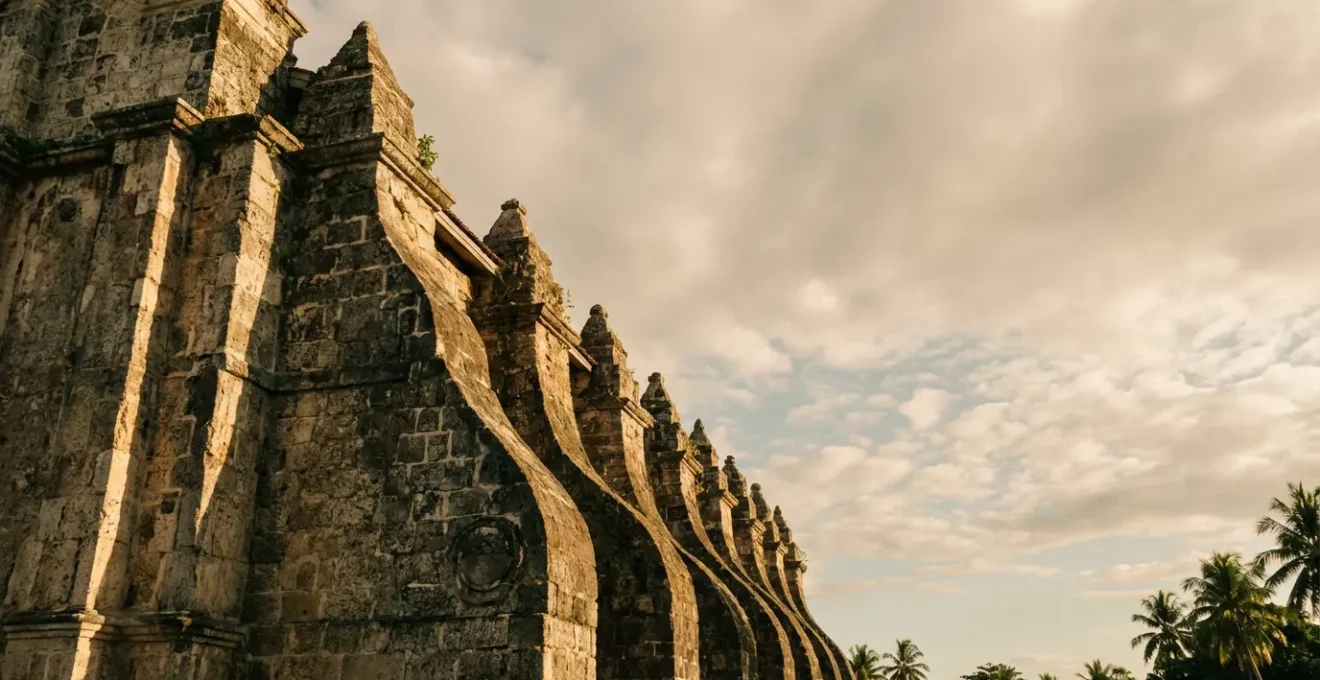
The defining buttresses of Philippine Baroque churches are a masterclass in structural pragmatism, deliberately sacrificing European aesthetics for seismic resilience.
- This “Earthquake Baroque” style evolved by combining Spanish design with local engineering ingenuity to withstand the region’s intense tectonic activity.
- Construction involved innovative material syncretism, using local resources like coral stone and egg whites to create durable, flexible mortar.
Recommendation: Appreciate these structures not as provincial copies of European designs, but as a unique architectural language—a seismic vernacular—born from a specific and challenging environment.
For an architecture buff accustomed to the soaring, delicate lines of European cathedrals, the first encounter with a Philippine Baroque church can be jarring. The structures appear heavy, squat, and almost defensive, flanked by disproportionately massive buttresses that seem to defy the very essence of Baroque’s ornamental flourish. The immediate assumption, often repeated, is that these are simply a defense against earthquakes. While correct, this explanation barely scratches the surface. It misses the genius of the design, which is not a mere reaction but a proactive, sophisticated architectural synthesis.
This style, now known as Earthquake Baroque, represents a conscious departure from its Spanish precedents. It is a dialogue between the imperial aesthetic and the unforgiving reality of the Pacific Ring of Fire. Colonial builders, faced with the constant threat of destruction, were forced to innovate. They integrated the structural logic of pre-colonial building techniques with their own, resulting in a unique seismic vernacular. This article analyzes the engineering, materials, and cultural context of these fortress-like churches, revealing how they sacrificed aesthetic ideals for a structural pragmatism that has allowed them to endure for centuries.
To fully appreciate this architectural marvel, we will explore the practicalities of visiting these sacred sites, the unique materials used in their construction, and the ongoing challenges of their preservation. We’ll compare key examples and even delve into the living history of surrounding colonial landscapes, providing a comprehensive view for the discerning architectural historian.
Summary: Understanding the Philippine ‘Earthquake Baroque’ Style
- Shorts and Tank Tops: The Mistake That Gets You Barred from San Agustin
- How Was Egg White Used to Build Churches That Lasted 400 Years?
- Paoay vs. Miagao: Which UNESCO Church Is Worth the Detour?
- When to Visit Baclaran Church to Hear the Unique Mass Singing?
- How to Donate for Church Restoration Without Getting Scammed by Touts?
- Why Are Some UNESCO Heritage Churches Crumbling Despite Status?
- When to Avoid Visiting Old Churches After a Magnitude 5 Earthquake?
- Vigan’s Calle Crisologo vs. Intramuros: Which Colonial Site Is More Authentic?
Shorts and Tank Tops: The Mistake That Gets You Barred from San Agustin
Before analyzing the architectural form, it’s crucial to acknowledge the living function of these structures. The four UNESCO World Heritage Baroque churches are not just historical monuments; they are active places of worship that receive millions of visitors annually. This dual role as both tourist destination and sacred space necessitates a code of conduct, particularly concerning attire. The most common mistake visitors make is arriving in casual beachwear—shorts and tank tops—which is considered disrespectful and will often result in being denied entry, especially at prominent sites like San Agustin Church in Intramuros.
Observing a modest dress code is a sign of respect for the local culture and the sanctity of the site. It is not an arbitrary rule but a deeply ingrained cultural norm in the predominantly Catholic Philippines. For the architectural enthusiast keen on spending time inside, proper attire is a practical necessity. Planning ahead ensures your visit is not cut short at the entrance.
To avoid any issues, follow these simple guidelines:
- Cover your shoulders: Bring a light scarf, shawl, or cardigan to drape over tank tops or sleeveless shirts.
- Ensure knees are covered: Wear long trousers, capri pants, or skirts that fall below the knee. Carrying a sarong to wrap around shorts is also a popular and effective solution.
- Remove headwear: Hats and caps must be removed before entering the main church building as a universal sign of respect.
- Dress for photography: While many churches restrict flash, respectful photography is usually permitted. Appropriate attire ensures your presence is not disruptive to worshippers.
Some visitors choose to purchase a traditional Filipino scarf, like a malong, from vendors near the church, turning a practical necessity into a cultural souvenir.
How Was Egg White Used to Build Churches That Lasted 400 Years?
The resilience of Philippine Baroque churches is not solely due to their massive buttresses; it also lies in the very mortar holding them together. A fascinating example of local material syncretism is the widespread use of egg whites as a binder in the lime mortar. This technique, known as albumen mortar, was an ingenious adaptation to improve the durability and weather resistance of the structure. Builders mixed egg whites with slaked lime and sand, creating a mortar that was more viscous, less porous, and had superior binding properties compared to lime mortar alone.
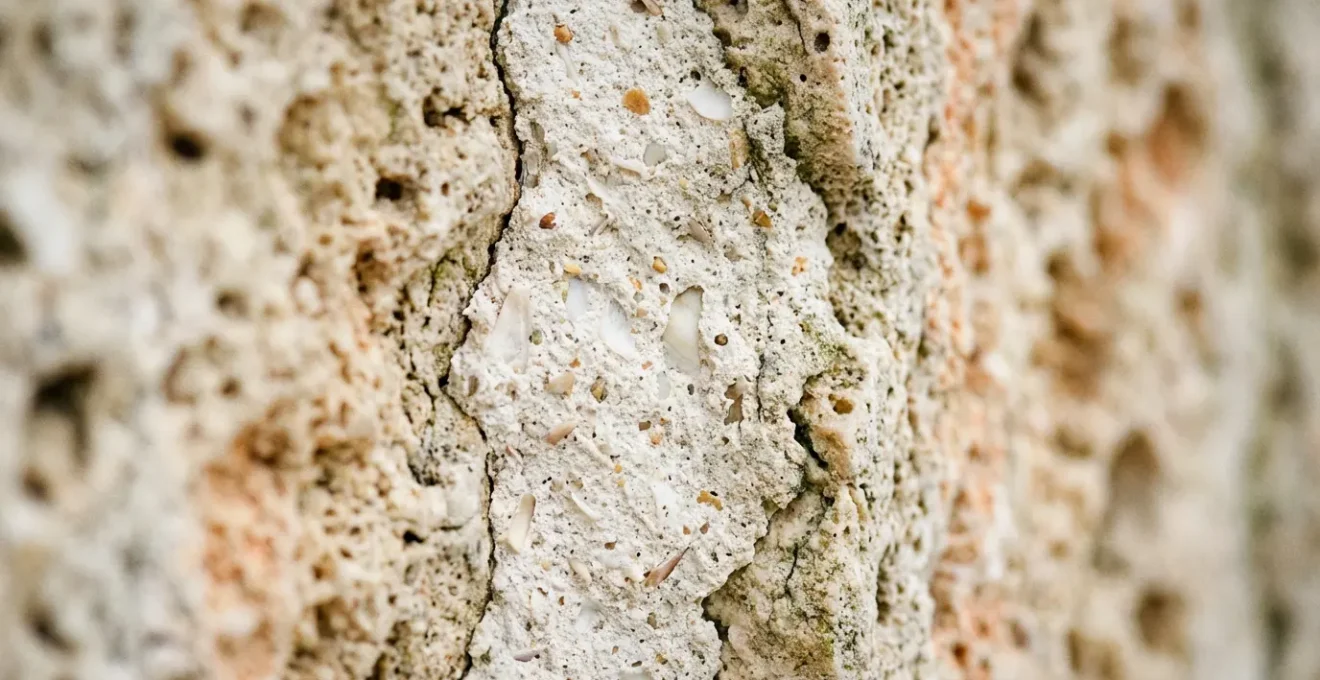
The proteins in the egg white acted as a natural polymer, increasing the plasticity and adhesion of the mortar. This allowed it to better accommodate the subtle shifts and stresses caused by thermal changes and minor seismic tremors, preventing the formation of cracks. A prime example is the Baclayon Church in Bohol, which was constructed from coral stones held together by a mortar believed to have been mixed with millions of egg whites. Despite damage in the 2013 earthquake, its core structure demonstrated the incredible longevity of this traditional building method.
This large-scale use of eggs had a surprising and delicious side effect on Filipino cuisine. As historian Pia Lim-Castillo notes in her research on the topic for “Eggs in Philippines Church Architecture and its Cuisine,” a culinary tradition was born from the surplus of yolks:
The extensive use of egg white and eggshells brought about the ingenuity of the Filipino women who saw all these egg yolks being thrown in the river. Recipes were created to make use of the egg yolks, like pan de San Nicolas, yema, tocino del cielo, leche flan, pastries, and tortas.
– Pia Lim-Castillo, Eggs in Philippines Church Architecture and its Cuisine
This connection between architecture and gastronomy provides a rich cultural context, demonstrating how engineering solutions can have far-reaching impacts on a society’s traditions.
Paoay vs. Miagao: Which UNESCO Church Is Worth the Detour?
For the architecture buff, a tour of the Philippines’ UNESCO sites presents a compelling choice between two titans of Earthquake Baroque: the San Agustin Church in Paoay, Ilocos Norte, and the Santo Tomás de Villanueva Church in Miagao, Iloilo. While both are masterpieces, they represent different expressions of structural pragmatism and are worth visiting for distinct reasons. Deciding which is “worth the detour” depends entirely on what the observer wishes to prioritize: pure structural form or ornate narrative detail.
Paoay Church is arguably the most dramatic and photogenic example of Earthquake Baroque. Its fame rests on its 14 colossal buttresses, which are detached from the main wall and flow in wave-like, pyramidal forms. With walls that are 1.67 meters thick, the design is an unapologetic display of seismic engineering. The separate bell tower, built at a distance to prevent it from toppling onto the main church during a quake, further underscores this fortress-like phenomenology. Paoay is an exhibition of engineering as art.
Miagao Church, conversely, directs its artistic energy toward its facade. While also featuring sturdy buttresses, they function more like massive bookends to a single, intricate sculptural piece. The facade is a celebrated example of cultural syncretism, famously depicting St. Christopher carrying the Christ child through a lush landscape of local flora, including coconut palms and papaya trees. Miagao is a masterclass in integrating local identity into a European religious template. The following table provides a direct comparison for the discerning visitor:
| Feature | Paoay Church (Ilocos Norte) | Miagao Church (Iloilo) |
|---|---|---|
| Buttress Style | 14 massive pyramidal buttresses, detached and sculptural | Integrated buttresses acting as ‘bookends’ to facade |
| Architectural Highlight | Most outstanding example of ‘Earthquake Baroque’ | Elaborate facade with local flora carvings (palms, papaya) |
| Bell Tower | Detached coral stone tower with pagoda influence | Twin asymmetrical towers integrated with main structure |
| Best For | Engineering enthusiasts, dramatic photography | Art lovers, detailed facade exploration |
| Construction Period | Started 1694, completed 1710 | Built 1787-1797 |
When to Visit Baclaran Church to Hear the Unique Mass Singing?
While the Spanish-era churches represent the historical foundation of Filipino faith, the National Shrine of Our Mother of Perpetual Help, commonly known as Baclaran Church, embodies its modern, dynamic expression. Although its Modern Romanesque architecture contrasts with the older Baroque style, it is a key pilgrimage site and offers a powerful experience of contemporary Filipino devotion. The church is famous for its Wednesday Novena, a tradition that draws massive crowds and is characterized by a unique, thunderous form of communal mass singing.
To experience this phenomenon, you must visit on a Wednesday. The novena services run almost hourly throughout the day, but the late afternoon and evening masses are typically the most attended. This is when the church, which can hold up to 11,000 people with 2,000 seated, fills to capacity and beyond, with devotees spilling out into the surrounding grounds. The sheer volume of thousands of voices singing in unison is an unforgettable acoustic and emotional experience, a testament to collective faith.
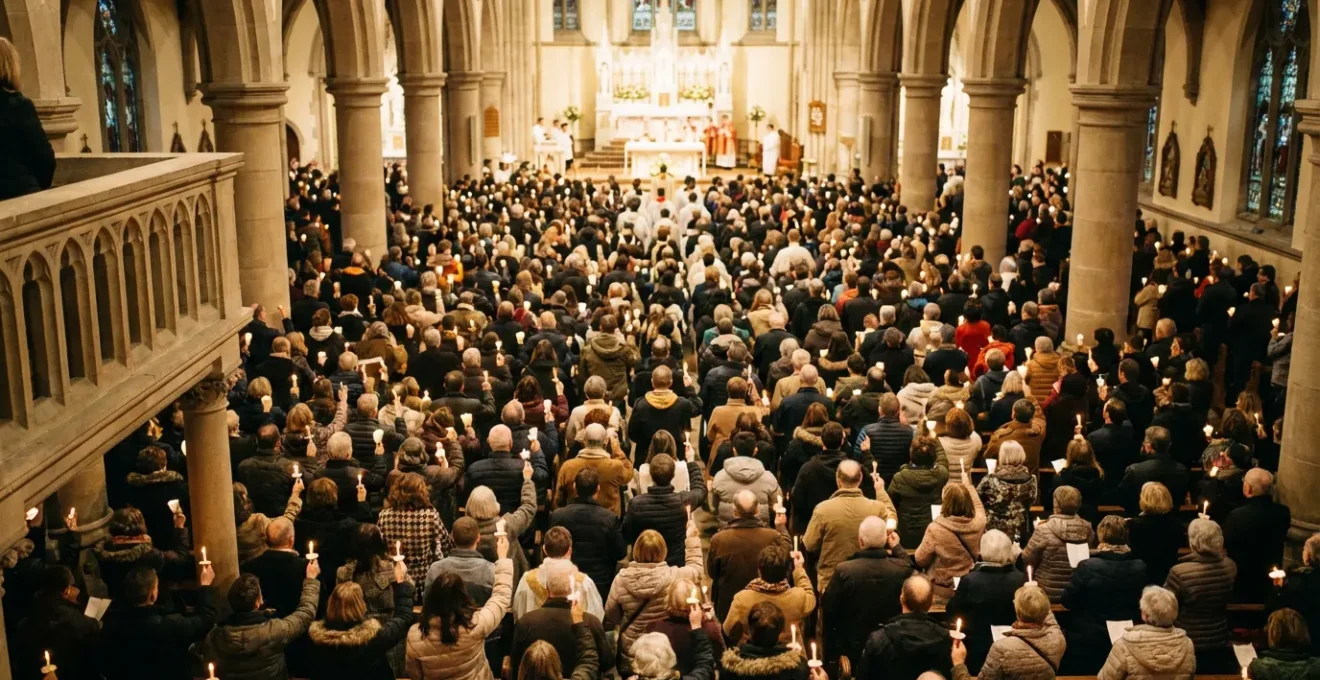
This weekly event is so significant that it impacts the entire district. As noted in its public records, “Wednesdays are popularly called ‘Baclaran Day’ due to congested roads near the shrine.” Visitors should be prepared for heavy traffic and immense crowds. For an architectural historian, it provides a vivid contrast: while the old Baroque churches were built to physically withstand the tremors of the earth, modern shrines like Baclaran are sites that generate their own human and spiritual tremors every week. Visiting on any other day will offer a quiet look at the architecture, but visiting on a Wednesday offers a look into the soul of Filipino popular piety.
How to Donate for Church Restoration Without Getting Scammed by Touts?
The very features that make Philippine Baroque churches so resilient—their age, their massive scale, and their location in a challenging climate—also make them incredibly demanding to maintain. The four main UNESCO Baroque churches require continuous maintenance in a tropical, seismic zone, a costly and highly specialized endeavor. Many visitors feel moved to contribute to their upkeep, but this goodwill is sometimes exploited by scammers and unofficial touts operating near the sites. Donating safely and effectively requires knowing the proper channels.
The primary rule is to never give cash to individuals on the street claiming to represent the church or a heritage foundation. Official donation channels are designed to be transparent and secure. Restoration projects are typically managed by the parish itself, often in coordination with national bodies like the National Commission for Culture and the Arts (NCCA) or the National Museum. Supporting these official efforts ensures that your contribution goes directly to the materials, labor, and expertise needed for authentic conservation work.
For those wishing to contribute, it is critical to follow a clear set of guidelines to ensure your donation is effective and not diverted. These steps protect both the donor and the heritage site.
Action Plan: Ensuring Your Donation Supports Heritage Preservation
- Donate directly through the official channels of the National Commission for Culture and the Arts (NCCA) or the National Museum of the Philippines.
- Look for sealed and clearly marked official donation boxes located inside the church or parish office, never with street collectors.
- Support parish-run initiatives like ‘Escuela Taller’ workshop schools, which train young people in traditional conservation crafts.
- Purchase official souvenirs and publications exclusively from the parish office or designated gift shop, as proceeds often support maintenance.
- For online donations, meticulously verify the website URL. It should end in .gov.ph for government bodies or match the official, verifiable domain of the specific church or diocese.
Why Are Some UNESCO Heritage Churches Crumbling Despite Status?
It is a troubling paradox: how can a building designated as a UNESCO World Heritage Site, recognized for its enduring design, be in danger of crumbling? The answer often lies in well-intentioned but misguided restoration efforts that fail to respect the original material science of Earthquake Baroque. A primary culprit in the deterioration of many Spanish colonial structures is the use of modern Portland cement for repairs.
The original structures were built with a “breathable” system. The coral or adobe stone walls were bound with lime-based mortar (often with the aforementioned egg white additive). This system allows moisture to enter and exit the porous stone naturally. When a patch repair is made with non-breathable Portland cement, it creates a rigid, impermeable seal. Moisture that enters the wall from other areas becomes trapped behind the cement patch. As conservation experts have repeatedly warned, “The non-breathable cement traps moisture, causing the original adobe or coral stones to literally disintegrate from within,” an observation highlighted in analyses of Philippine heritage structures.
Case Study: The Destructive Effect of Incompatible Materials
Studies on historical mortars have shown that Portland cement is fundamentally incompatible with the soft, porous bricks and stones of colonial buildings. Its rigidity and impermeability cause a buildup of salts and water pressure within the original wall, leading to spalling (flaking) and powdering of the historic material. The very agent used for “repair” becomes the source of accelerated decay. True conservation requires using modern materials that are chemically and physically compatible with the original lime-based, breathable construction, respecting the ‘seismic vernacular’ down to its molecular level.
This issue highlights a critical challenge in heritage conservation. The UNESCO status provides recognition and a framework for protection, but it does not guarantee a flawless execution of repairs on the ground. The survival of these churches depends not just on funding, but on a deep, technical understanding of their original construction and a commitment to using materials that honor that history.
When to Avoid Visiting Old Churches After a Magnitude 5 Earthquake?
Given that these churches are paragons of seismic-resistant design, it might seem counterintuitive to avoid them after an earthquake. However, even the most robust structures can sustain damage, and safety must always be the first priority. The “Earthquake Baroque” design was intended to prevent catastrophic collapse, not to render the buildings immune to all damage. After a significant seismic event—generally considered to be magnitude 5.0 or greater—a period of caution is essential.
The recommended protocol is to avoid entering any massive, old stone structures, including heritage churches, for at least 48 to 72 hours following a notable earthquake. This waiting period allows for two critical things to happen: the potential for immediate, strong aftershocks to decrease, and time for structural engineers and conservation architects to conduct initial safety assessments. These experts look for subtle but dangerous new signs of stress, such as micro-fractures in the walls or buttresses, shifts in the foundation, or displacement of the roof trusses. Even if the building appears intact from the outside, it could have sustained non-visible damage that compromises its stability.
These churches have proven their resilience, having survived centuries of tremors. According to UNESCO documentation, they are engineered to withstand immense forces. However, their age and the historical materials used mean that each new seismic event adds cumulative stress. Prudence dictates waiting for an official “all clear” from heritage authorities or the parish itself before visiting. These announcements are typically posted on the official social media pages of the NCCA, the National Museum, or the specific church.
Key Takeaways
- The ‘Earthquake Baroque’ style is a deliberate architectural choice, prioritizing seismic pragmatism over European aesthetic norms.
- Local material ingenuity, such as using egg whites in lime mortar, was critical to the long-term durability of these structures.
- Proper conservation requires using materials compatible with the original ‘breathable’ construction to prevent accelerated decay.
Vigan’s Calle Crisologo vs. Intramuros: Which Colonial Site Is More Authentic?
The appreciation of Philippine Baroque churches is often part of a broader interest in the country’s Spanish colonial heritage. Two sites stand out: the walled city of Intramuros in Manila and the historic town of Vigan in Ilocos Sur. For the architectural historian, they pose a fascinating question about authenticity: which site offers a more genuine colonial experience? The answer lies in their very different histories of preservation and destruction.
Vigan’s Calle Crisologo is often described as a time capsule. The town was famously spared from destruction during World War II, leaving its cobblestone streets and ancestral homes (bahay na bato) largely intact. Vigan’s authenticity lies in its state of preservation; it is a near-complete snapshot of a provincial colonial streetscape. The experience is one of stepping back into a preserved, almost curated, past. Its surrounding churches, like the Bantay Bell Tower, contribute to this sense of a region frozen in time.
Intramuros, on the other hand, tells a story of devastation and resilience. The “Walled City” was the seat of Spanish power and was almost completely obliterated during the Battle of Manila in 1945. Of its original seven churches, only one survived: the indomitable San Agustin Church. As UNESCO archives state, “The Church suffered a direct bomb blast which left holes in the wall but the building itself survived,” a testament to its Earthquake Baroque engineering. The authenticity of Intramuros is therefore layered and complex. It is a site of memory, reconstruction, and survival. It is not a preserved town but a living district where universities, government offices, and residential communities exist amidst the ruins and reconstructions.
The choice between them depends on the visitor’s definition of “authentic.” The following table clarifies their distinct characters:
| Aspect | Vigan’s Calle Crisologo | Intramuros, Manila |
|---|---|---|
| Historical Status | Original preserved streetscape, spared from destruction | Reconstructed after 1945 WWII devastation |
| Churches | Preserved regional churches (Bantay, Santa Maria) | San Agustin Church – sole survivor of 1945 |
| Current Use | Tourist and commercial hub | Universities, government offices, lived-in district |
| Authenticity Type | Time-capsule preservation | Layered history – Spanish, WWII damage, reconstruction |
| Best For Visitors | Preserved colonial streetscape experience | Complex historical narrative and active urban life |
Ultimately, understanding these sites—whether a perfectly preserved street in Vigan or the battle-scarred walls of San Agustin—enriches our appreciation for the broader context of Philippine history. To continue this journey, the next logical step is to explore these unique historical landscapes firsthand, armed with a new perspective on their architectural and cultural significance.
Frequent Questions About Philippine Baroque Churches
How long should I wait after a magnitude 5 earthquake before visiting?
Wait at least 48-72 hours for initial structural assessments by conservation architects and engineers to check for micro-fractures and foundation shifts.
Where can I check if a church has reopened after an earthquake?
Check official Facebook pages of the National Museum of the Philippines, NCCA, or the specific parish for closure and reopening announcements.
What makes these churches earthquake-resistant?
The ‘Earthquake Baroque’ design features massive buttresses, thick walls (up to 2.5 meters), and often detached bell towers to prevent collapse damage.