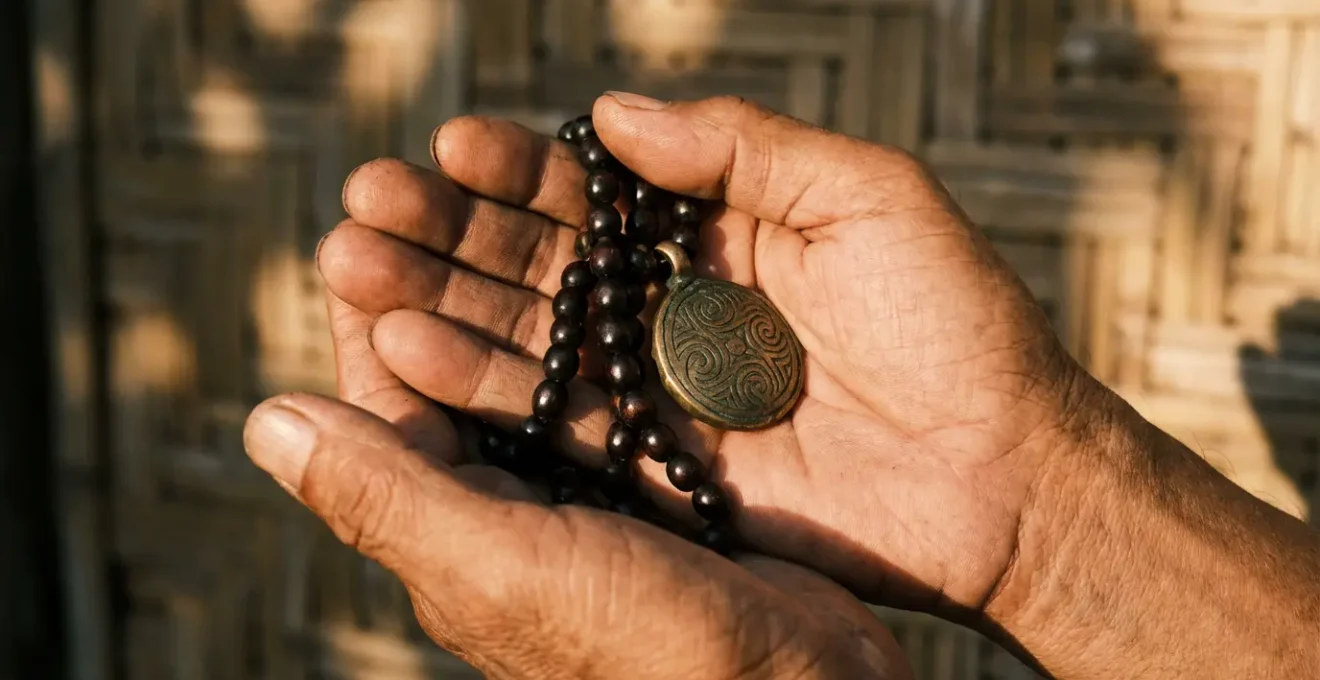
The common sight of a Filipino wearing a pagan anting-anting amulet with a Catholic rosary is often dismissed as mere superstition. This view misses the point entirely. This combination is not a contradiction but a sophisticated spiritual strategy. Filipinos often view both objects as compatible ‘power conduits,’ layering animistic protection with divine grace in a unified system of belief where all spiritual energy can be negotiated and channeled.
Gaze at the rearview mirror of a Manila jeepney, and you might see a Catholic rosary swaying gently, its crucifix catching the light. Look closer, and dangling beside it, you may find a small, curious bundle of cloth, a piece of wood etched with strange symbols, or a crocodile tooth tied with red string. This is the anting-anting, an animistic amulet. To the outside observer, this pairing seems like a profound contradiction: the sacred symbol of the world’s largest monotheistic faith alongside a talisman from a pre-colonial, polytheistic world. This juxtaposition is the key to understanding the intricate, layered, and deeply pragmatic soul of Filipino spirituality.
The easy explanation is to label it “folk Catholicism” or “syncretism” and move on. Many will simply say Filipinos are superstitious, blending old ways with the new. But this superficial take misses the elegant logic at play. This isn’t a confused jumble of beliefs; it is a coherent and powerful spiritual framework. It operates on a principle one might call spiritual stacking—the layering of different forms of power for a cumulative, amplified effect. The core of this belief system isn’t about choosing between two opposing faiths. Instead, it’s about seeing both the rosary and the anting-anting as valid conduits to a universal spiritual economy, where divine grace and elemental forces can both be accessed for protection and blessing.
This article delves into this fascinating symbiosis. We will not treat these beliefs as relics, but as a living, breathing part of the culture. We will explore the animistic foundations that give objects power, understand the profound role of Catholic icons, witness how these forces merge in sacred marketplaces, and see how historical layers have shaped this unique spiritual landscape. By the end, you will see the anting-anting and the rosary not as rivals, but as partners in a uniquely Filipino quest for guidance and protection in a complex world.
This guide will navigate the intricate tapestry of Filipino faith, revealing the logic that binds the cross and the talisman together. Below is a summary of the key facets we will explore to illuminate this spiritual duality.
Summary: The Filipino Symbiosis of Amulets and Faith
- Santo Niño: Why Is the Child Jesus the Most Celebrated Icon?
- The Mistake of Pointing at Trees at Night in Rural Provinces
- Siquijor Healers: How to Distinguish a Real “Albularyo” from a Scammer?
- Quiapo Church: How to Navigate the Crowds of Devotees on a Friday?
- Spanish vs. American Influence: Which Is More Visible in Modern Manila?
- Chinese Cemetery in Manila: Is It Respectful to Tour the Mausoleums?
- Siquijor vs. Camiguin: Which Mystical Island Offers Better Adventure?
- Sinulog vs. MassKara: Which Festival Offers the Best Street Photography?
Santo Niño: Why Is the Child Jesus the Most Celebrated Icon?
To understand why a physical object like an anting-anting holds power, one must first grasp how Filipinos perceive power in Catholic iconography. Nowhere is this more evident than in the fervent devotion to the Santo Niño, or Child Jesus. While the suffering Christ on the cross is a central Catholic figure, it is the royally adorned, child-like Santo Niño that captures the nation’s heart. This is because the Santo Niño is not just a symbol of innocence; He is seen as an approachable, miraculous, and powerful king. He is a divine figure you can have a personal relationship with, one who grants petitions and performs miracles. This intense focus on a physical statue is a direct bridge from pre-colonial animistic beliefs.
In his writings on the topic, Filipino author and parapsychologist Jaime Licauco explains this foundation perfectly. He notes that the “Filipino belief system is primarily animistic in nature… our people already believed that objects found in nature are alive and have certain magical powers. Such animist beliefs did not cease with the advent of Christianity.” This animistic lens was simply refocused onto Catholic icons. The Santo Niño, Magellan’s gift to Rajah Humabon’s wife in 1521, became the ultimate power object. Devotion to it isn’t just abstract faith; it’s a belief in the tangible, miraculous power residing within that specific icon. This makes sense in a country that is, as documented by Catholics & Cultures research, the third-largest Catholic nation in the world. The rosary, therefore, is not just a prayer counter; it is a physical conduit to the power of Mary and Jesus, just as the Santo Niño statue is a vessel of divine energy.
The Mistake of Pointing at Trees at Night in Rural Provinces
If the rosary and Santo Niño represent the channel to divine Catholic power, the anting-anting taps into an older, more terrestrial source: the spirits of nature. In rural provinces, elders will quickly chastise a child for pointing a finger at a large, old tree, especially a Balete (banyan) tree, after dusk. This is not a quaint folk tale; it is a sign of deep respect for another realm. Pointing is seen as a disturbance, an act that could offend the unseen residents, or engkanto, that dwell within. These spirits are believed to be powerful, capable of bestowing boons or inflicting illness and misfortune. The world is alive, and one must navigate it with care.
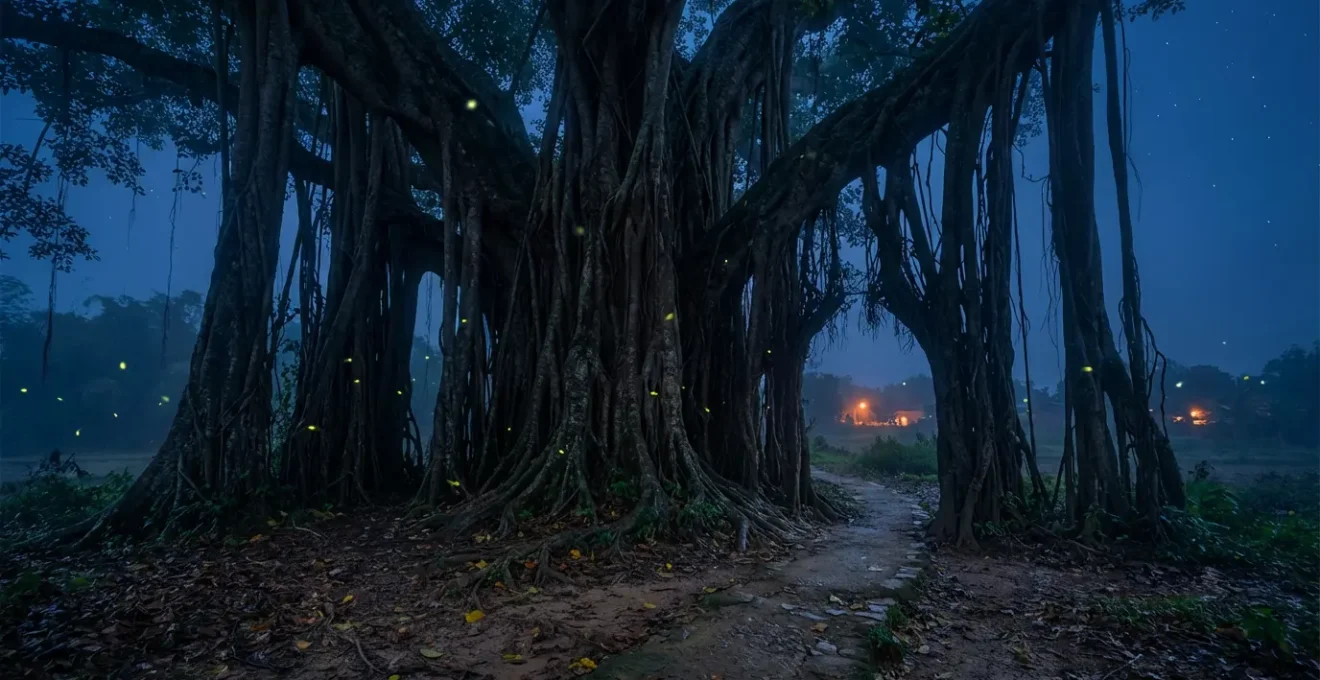
This worldview is the second half of the spiritual equation. The anting-anting is a tool of negotiation and protection within this spirit-filled environment. It might be made from a piece of the sacred tree itself, a stone from a blessed river, or inscribed with prayers designed to shield the wearer from malevolent engkanto or to gain favor from benevolent ones. As scholar Rhoderick V. Nuncio observes, folk religiosity among Filipinos can be generalized as a syncretic blending of these pre-colonial beliefs with the Catholic faith. It is not that one replaced the other; they fused. A Filipino might pray to God for salvation in the afterlife while wearing an anting-anting to protect them from a disgruntled earth spirit on their walk home. It is a holistic approach to security, covering both the divine and the elemental, the spiritual and the physical.
Siquijor Healers: How to Distinguish a Real “Albularyo” from a Scammer?
The island of Siquijor, known as the “Mystic Island” of the Philippines, is the epicenter of these living traditions. Here, the knowledge of anting-anting and the engagement with the spirit world are not just folklore but a specialized practice, managed by traditional healers known as albularyo. For the cultural explorer, seeking out an albularyo can be a profound experience, but it also carries the risk of encountering commercial opportunists preying on the island’s reputation. Distinguishing an authentic spiritual practitioner from a scammer is essential, not just for the visitor’s sake, but out of respect for the tradition itself. Authenticity lies in purpose and practice, not in flashy signs or fixed price lists.
A genuine albularyo is a community figure, whose reputation is built on generations of trust, not on tourism advertising. Their practice is rooted in a desire to heal and restore balance, a mission that is fundamentally spiritual, not commercial. This reality is deeply intertwined with the nation’s broader religious identity, where research shows that 78.81% of Filipinos, who are predominantly Catholics, frequently blend these traditional healing modalities with their mainstream faith. An authentic healer understands this blend and works within it. They are not an alternative to the church, but a complementary specialist for ailments and issues the priest may not address. The most potent anting-anting are often “charged” with prayers that mix local dialects, Latin-sounding phrases (orasyon), and Catholic invocations, a perfect microcosm of the syncretic belief system.
Your Action Plan: Identifying an Authentic Albularyo
- Observe if the healer operates on a donation-based ‘paga-abot’ system rather than fixed prices. Authentic healers frame their practice as a spiritual exchange, not a commercial transaction.
- Watch for dedication to diagnostic rituals like ‘tawas’ (divination using molten wax). Legitimate healers spend significant time identifying the root causes of an ailment rather than jumping to generic solutions.
- Verify community integration by asking locals, “Who does the community trust for healing?” rather than looking for signs or advertisements. Genuine healers build organic reputations over generations.
Quiapo Church: How to Navigate the Crowds of Devotees on a Friday?
If Siquijor is the quiet, rural heart of mysticism, then Quiapo in Manila is its loud, chaotic, and commercial soul. The area surrounding the Minor Basilica of the Black Nazarene is a sprawling spiritual marketplace, especially on Fridays, the traditional day of devotion. Here, the blending of animism and Catholicism is on full, vibrant display. Outside the church where thousands of devotees flock to touch a replica of the miraculous Black Nazarene statue, vendors line the streets selling not just rosaries and prayer books, but a staggering array of anting-anting. You can find amulets for protection, love potions (gayuma), talismans for business success, and items to ward off evil spirits, all sold within the shadow of a major Catholic shrine.
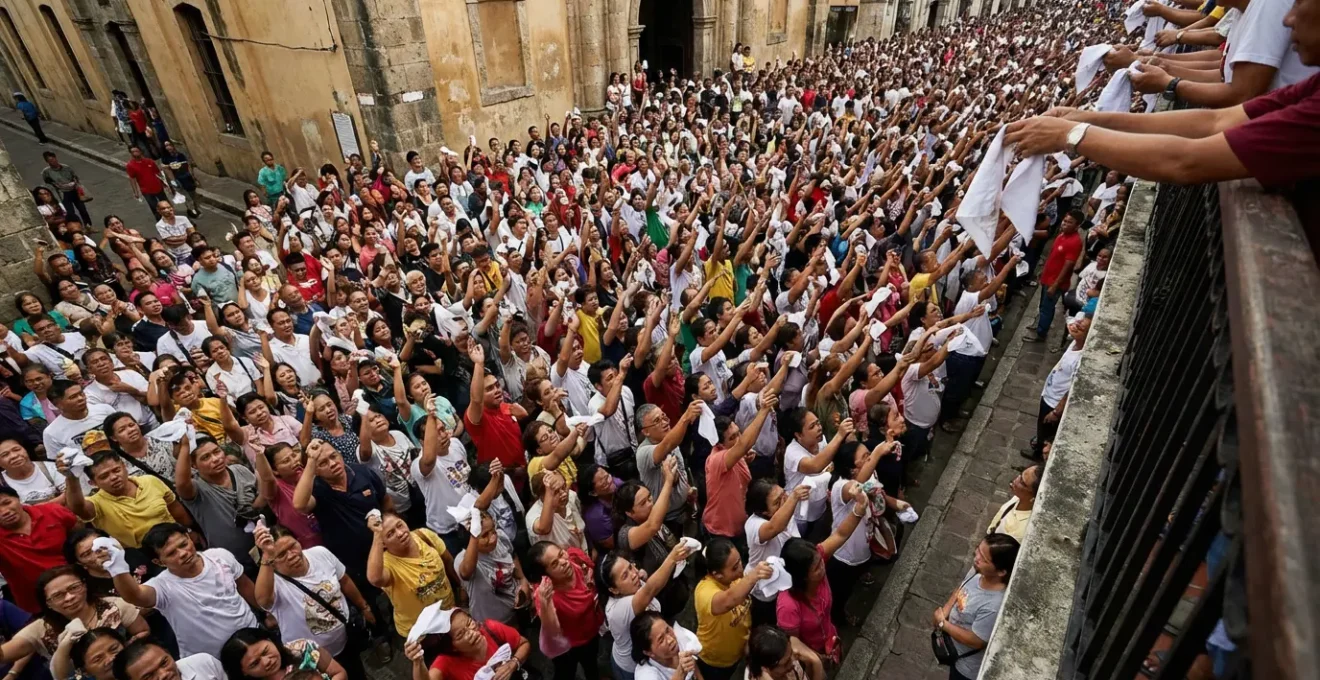
This is not seen as a contradiction. As noted by anthropologist Dr. Michael L. Tan, this is about pragmatism and access to power. He states that anting-anting, with their mix of Catholic imagery and arcane inscriptions, represent ” negotiations on accessing that powerful God, or at least Jesus, or the Virgin Mary, or the saints.” In the Filipino spiritual economy, all power ultimately flows from a divine source, but there are many different conduits. The Black Nazarene is one powerful channel; an anting-anting blessed with an orasyon is another. A devotee navigating the dense Friday crowds might buy a candle to light inside the church and an amulet from a street vendor to put in their pocket. It is, once again, spiritual stacking: covering all bases and utilizing all available channels to petition for grace and protection.
Spanish vs. American Influence: Which Is More Visible in Modern Manila?
The spiritual landscape of the Philippines is a direct product of its layered colonial history. The “stacking” of beliefs mirrors the stacking of foreign influences, primarily from Spain and the United States. To understand modern Manila is to learn to see both influences, often coexisting in the same city block. The Spanish colonial period (1521-1898) was defined by the sword and the cross, leaving an indelible Catholic mark on the archipelago. This period gave the Philippines its religion, the plaza-church urban layout, thousands of Spanish loanwords in its languages, and a deep-seated, family-centered sense of piety. The rosary is a direct artifact of this era.
The subsequent American period (1898-1946) brought a different kind of influence. It was more secular, introducing a public education system, the English language, democratic ideals, and a wave of consumerism. The Americans brought Protestantism, which grew steadily, but they did not supplant the Catholic foundation. Instead, they built a modern, commercial, and English-speaking layer on top of the Spanish-Catholic base. This colonial history explains why a Filipino might conduct a business meeting in fluent English (American influence) in a building in Makati, then go home to a neighborhood fiesta celebrating a patron saint (Spanish influence). The anting-anting, the pre-colonial, animistic layer, was never erased by either; it simply adapted, surviving underneath both colonial structures and continuing to inform the Filipino worldview.
The following table breaks down the most visible legacies of these two colonial powers, illustrating how both shaped the modern Filipino identity.
| Aspect | Spanish Influence (1521-1898) | American Influence (1898-1946) |
|---|---|---|
| Religion | Catholicism – Foundational to national identity | Protestant denominations & secularism growth |
| Language | Thousands of integrated Tagalog loanwords | English proficiency & Taglish code-switching |
| Architecture | Bahay na bato structure, plaza-church layout | Art Deco buildings, Burnham urban planning |
| Education | Religious instruction focus | Public education system establishment |
| Values | Family-centered, religious devotion | Democratic ideals, consumerism |
Chinese Cemetery in Manila: Is It Respectful to Tour the Mausoleums?
To complicate the spiritual tapestry even further, the blend is not just a binary of animism and Catholicism. Significant influence from Chinese culture adds another rich layer, particularly visible in the heart of Manila. The Chinese Cemetery is a stunning example—a city within a city, where the dead reside in “ghost mansions” complete with air conditioning, running water, and fully furnished interiors. To an outsider, touring these elaborate mausoleums might feel voyeuristic or disrespectful. However, approaching it with the right mindset reveals another facet of Filipino syncretism.
This practice is a blend of Catholic burial traditions and Confucian filial piety. The luxurious accommodations are not a display of wealth but an expression of providing comfort for deceased family members in the afterlife, a core Confucian value. As the Asia Society notes in its analysis of Philippine religions, the influential Chinese minority has colored Filipino Catholicism with elements of Buddhism and Taoism. This can be seen in the burning of incense and “ghost money” at gravesites, practices adopted from Chinese folk religion to honor ancestors alongside Catholic prayers. Visiting the cemetery is respectful if one behaves not as a tourist in an attraction, but as a visitor in a unique neighborhood. Engaging with the caretakers (katiwala) and understanding the architecture as an act of love rather than opulence transforms the experience from spectacle to cultural immersion. It shows, once again, the Filipino capacity to absorb and integrate different spiritual logics into a cohesive whole.
Key Takeaways
- Animistic Foundation: Pre-colonial beliefs in object-based power were never erased; they were integrated, providing the logic for why physical items like amulets and icons hold power.
- Spiritual Stacking: The rosary and anting-anting are not contradictory but are seen as complementary tools used to layer divine grace (from Catholicism) with elemental protection (from animism).
- Living Tradition: This syncretism is not a historical relic but a vibrant, living practice visible everywhere from rural healers in Siquijor to the bustling spiritual markets of Quiapo.
Siquijor vs. Camiguin: Which Mystical Island Offers Better Adventure?
For the cultural explorer wishing to experience the Philippines’ mystical side firsthand, two islands in the Visayas stand out: Siquijor and Camiguin. While both are steeped in folklore and natural beauty, they offer fundamentally different types of adventure, reflecting the dual sources of spiritual power discussed throughout this article. Choosing between them depends on what kind of mystery you seek: the human-centric magic of healers and shamans, or the raw, elemental power of nature itself.
Siquijor offers an anthropocentric mystique. Its fame is built on the stories of its human practitioners: the albularyo who heal, and the sorcerers (mangkukulam) who supposedly curse. An adventure here is a shamanic journey, a quest to interact with the keepers of ancient knowledge, seek a traditional diagnosis, or acquire a blessed anting-anting. The island’s power is channeled through people. Camiguin, the “Island Born of Fire,” offers a geocentric mystique. Its power is elemental, stemming from its seven volcanoes. The adventure here is one of exploration: climbing volcanic peaks, diving to the Sunken Cemetery reclaimed by the sea after an eruption, and feeling the raw energy of a landscape that is constantly being shaped by immense geological forces. The island’s magic is in its very earth and water.
The choice between the two is a choice between two sides of the Filipino spiritual coin, as detailed in this comparative overview.
| Aspect | Siquijor | Camiguin |
|---|---|---|
| Mystique Type | Anthropocentric & Dark – Human magic, healers, sorcerers | Geocentric & Elemental – Volcanic power, nature-reclaimed spaces |
| Adventure Style | Shamanic Journey – Seeking healers, rituals, spirit boundaries | Explorer’s Adventure – Volcano climbing, sunken cemetery diving |
| Key Souvenirs | Love potions, protective amulets (anting-anting) | Pastel de Camiguin (sweet bun) |
| Tourism Draw | Traditional healers, anting-anting makers | Natural wonders, volcanic landscapes |
Sinulog vs. MassKara: Which Festival Offers the Best Street Photography?
The personal, internal act of “spiritual stacking” finds its ultimate external expression in the Philippines’ massive public festivals. For a cultural explorer, especially one with a camera, these events are unparalleled opportunities to witness the nation’s soul on display. Two of the most famous, Sinulog in Cebu and MassKara in Bacolod, offer spectacular but very different photographic narratives. While both are vibrant street spectacles, they spring from different aspects of the Filipino psyche: one from pure religious ecstasy, the other from defiant resilience.
Sinulog is a direct line to the heart of Filipino Catholicism. It is a devotional festival honoring the Santo Niño, and its photographic story is one of collective faith. The key shots are epic-scale images of massive crowds moving as one, portraits of devotees lost in a prayerful trance, and the vibrant red and gold colors of the Santo Niño’s vestments reflected everywhere. The narrative is about the overwhelming power of shared belief. MassKara, on the other hand, was born from tragedy—a ship sinking and a sugar industry crisis. Its name means “many faces,” and it is a festival of defiant resilience. The photographic story is about the triumph of the human spirit. The key shots are intimate portraits of individual masked performers, the explosion of every color imaginable on their costumes, and the powerful contrast between the smiling masks and the often-somber story behind the festival’s origin. The narrative is about finding joy in the face of hardship.
For the photographer, the choice depends on the desired story: the epic scale of divine worship or the intimate portrait of human strength.
| Element | Sinulog (Cebu) | MassKara (Bacolod) |
|---|---|---|
| Photography Focus | Spiritual ecstasy & collective faith | Defiant resilience & triumph over tragedy |
| Color Palette | Red & yellow of Santo Niño vestments | Explosion of every color imaginable |
| Subject Interaction | Vast crowds, devotees in prayer | Individual masks, direct camera engagement |
| Narrative | Religious devotion, trance dancing | Story behind the smile, contrast with dark history |
| Best Shots | Epic crowd movements, collective worship | Intimate portraits, masked performers |
Ultimately, the anting-anting and the rosary are two threads woven into the same magnificent, complex tapestry. They represent a spiritual worldview that is inclusive, pragmatic, and profoundly resilient. It is a system that has absorbed centuries of change without losing its ancient echoes. To truly experience this living culture, move beyond simple observation and start looking for these fascinating points of spiritual connection on your next journey through the Philippines.