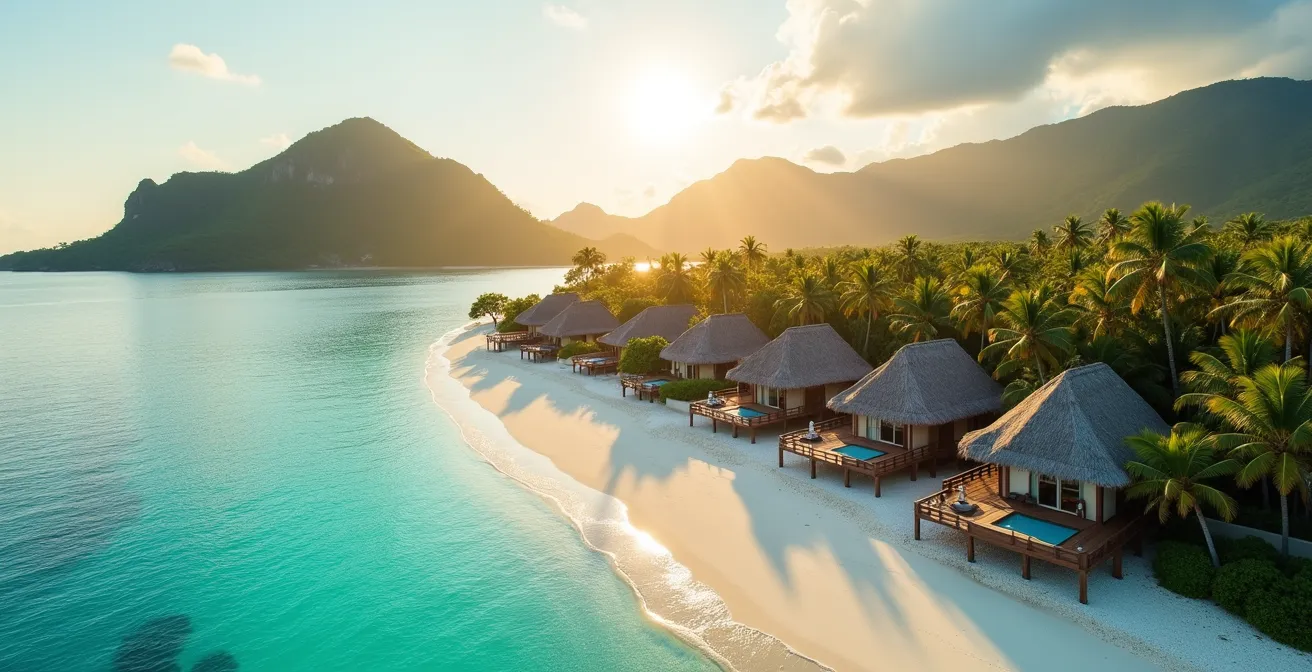
The higher price of Philippine luxury resorts is not a market inefficiency but a deliberate design choice rooted in “programmatic luxury.”
- This model engineers exclusivity through high-friction access (costly transfers), curated cultural narratives, and a deeply personalized service ethos.
- Unlike Thailand’s volume-driven luxury, the Philippine premium is the price of guaranteed privacy, authentic cultural immersion, and a service philosophy that transcends simple transactions.
Recommendation: Evaluate these resorts not on a simple cost-per-night basis, but on the comprehensive value of the “programmed” experience they deliver, from logistical filters to cultural depth.
The discerning affluent traveler, mapping out a Southeast Asian sojourn, inevitably confronts a puzzling discrepancy: why does a top-tier private villa in Palawan command a significantly higher price than a comparable property in Phuket? The immediate conclusion often points to logistical complexities or market immaturity. Common refrains about the Philippines’ 7,000 islands driving up transport costs or Thailand’s more developed tourism infrastructure creating competitive pricing are frequently cited. While containing elements of truth, these explanations are superficial; they address the “what” but completely miss the “why.”
This analysis moves beyond these platitudes. The price disparity is not a bug; it is a feature. It is the visible outcome of a fundamentally different philosophy of hospitality, one we can term “Programmatic Luxury.” This model architects exclusivity not merely through opulent amenities, but through a structured series of filters, experiences, and service interactions designed to deliver a qualitatively different, and therefore more valuable, form of escape. The premium you pay is for an engineered ecosystem of privacy and personalization, a stark contrast to the more accessible, volume-oriented luxury model prevalent in many parts of Thailand.
This guide will deconstruct the components of this programmatic luxury. We will explore how privacy is not just found but manufactured, how booking hurdles and transfer fees are deliberate gatekeepers, and how the very soul of a resort is tied to its cultural and narrative depth. Understanding this framework is the key to accurately evaluating the true value proposition of high-end Philippine hospitality.
This article provides a detailed breakdown for the sophisticated traveler, exploring the structural elements that define the luxury resort experience in the Philippines. The following sections will guide you through the key considerations, from privacy and booking strategies to understanding the cultural nuances of service.
Summary: Decoding the Premium of Philippine Luxury Hospitality
- Beachfront Villa vs. Overwater Bungalow: Which Offers Better Privacy in El Nido?
- How to Secure a Reservation at Amanpulo Without Booking a Year Ahead?
- The Hidden Transfer Fees That Can Add $500 to Your Resort Bill
- How to Upgrade Your Resort Package for Free Upon Arrival?
- When to Book Luxury Resorts to Experience Private Cultural Galas?
- How to Request a Room That Is Actually Soundproof in Manila?
- Tipping Etiquette: When to Tip Like an American and When to Hold Back?
- Chain Hotel vs. Boutique Heritage: Which Luxury Stay in Manila Has More Soul?
Beachfront Villa vs. Overwater Bungalow: Which Offers Better Privacy in El Nido?
In the lexicon of luxury travel, “privacy” is the ultimate commodity. In El Nido, this isn’t left to chance; it’s a product of geography, design, and stringent environmental regulation. The choice between a beachfront villa and an overwater bungalow is not merely aesthetic but a strategic decision in what we call Engineered Privacy. Philippine coastal laws often mandate a significant 25-meter setback from the high-tide line, a regulation that inadvertently creates a natural and legally enforced buffer zone for beachfront villas, enhancing both acoustic and visual seclusion.
Beachfront villas, often elevated and screened by mature vegetation, offer superior acoustic insulation. The sound of waves masks conversations, and the distance between units is dictated by land, not by the costly-to-build stilts over water. Conversely, overwater bungalows, while offering dramatic, uninterrupted sea views, face a privacy paradox. Sound travels remarkably well over water, and the linear arrangement of bungalows can expose them to neighbors and, more significantly, to passing boat traffic. What one gains in direct water access, one may lose in true seclusion.
The following table, based on an analysis of El Nido’s top resorts, quantifies these privacy trade-offs. It illustrates how factors like tidal changes and building codes contribute to the perceived value of each accommodation type.
| Privacy Factor | Beachfront Villa | Overwater Bungalow |
|---|---|---|
| Acoustic Privacy | Superior – Natural foliage buffer, 20+ meters from neighbors | Moderate – Water carries sound, 10-15 meters spacing |
| Visual Privacy | High – Screened by vegetation, elevated position | Variable – Open water views but exposed to boats |
| Tidal Impact | Gains 50-100m private beach at low tide | No change – Consistent water separation |
| Boat Traffic Exposure | Minimal – Set back from waterline | High – Direct exposure to passing vessels |
| Conservation Compliance | Mandatory 25m coastal setback creates forced privacy | Built over reef protection zones |
Case Study: Cauayan Resort’s Privacy Design
Cauayan Resort exemplifies how El Nido’s environmental regulations shape privacy design. The property, which opened in 2016 on its own private island, offers luxurious stilted wooden villas, some with plunge pools. The placement of these villas is a masterclass in leveraging regulatory constraints for guest benefit. They are strategically positioned to maximize both acoustic and visual separation, complying with coastal protection mandates while creating a superior sense of seclusion that justifies its premium positioning for a well-heeled clientele.
How to Secure a Reservation at Amanpulo Without Booking a Year Ahead?
The infamous difficulty of securing a reservation at a resort like Amanpulo is a prime example of High-Friction Access. This perceived obstacle isn’t a flaw in their booking system; it is the system working as intended. It acts as a primary filter, ensuring that the guest roster remains exclusive and the on-island experience remains uncrowded. However, for the strategic traveler, this system contains predictable loopholes and backdoors. The key is not to try and book earlier, but to book smarter by targeting specific windows and leveraging professional networks.
The most effective strategy involves targeting “soft spot” windows. These are brief periods, typically one to two weeks immediately following major international holidays like New Year’s or the Philippines’ Holy Week. The primary wave of travelers has departed, but the resort’s service levels and staffing remain at peak capacity, creating a window of opportunity with higher availability. Another powerful tactic is to engage a senior travel agent from a top-tier consortium like Virtuoso or Signature. These agents have direct lines to resort management and often have access to inventory blocks held back from public booking channels.
For those willing to be more proactive, directly contacting the resort’s reservation manager to join a waitlist for last-minute releases of signature villas (often held for VIPs) can yield surprising results, typically within a 7-14 day advance window. These strategies transform the booking process from a game of chance into a calculated exercise in strategic timing and relationship management, with villa rates varying from ₱70,874 to ₱419,787 per night based on these very factors. Booking shoulder seasons like May-June or September-October also provides a distinct advantage, offering a superb balance of ideal weather and better availability.
Your Action Plan: Insider Strategies to Book Amanpulo
- Target ‘Soft Spot’ Windows: Aim for the second week of January or the week after Holy Week, when the holiday rush has subsided but service is still at its peak.
- Leverage Travel Consortium Seniority: Partner with a Virtuoso or Signature agent who has established relationships and can access reserved room blocks.
- Monitor VIP Holdback Releases: Contact the reservation manager directly to be placed on the 7-14 day notification list for signature villas that become available.
- Use Shoulder Season Advantage: Focus on May-June and September-October for a combination of great weather and higher availability.
- Consider Package Deals: Inquire about multi-night stay packages, as they sometimes have better availability than standard single-night bookings and include valuable credits and experiences.
The Hidden Transfer Fees That Can Add $500 to Your Resort Bill
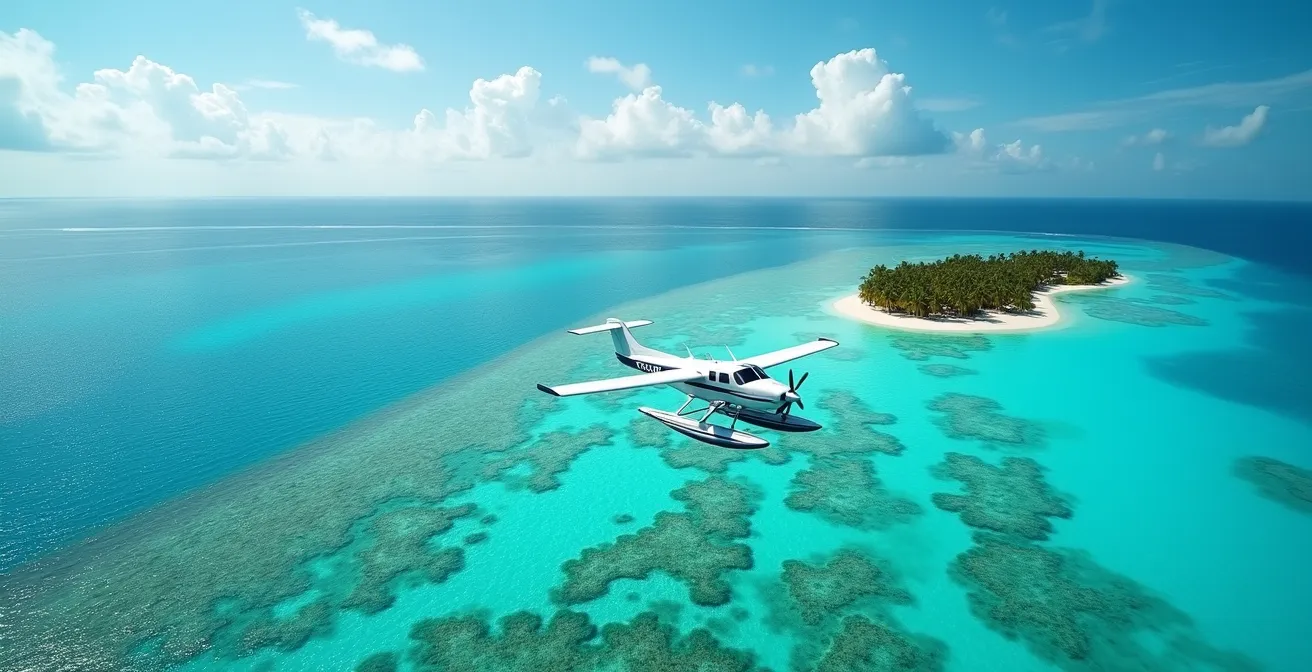
The sticker shock of mandatory resort transfers in the Philippines is another core component of the “Programmatic Luxury” model. A fee that can easily exceed $500 per person is not an ancillary charge; it’s a fundamental part of the value proposition, acting as a significant financial barrier that maintains the destination’s exclusivity. For instance, the journey to Amanpulo requires a transfer from Manila via a private plane, with return flight transfers costing US$660 per adult. This is not an optional add-on; it is an integral, non-negotiable part of the arrival experience.
This cost, while substantial, is not arbitrary. It is a composite of several high-value components. The primary expense is the seat on a private charter, typically a 14-seat turboprop aircraft, which offers a level of convenience and privacy impossible on a commercial flight. This is followed by island landing fees, which contribute to the maintenance and operation of a private airstrip—a massive infrastructural cost. Furthermore, there are stringent luggage restrictions, often around 20kg per adult, with significant charges for excess baggage, further filtering the type of travel. The final leg of the journey, the transfer from the airstrip to your specific villa, is usually included but represents the last mile of a complex and expensive logistical chain.
Understanding this breakdown is crucial. It reframes the fee from a mere “cost” to an investment in a seamless, secure, and exclusive transit experience. It is the price of bypassing crowded airports, long security lines, and unpredictable commercial schedules. For the resorts, it’s a way to control the entire guest journey from city to beachfront, ensuring their standard of service begins the moment you check in for your private flight, not when you arrive, flustered, at the resort lobby.
How to Upgrade Your Resort Package for Free Upon Arrival?
The classic travel hack of seeking a “free upgrade” upon arrival is a mindset rooted in a transactional, tiered model of luxury. In the context of the Philippines’ most elite resorts, this approach is not only often ineffective but misses the point entirely. The pinnacle of “Programmatic Luxury” isn’t about getting a better room; it’s about entering an ecosystem where the concept of an “upgrade” is obsolete because the standard package is already all-encompassing.
The pursuit of a free upgrade presupposes a hierarchy of experience that the best resorts aim to eliminate. They operate on a principle of inclusive excellence, where the goal is to provide every guest with the best possible experience from the outset, rather than upselling them at every turn. Asking for an upgrade in this environment can be seen as a misunderstanding of the resort’s core philosophy. The value is not in a marginal improvement of your view, but in the seamless integration of all activities, dining, and services into a single, worry-free package.
This all-inclusive philosophy represents a more advanced, and ultimately more relaxing, form of luxury. It removes the mental burden of constant decision-making and cost-benefit analysis. You are not a customer navigating a menu of options; you are a guest in a private home, where everything is at your disposal. The real “upgrade” is the shift from a transactional relationship to a truly experiential one. This is the new standard that redefines what a premium hospitality experience can be.
Case Study: The Nay Palad Hideaway All-Inclusive Philosophy
Nay Palad Hideaway in Siargao is a perfect illustration of this paradigm shift. The resort operates on a sophisticated all-inclusive basis, where the initial price point combines all tours, water sports, spa treatments, and world-class dining and drinking into a single, comprehensive fee. This model effectively eliminates the need for upgrades. By including what other resorts would classify as premium, add-on experiences as standard, Nay Palad delivers a truly worry-free and high-value experience. This approach sets a benchmark for modern luxury hospitality in the region, focusing on holistic guest satisfaction rather than tiered service levels.
When to Book Luxury Resorts to Experience Private Cultural Galas?
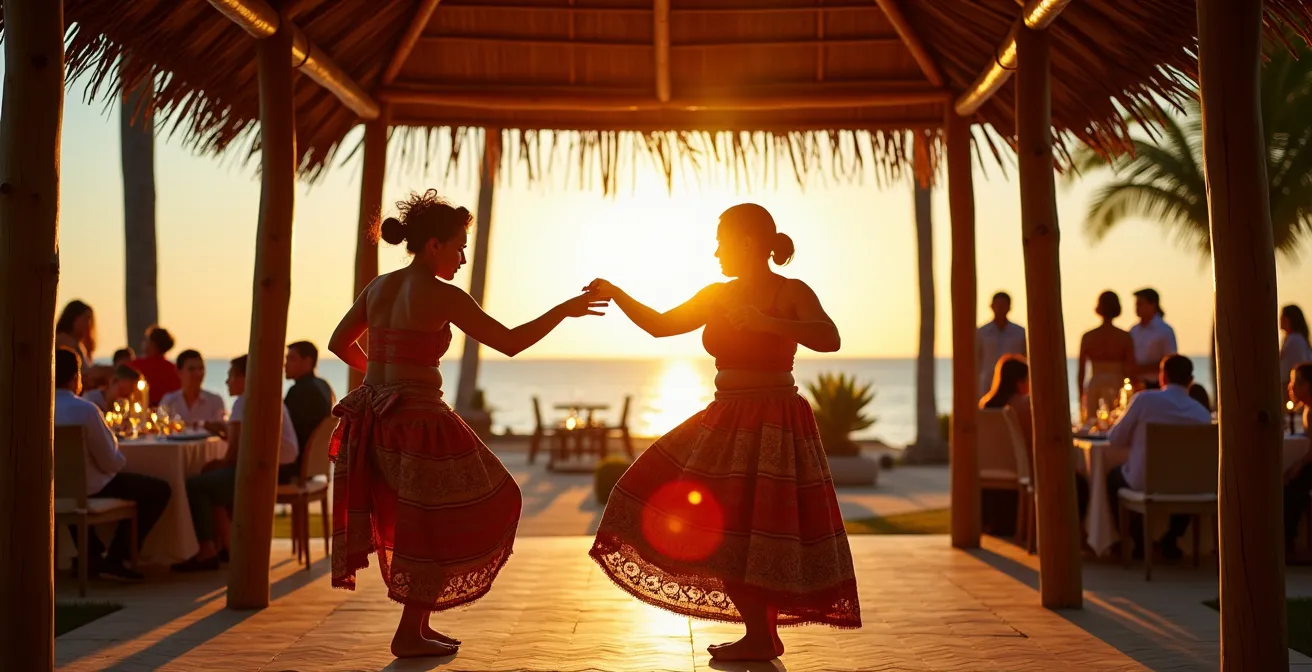
The most sophisticated form of luxury travel transcends physical amenities and moves into the realm of unique, time-sensitive experiences. For discerning travelers in the Philippines, this means timing a visit to coincide with exclusive, resort-hosted cultural galas. These are not the generic “cultural nights” found in mass-market hotels but meticulously curated private events showcasing the pinnacle of Filipino arts, music, and dance for a very limited audience. This is where Narrative Density—the depth of the story a place tells—becomes a tangible asset.
Booking for these events requires a different calendar. Forget high season versus low season; the key is to align your travel with the local festival calendar and the resort’s own programming schedule. Major national festivals like Sinulog (January), Ati-Atihan (January), and MassKara (October) often inspire resorts to host their own elevated, private versions of these celebrations. The best strategy is to join the resort’s mailing list or establish contact with their concierge months in advance to inquire about their planned cultural programming. Booking during these specific, often narrow, windows is the only way to access these unique convergences of luxury and culture.
The robust post-pandemic demand for such authentic experiences is clear. The Philippine Department of Tourism reported that tourism revenues achieved a 126.75% recovery rate from pre-pandemic levels in early 2024, a testament to the powerful draw of the country’s unique cultural offerings. This surge indicates that travelers are increasingly willing to pay a premium not just for a beautiful beach, but for a meaningful connection to the local culture, making access to these private galas one of the most sought-after luxuries.
How to Request a Room That Is Actually Soundproof in Manila?
In a bustling metropolis like Manila, true luxury is not a larger suite, but silence. Achieving this requires a proactive, informed strategy that goes far beyond a simple “quiet room, please” request at check-in. It involves applying the principles of “Programmatic Luxury” to an urban environment, using specific language and geographic intelligence to secure a truly soundproof sanctuary. The goal is to insulate yourself not just from street noise, but also from the internal operational noise of the hotel itself.
Your request must be specific and layered. First, specify the *types* of noise to avoid: ask for a room insulated from both “street noise” (requiring a high floor or inner courtyard-facing view) and “internal noise” (meaning away from service elevators, ice machines, and housekeeping stations). Second, use blueprint intelligence. A quick study of the hotel on Google Maps’ satellite view can reveal which side of the building faces away from major thoroughfares like EDSA or Ayala Avenue, and which faces a quieter side street or park. Third, request “structural buffer zones” by asking for a room directly below the Club Level or a floor of suites, as these floors often feature superior construction and insulation.
Referencing specific hotel geography demonstrates your savviness. For instance, when booking at the Conrad Manila, you might request a high-floor premier room with a bay view, knowing its position atop the S Maison retail complex provides a buffer from ground-level city clamor. The Conrad is a prime example of strategic design, where its luxurious spa and infinity pool are positioned to leverage views while minimizing noise exposure. Ultimately, the most effective strategy is to leverage premium floor benefits, as executive lounges are almost always situated on quieter, better-insulated floors, making any room on that level a better bet for tranquility.
Your Action Plan: Manila Hotel Soundproofing Request Strategy
- Specify Noise Types to Avoid: Explicitly request a room insulated from both “street noise” and “internal noise” (service elevators, ice machines).
- Use Building Blueprint Intelligence: Use Google Maps to identify the hotel’s quiet-facing side, away from major avenues.
- Request Structural Buffer Zones: Ask for a room located directly beneath the Club Level or a suite floor, which typically have better soundproofing.
- Reference Specific Manila Geography: Mention your preference for a side of the hotel away from known traffic arteries like EDSA.
- Leverage Premium Floor Benefits: A room on the Executive or Club level is often inherently quieter due to its location and construction.
Tipping Etiquette: When to Tip Like an American and When to Hold Back?
In the Philippines, tipping transcends a simple financial transaction; it’s a deeply cultural act. Understanding when and how to tip is crucial for the sophisticated traveler, as it plugs directly into the local service philosophy. While a 10% service charge is often automatically added to bills in luxury resorts, this amount is typically pooled and distributed among all staff. It is a baseline compensation, not a reward for exceptional, personal service. The real art of tipping lies in understanding the concept of ‘utang na loob’, or a debt of gratitude.
A personal cash tip, given directly to an individual who has gone above and beyond, is an expression of this ‘utang na loob’. It creates a personal bond and acknowledges a service that exceeded the transactional. This is where a strategic, “American style” approach can be highly effective. A generous tip to the head concierge or your personal butler upon arrival isn’t just a reward for past service; it’s an investment in future access. This act ensures you receive priority for sought-after restaurant reservations, the best-located beach cabanas, or hard-to-get tour slots. Conversely, for general good service, a “spread the wealth” strategy is more appropriate: leave a single, larger amount with the front desk manager at checkout to be distributed among the wider staff.
For individual service providers not part of the core resort team, such as a babysitter, direct tipping is essential. The economic impact is significant; in a country where tourism supported 4.9 million jobs, or 13.8 percent of the labor force in 2024, direct tips are a vital part of service workers’ income. Knowing when to give a communal tip and when to give a personal, strategic one is the hallmark of a traveler who understands and respects the local culture.
Key takeaways
- The premium on Philippine luxury is by design, a “programmatic” approach creating value through engineered exclusivity.
- High-friction elements like booking complexity and transfer fees are not flaws but deliberate filters to enhance the guest experience.
- True luxury often lies in all-inclusive models that eliminate the concept of “upgrades” and in timing visits to access exclusive cultural events.
Chain Hotel vs. Boutique Heritage: Which Luxury Stay in Manila Has More Soul?
The final consideration for the affluent traveler in Manila is a choice between two distinct philosophies of luxury: the predictable, flawless execution of an international chain hotel versus the character-rich, narrative-driven experience of a boutique heritage property. This is not a question of which is “better,” but which delivers more of the intangible quality travelers often describe as “soul.” This “soul” can be quantified through a framework focusing on Narrative Density and Curatorial Specificity.
Major chain hotels like The Peninsula or Shangri-La offer a globally standardized promise of luxury. Their “soul” is rooted in brand history, flawless service predictability, and a sense of being part of an exclusive international club. The narrative is one of corporate excellence. A boutique heritage hotel, often a converted pre-war mansion or an estate with deep local roots, offers a different proposition. Its soul is derived from its unique story—the lives of its previous owners, its architectural significance, and its deep integration with the local neighborhood. The experience is curated with pieces from renowned local artisans like Kenneth Cobonpue, and the service, while perhaps less polished, is deeply personalized and characterful. This segment is a growing force in a market projected to reach USD 7.65 billion in 2025.
The choice depends entirely on the traveler’s goal. For a business trip where seamless efficiency is paramount, a chain hotel is often the superior choice. For a leisure trip where the goal is to connect with the authentic spirit of Manila, a boutique heritage hotel offers a far richer, more memorable experience. The “Soul Score” table below breaks down these differing value propositions.
| Soul Factor | Chain Hotels (Peninsula, Shangri-La) | Boutique Heritage Hotels |
|---|---|---|
| Narrative Density | Corporate history, global standards | Pre-war mansion stories, local legends |
| Curatorial Specificity | International luxury brands | Kenneth Cobonpue furniture, local artisans |
| Community Integration | Generic city tours, isolated luxury | Local historian tours, neighborhood connections |
| Service Predictability | Flawless, standardized globally | Characterful, personalized, sometimes imperfect |
| Market Share | Dominant in the NCR with high occupancy | Growing niche market |
Action Plan: Auditing a Hotel’s “Soul”
- Review the “About Us” Page: Does it tell a corporate history or a personal, place-based story? This is the first indicator of narrative density.
- Scan the Photo Gallery for Art & Furniture: Look for unique, locally sourced pieces (curatorial specificity) versus generic, mass-produced luxury decor.
- Examine the Concierge/Experiences Menu: Are they offering standard city tours or unique experiences led by local historians, artists, or chefs (community integration)?
- Read Guest Reviews Focusing on Service: Filter for terms like “personal,” “character,” or “knew my name” versus “efficient” and “professional” to gauge service style.
- Assess the Location on a Map: Is the hotel in a sterile business district or embedded in a historic, walkable neighborhood with local character?
By understanding the Philippines’ model of “Programmatic Luxury,” the discerning traveler can see beyond the price tag. The premium is not for the room itself, but for the meticulously engineered ecosystem of privacy, exclusivity, and cultural depth. To fully capitalize on this, the next step is to align your travel strategy with this philosophy, proactively shaping your experience rather than simply consuming it.