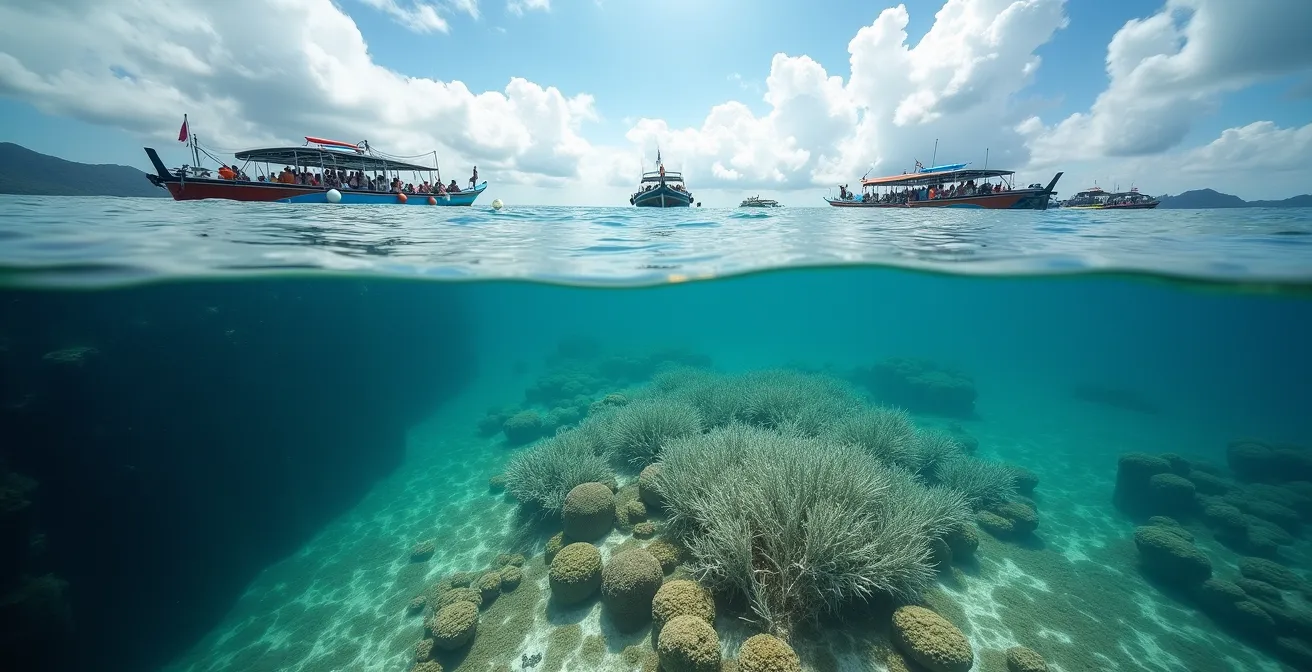
True sustainable travel in the Philippines goes beyond reusable straws; it requires actively challenging the tourism model that harms local communities and ecosystems.
- Many “eco-tours” are a form of greenwashing that exploit both wildlife and local guides.
- The most impactful trips are often slower, community-led, and prioritize cultural respect over a packed itinerary.
Recommendation: Shift your mindset from a consumer of experiences to an ally of the places and people you visit.
The image of the Philippines—pristine white-sand beaches, crystal-clear waters, and lush jungles—is a powerful lure for travelers. In response, a wave of “ecotourism” has emerged, promising guilt-free exploration of this paradise. You’ve likely heard the standard advice: pack a reusable bottle, say no to plastic bags, and don’t touch the wildlife. While well-intentioned, this advice barely scratches the surface. It places the responsibility on individual actions while ignoring the larger, more insidious systems at play.
The popular narrative often misses the deeper story of communities displaced for luxury resorts, of “eco-tours” that are little more than cleverly disguised wildlife exploitation, and of ancestral lands threatened by development. But what if the true purpose of a conscious traveler wasn’t just to leave no trace, but to leave a positive one? What if your trip could be an act of solidarity rather than consumption? This guide is built on that premise. It’s about dismantling the very idea of mass tourism by understanding its hidden costs and choosing a better way.
We will explore how to identify fraudulent eco-tours, weigh the real impact of your travel style, and understand the critical issues facing local and indigenous communities. By the end, you’ll have a framework for planning a trip that doesn’t just pass through the Philippines but actively contributes to its protection and the prosperity of its people.
Summary: Unpacking the Real Impact of Tourism in the Philippines
- How to Spot Fake Eco-Tours in Palawan Before Booking?
- Volunteering vs. Sightseeing: Which Impact Trip Suits Your 2-Week Stay?
- The Mistake That Harms Whale Sharks in Oslob Despite Guidelines
- How to Maintain a Zero-Waste Routine While Island Hopping for 10 Days?
- When to Visit Protected Areas: The Seasonal Calendar for Responsible Travelers
- Chocolate Hills vs. Taal Volcano: Which Geological Wonder is More Accessible?
- Why Are Some Ancestral Domains Closed to Tourists?
- The “Too Many Airports” Mistake That Ruins 10-Day Itineraries
How to Spot Fake Eco-Tours in Palawan Before Booking?
The term “ecotourism” has become a powerful marketing buzzword, but its widespread use has led to significant greenwashing. Many operators in popular destinations like Palawan simply rebrand standard adventure trips as “eco” without any meaningful commitment to sustainability. As University of Utah professor Kelly Bricker notes, “Unfortunately, there’s a lot of greenwashing still out there today. Programmes that claim to be ecotourism really are just nature-based or adventure travel.” This isn’t just misleading; it exploits both the environment and the traveler’s good intentions.
The problem became so prevalent that the Philippine government took notice. Concerns over greenwashing prompted the launch of an ecotourism tracking tool by the Department of Environment and Natural Resources to audit 32 initial sites. For a traveler, however, the challenge is to vet operators before booking. A genuinely sustainable tour prioritizes ecological integrity and community benefit over guaranteed sightings or close encounters. They operate in small groups, employ local guides who are paid fair wages, and contribute directly to conservation or community projects. A fake eco-tour is a transactional experience; a real one is a form of support.
Deconstructing a tour’s promises is the first step toward becoming an ally. Instead of taking claims at face value, a conscious traveler must become a detective, looking for red flags that reveal the truth behind the marketing. This critical approach ensures your money supports genuine conservation and not just a clever business model.
Action Plan: Red Flags for Greenwashing in Palawan
- Ask if tourists are allowed to touch or feed animals. Legitimate sanctuaries prohibit direct interaction, as this alters natural behaviors.
- Look for photos showing chains, small cages, or animals performing unnatural behaviors. These are signs of exploitation, not conservation.
- Verify eco-certifications. Check if they are officially recognized by the Department of Tourism or have partnerships with reputable NGOs like WWF or Green Destinations.
- Check hotel policies in practice. Does a hotel that claims to be “green” still replace linens daily or offer single-use toiletries? Look for reviews mentioning actual practices.
- Research reviews for mentions of overcrowding or “guaranteed” wildlife sightings. Ethical tours respect nature’s unpredictability and manage visitor numbers to minimize impact.
Volunteering vs. Sightseeing: Which Impact Trip Suits Your 2-Week Stay?
The desire to “give back” often leads travelers to consider volunteering. However, short-term “voluntourism” can sometimes be more disruptive than helpful, creating dependency or taking jobs from locals. A more sustainable and empowering alternative is emerging: Community-Based Ecotourism (CBET). This model moves beyond passive sightseeing and places local communities in control of the tourism experience, ensuring that the benefits—both financial and cultural—stay within the community.
A prime example is the Bojo River Ecotourism Association in Cebu. Before the project, the river and its mangroves were exploited for survival. Today, locals, particularly women, have been empowered as leaders and stewards. As one local woman stated in a report on the transformation of the Bojo River, “Ecotourism provides income and also empowers us women. Before, we were just at home…just waiting for our husbands to catch something before we could buy rice.” This project, awarded by the UN World Tourism Organization, demonstrates how tourism, when structured correctly, can be a powerful tool for conservation and social uplift.
For a traveler with a limited two-week stay, choosing a CBET experience over a conventional tour or a short-term volunteer placement offers a more profound impact. It is a direct investment in community sovereignty. Instead of just observing, you participate in a system designed by and for the local population, where your presence supports their long-term vision for their home. This is the difference between being a spectator and being a genuine guest.
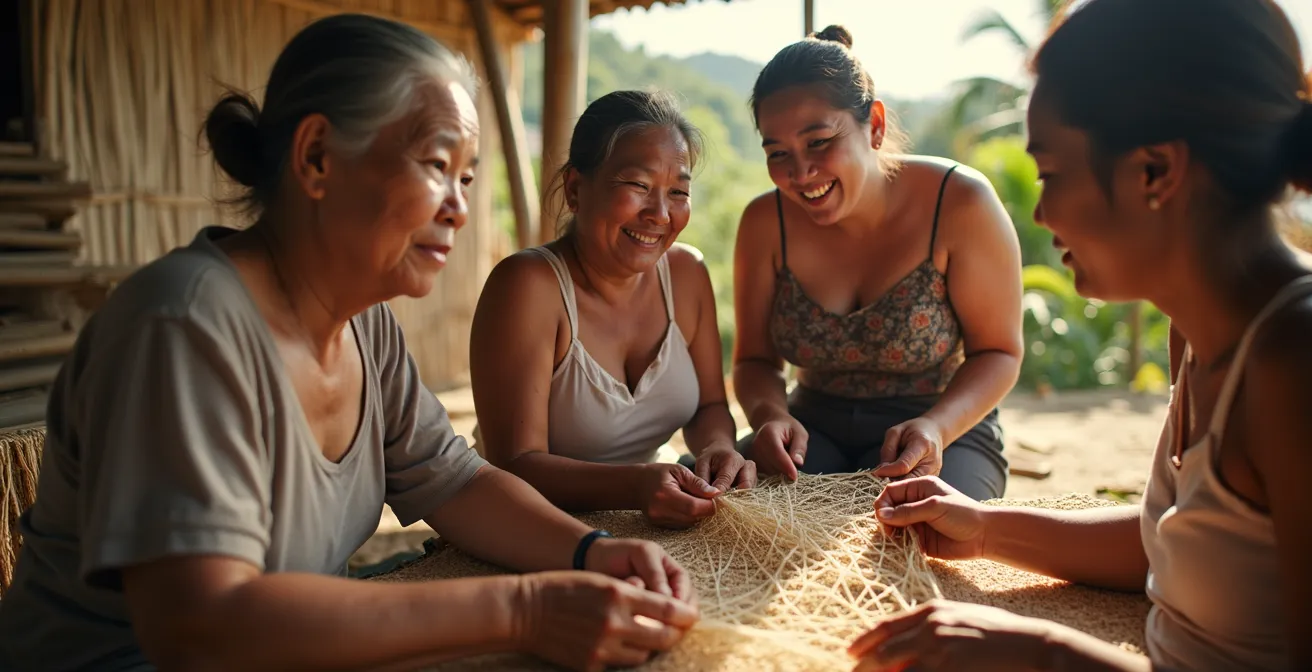
These interactions, built on respect and mutual learning, form the heart of true sustainable travel. They replace the fleeting thrill of sightseeing with the lasting fulfillment of genuine human connection and positive impact.
The Mistake That Harms Whale Sharks in Oslob Despite Guidelines
The whale shark encounters in Oslob, Cebu, are one of the most popular and controversial tourist attractions in the Philippines. While strict guidelines exist—maintain a minimum distance, no flash photography, no touching—the reality on the ground is starkly different. The core mistake travelers make is assuming that their individual actions don’t matter in the face of a massive, organized operation. They see hundreds of others and feel that their single transgression is insignificant.
This collective failure has a measurable impact. A long-term study showed the devastating effects of this mass non-compliance. The research found that an astonishing 93% of tourists violate the minimum distance rule, coming far too close to the animals. This isn’t just about breaking a rule; it’s about fundamentally disrupting the ecological integrity of a species. The sharks have become conditioned to associate boats and people with food, a modified behavior that can affect their natural migration and feeding patterns. They are no longer wild animals in their natural habitat, but performers in a marine circus.
The very system of provisioning—feeding the sharks to guarantee sightings—is the root of the problem. It creates a completely artificial environment where the sharks’ health and behavior are compromised for the sake of a photo opportunity. While some argue that the practice provides local income, it comes at an unacceptable ecological cost. Choosing to participate in this activity, even if you intend to follow the rules, directly funds and perpetuates a system that harms the very creatures you came to admire. The most responsible action a traveler can take in Oslob is to not participate at all, sending a clear message that such exploitative practices are not what conscious tourism looks like.
How to Maintain a Zero-Waste Routine While Island Hopping for 10 Days?
The challenge of avoiding single-use plastics can feel overwhelming when traveling through an archipelago like the Philippines, where convenience often comes in a sachet. However, maintaining a zero-waste ethos is not only possible but essential to protect the fragile marine environments you’re there to enjoy. The key is to shift from a mindset of individual responsibility to one of participating in a growing local movement.
Islands like Siquijor are leading the charge, striving to become the Philippines’ first zero-waste destination. Faced with a surge in tourism, the province took decisive action, passing an ordinance to ban styrofoam and regulate single-use plastics. As detailed in a report by Eco-Business, this initiative is a community-wide effort, with local government and NGOs working together to implement practical solutions. This proves that systemic change is possible, creating an environment where it’s easier for travelers to make sustainable choices.
For a 10-day island-hopping trip, this means preparing strategically and tapping into local systems. Instead of seeing it as a series of individual battles against plastic, view it as an opportunity to support businesses and communities that are part of the solution. Your choices have a ripple effect, signaling to vendors that there is a demand for sustainable options.

Here are some practical strategies to adopt:
- Bring reusable containers to small local shops (sari-sari stores) for bulk purchases of items like vinegar or soy sauce.
- Utilize the growing number of glass bottle refill systems available on progressive islands.
- Patronize plastic-free markets where vendors provide reusable plates and cups.
- Carry a dedicated “exit bag” for any non-biodegradable waste you can’t avoid, and transport it back to a major city with proper disposal facilities.
- Actively choose accommodations that participate in and advertise their zero-waste programs.
When to Visit Protected Areas: The Seasonal Calendar for Responsible Travelers
The Philippines’ protected areas are the jewels of its ecological crown, drawing millions of visitors and generating significant revenue. Government data showed that from 2014 to 2022, 19 million visitors to protected areas generated P420 million, highlighting their economic importance. However, this popularity comes with immense pressure. The responsible traveler’s calendar shouldn’t just be guided by weather patterns or holiday schedules, but by an understanding of ecological and social carrying capacity.
Visiting during the off-peak or “shoulder” seasons is one of the most effective ways to reduce your impact. This simple choice helps distribute tourist revenue more evenly throughout the year, providing more stable income for local communities. More importantly, it alleviates the intense pressure on fragile ecosystems and local infrastructure during peak months. Overcrowding doesn’t just diminish the visitor experience; it stresses water supplies, waste management systems, and the wildlife that call these areas home.
Furthermore, a responsible calendar respects nature’s own rhythms. This means avoiding areas during sensitive periods like wildlife breeding seasons or coral spawning events. It requires a bit more research, often looking beyond generic travel blogs to the websites of local conservation NGOs or the park authorities themselves. It’s about aligning your travel plans with the well-being of the ecosystem, not forcing the ecosystem to accommodate your schedule. This philosophy is perfectly captured by wildlife tourism researcher Daniel Blumstein.
We want people to like and respect and understand nature. We want people to get experiences out in the wild, but there are better and worse ways of doing it.
– Daniel Blumstein, Business Destinations
Choosing *when* to go is as important as choosing *where*. It transforms a simple vacation into a strategic act of support for the long-term health of the Philippines’ most precious natural assets.
Chocolate Hills vs. Taal Volcano: Which Geological Wonder is More Accessible?
When choosing between iconic landmarks, the “most accessible” option is often seen as the easiest to get to. A responsible traveler must redefine accessibility, looking beyond logistics to consider the systemic impact of their visit. A comparison between Bohol’s Chocolate Hills and the Taal Volcano reveals two vastly different models of tourism and their consequences.
The Chocolate Hills, being a land-based attraction, has a fundamentally lower environmental footprint. While it puts a strain on local roads, the tourism model allows revenue to be more easily distributed among local businesses. Taal Volcano, on the other hand, presents a far more complex and high-impact scenario. It requires fossil-fuel-powered boats for access and is situated within a Permanent Danger Zone, placing a constant strain on local emergency services. The choice is not just between two sights; it’s between two different levels of ecological and social risk.
This decision is put into stark relief by the cautionary tale of Boracay. Once lauded as a paradise, it was shut down in 2018 after being labeled a “cesspool” due to unchecked development and inadequate infrastructure. As a report from Eco-Business highlights, even after reopening with a visitor cap, the island still struggles with garbage management and sanitation, and local livelihoods have been hurt by the decline. Boracay is a powerful reminder that “accessibility” without proper management leads to collapse. Choosing the less conventionally accessible, lower-impact option is a vote for a more sustainable tourism model that avoids repeating these mistakes.
| Aspect | Chocolate Hills | Taal Volcano |
|---|---|---|
| Physical Access | Land-based transport only | Requires fossil-fuel powered boats |
| Community Impact | Tourism revenue distributed locally | Located in Permanent Danger Zone |
| Environmental Footprint | Lower carbon emissions | Higher due to boat transport |
| Infrastructure Strain | Moderate on local roads | High on emergency services |
Why Are Some Ancestral Domains Closed to Tourists?
For many travelers, a “No Entry” sign on a path to a beautiful beach or pristine forest can be a source of frustration. But in the Philippines, these closures often represent something far more profound: the assertion of community sovereignty by Indigenous Peoples over their ancestral lands. These are not arbitrary restrictions; they are acts of self-preservation against the encroaching threats of destructive development, often disguised as “eco-luxury” tourism.
A stark and recent example is the plight of the Molbog and Cagayanin peoples on Maria Hangin Island in Palawan. As reported by the International Work Group for Indigenous Affairs, the community has been appealing for help since June 2024. They allege that armed security personnel from a corporation are attempting to drive them from their ancestral lands to make way for a massive eco-luxury tourism project. Jomly Callon, President of the Sambilog-Balik Bugsuk Movement, made a desperate plea, stating that the project is “evicting Indigenous Peoples in Palawan.”
This is not an isolated incident. The report details how staff from the Department of Agrarian Reform allegedly informed residents their homes would be demolished for a project covering more than 5,000 hectares. When a community closes its domain to outsiders, it is often a defensive measure against these exact threats. It’s a statement that their culture, their environment, and their right to self-determination are not for sale. For a traveler, the most profound act of respect is to honor these boundaries without question. It is an acknowledgment that some places are not meant for us, and that the protection of a people’s home is infinitely more important than our desire to see it.
Key Takeaways
- True ecotourism is community-led and prioritizes conservation and cultural integrity over profit.
- Individual choices, from the tours you book to the season you travel in, have a cumulative systemic impact.
- The most responsible travel respects boundaries, including those of ancestral domains closed to tourism, recognizing them as acts of community self-preservation.
The “Too Many Airports” Mistake That Ruins 10-Day Itineraries
In a country of over 7,000 islands, the temptation to “see it all” is strong. This often leads to the “too many airports” mistake: an itinerary packed with multiple domestic flights over a short period, like 10 days. While it may seem efficient on paper, this approach is one of the most damaging ways to travel. It treats the Philippines as a checklist of destinations rather than a collection of unique, living cultures and ecosystems. Each flight adds a significant carbon footprint, and the constant transit means more time in terminals and less time engaging with and contributing to the local economy.
Tourism is a massive economic driver, accounting for a significant portion of the nation’s economy. Data shows that tourism accounts for 8.9% of Philippine GDP, worth USD 41 billion. Your travel choices direct a small part of that flow. A fast-paced, flight-heavy itinerary funnels money primarily to airlines and large hub airports. A slower itinerary, one that focuses on exploring a single region using land and sea transport, distributes your money more effectively to smaller, local operators, guesthouses, and restaurants. It is a conscious choice to favor depth over breadth.
Planning your itinerary is not just a logistical exercise; it’s an environmental and economic intervention. Choosing to spend 10 days exploring the islands around Palawan by boat and bus, rather than flying from Luzon to Visayas and then to Mindanao, fundamentally changes the nature of your impact. It reduces your carbon emissions, increases your financial support for local communities, and allows for the kind of spontaneous, meaningful interactions that are impossible when you’re rushing to catch the next flight. It’s about trading a packed passport for a rich experience.
To truly travel as an ally in the Philippines, adopt a philosophy of “less is more.” Go slower. Stay longer in one place. Your wallet, your well-being, and most importantly, the incredible ecosystems and communities of the Philippines will thank you for it. Start planning your next trip not by how much you can see, but by how deeply you can connect.