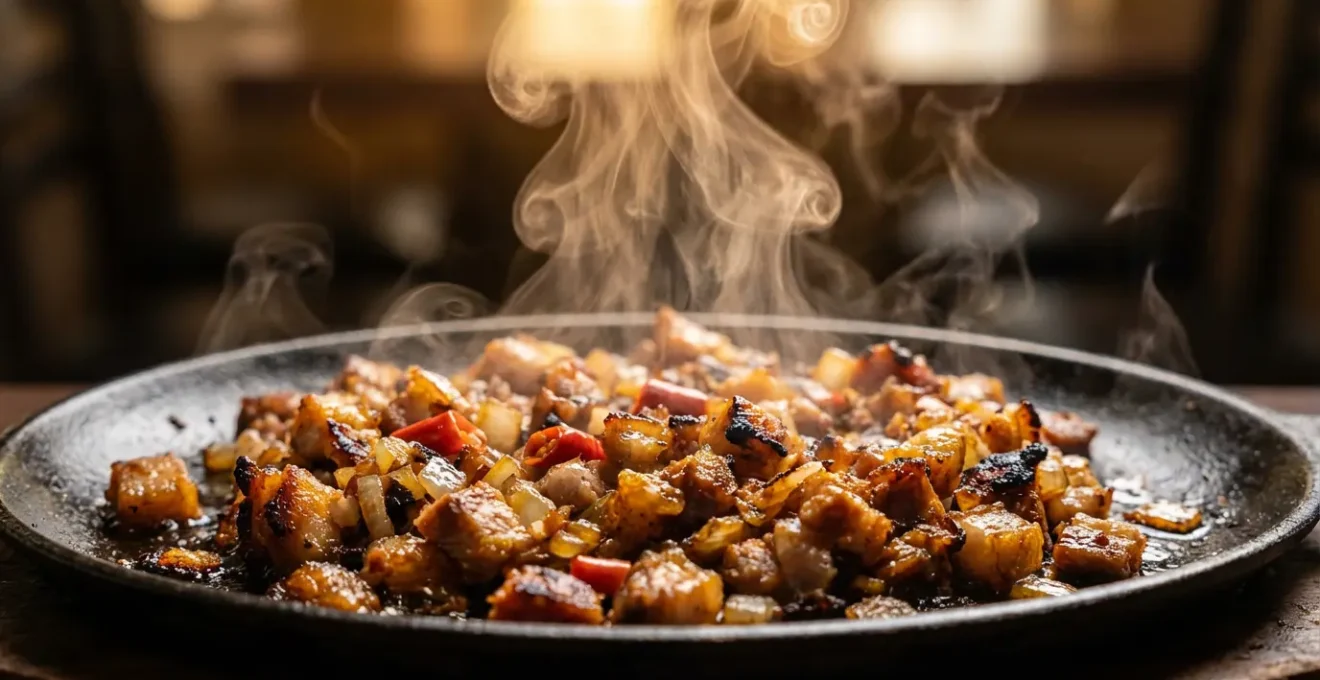
Adding mayonnaise to sisig isn’t a modern twist; it’s a fundamental misunderstanding of the dish’s entire culinary philosophy.
- Authentic sisig relies on rendered pork fat, and sometimes brain, for richness, not a dairy-based sauce that masks its true character.
- Its signature tang from calamansi and vinegar is designed to cut through fat, a critical role that the creaminess of mayonnaise actively obstructs.
Recommendation: To truly appreciate sisig, seek the sizzling, crunchy, and sour original that celebrates textural contrast, not the muted uniformity of a creamy counterfeit.
The sizzle is a declaration. The aroma, an assault of char, citrus, and chili, is intoxicating. This is sisig, the undisputed king of Filipino pulutan (bar chow). Yet, a great debate rages in restaurants and online forums, splitting purists and newcomers: the creamy versus the crunchy. At the heart of this conflict is a single, controversial ingredient: mayonnaise. To the uninitiated, it seems like a harmless addition, a simple way to achieve a creamy texture. To a Kapampangan, the people from the province of Pampanga where sisig was born, it is nothing short of heresy.
This is not a matter of being a stubborn traditionalist. The opposition to mayonnaise is rooted in a deep understanding of culinary integrity. Authentic sisig is a masterpiece of balance and texture, a dish born from resourcefulness and perfected with precision. Adding a dollop of creamy dressing doesn’t “enhance” it; it fundamentally breaks it. It is an act of flavor muting, a blanket thrown over a complex interplay of tastes that have been honed over decades. The use of an egg, often cracked raw onto the sizzling plate, is itself a modern evolution, but one that respects the dish’s heat and texture. Mayonnaise, however, is an intruder with no respect for the established order.
To understand why mayonnaise has no place on a plate of sisig, one must look beyond a simple list of ingredients. We must dissect its history, from a humble railroad stall to a national icon. We must appreciate the science of the sizzling plate, the cultural significance of its sour profile, and its unbreakable bond with an ice-cold beer. This is not just a recipe; it is a philosophy on a plate.
This guide deconstructs the essential truths of authentic sisig, exploring the non-negotiable elements that define it. From its perfect beverage pairing to its very name, each component tells a story of why this dish must be respected in its original, sizzling, and unapologetically bold form.
Summary: Why Is Authentic Kapampangan Sisig Never Served With Mayonnaise?
- Red Horse Beer: Why Is It the Mandatory Partner for Sisig?
- The Risk of Eating Undercooked Sisig Egg in Hot Climates
- Aling Lucing: How a Railroad Crossing Stall Created a National Dish?
- Sizzling Plate vs. Takeout Box: Why You Should Never Order Sisig To-Go?
- Sisig for Breakfast: How “Silog” Meals Changed the Rules?
- The Mistake of skipping the “Soup #5” in Chinatown
- Lodi, Petmalu, and Werpa: Which Slang Words Will Impress Your Local Friends?
- Why Is Filipino Food So Sour Compared to Other Asian Cuisines?
Red Horse Beer: Why Is It the Mandatory Partner for Sisig?
The pairing of sisig with beer is not a suggestion; it is a directive. Specifically, a strong, high-alcohol lager like Red Horse Beer is considered the mandatory partner. This is central to understanding the pulutan philosophy. Sisig is not delicate food. It is unapologetically rich, fatty, spicy, and sour. Its purpose is to stand up to and cut through the bitterness of a strong beer, creating a cycle where each bite invites another sip, and each sip readies the palate for another forkful. A light beer would be overwhelmed, and wine or cocktails are simply out of place.
This perfect symbiosis is deeply ingrained in the dish’s identity as working-class fare. As noted in a Filipino food culture analysis, both sisig and strong beer have roots as affordable, unpretentious, blue-collar staples. The pairing reinforces the dish’s soul. Mayonnaise, with its cloying creaminess, disrupts this sacred balance. It coats the tongue and mutes the sharp flavors of the pork and calamansi, thereby weakening the sisig’s ability to “fight” the beer. The result is a bland, heavy experience that leads to umay (flavor fatigue), the very thing authentic sisig is designed to prevent.
The experience is a conversation between the fat and char of the pork, the sharp acidic counterpoint of the citrus, the kick of chili, and the bitter cold of the beer. It is a four-way dialogue where every participant has a crucial role. Introducing mayonnaise is like adding a fifth person who does nothing but shout over everyone else, ruining the entire conversation. True sisig is meant to be a bold and assertive dish, and it requires a beverage partner of equal character.
The Risk of Eating Undercooked Sisig Egg in Hot Climates
One of the most dramatic moments in the sisig experience is the cracking of a raw egg onto the “screaming hot” cast-iron plate at the table. This is a modern, post-Aling Lucing addition, but one that has been widely accepted because it adds a layer of richness without compromising the dish’s core identity. However, this practice is not without its risks, especially in a tropical climate like the Philippines. The entire premise relies on the residual heat of the plate to cook the egg through, binding the chopped meat together. If the plate isn’t hot enough, you are left with a partially raw egg, a perfect breeding ground for Salmonella and other bacteria.
This is where the argument against mayonnaise gains another dimension. Some proponents of the creamy version argue that mayonnaise provides a safer way to achieve richness. This is a flawed argument. The solution to the risk of an undercooked egg is not to introduce an entirely foreign ingredient, but to ensure the dish is prepared correctly. The sizzling plate must be ferociously hot. This heat is not just for show; it is a critical cooking component. A well-prepared sisig will continue to cook and crisp up at the table, ensuring the egg is fully incorporated and safe to eat.
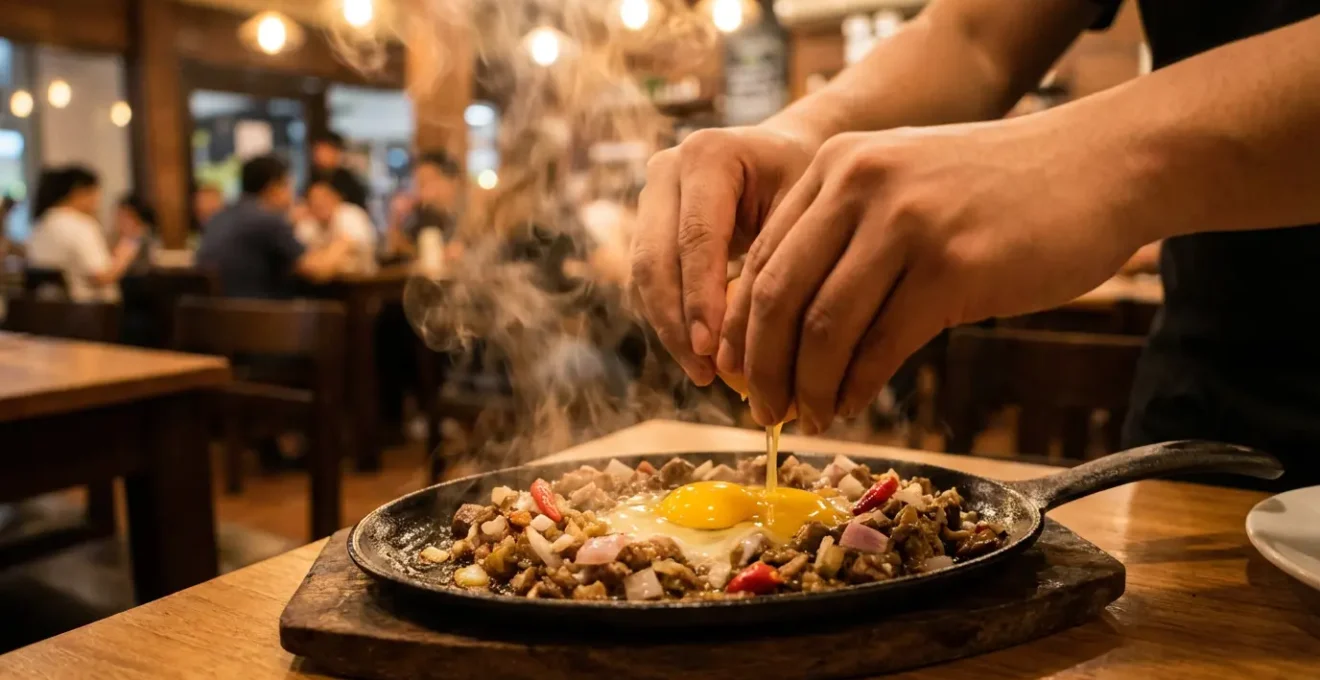
As the illustration shows, the act of mixing the egg is an interactive part of the meal, completing the cooking process just before consumption. Ultimately, authentic Kapampangan sisig needs no egg to be complete. In fact, an analysis of the original recipe confirms that traditional Kapampangan sisig specifically excludes mayonnaise and often the egg as well, relying solely on the rendered fat and sometimes pig brain for its signature richness. The egg is a tolerable addition; mayonnaise is a fundamental violation.
Aling Lucing: How a Railroad Crossing Stall Created a National Dish?
To speak of sisig is to speak of Lucia Cunanan, the woman affectionately known as “Aling Lucing.” While the concept of sisig as a sour salad or appetizer has existed for centuries— sisig’s history dates back to the 17th century but was revolutionized in the 1970s—it was Aling Lucing who transformed it into the sizzling masterpiece known today. From her humble carinderia (food stall) by the railroad tracks in Angeles City, Pampanga, she redefined the dish. Her genius was in the preparation method: boiling, grilling, and then chopping the pig’s face parts before serving them on a sizzling plate.
The historical context is crucial. According to a case study on sisig’s origins, the modern version owes its existence to the commissaries of the former Clark Air Base. American servicemen discarded pig heads, which were then bought cheaply by local vendors. Aling Lucing saw an opportunity in this surplus. Her trademark sisig was developed in the mid-1970s, a concoction of grilled pig ears and cheeks with vinegar, calamansi juice, onions, and chicken liver. There was no mayonnaise. The richness came from the collagen and fat of the pig’s head itself. This innovation was so impactful that the Philippine Department of Tourism eventually recognized her role, and Angeles City was declared the “Sisig Capital of the Philippines” in 1974.
Aling Lucing’s method is the gold standard. It is a testament to Filipino resourcefulness and culinary ingenuity—transforming humble, discarded parts into a national treasure. To add mayonnaise is to disrespect this legacy. It implies that her original creation was somehow lacking, that it needed a commercial, creamy binder to be complete. This is an insult to the woman who single-handedly elevated a simple sour dish into a cultural phenomenon.
Sizzling Plate vs. Takeout Box: Why You Should Never Order Sisig To-Go?
The sizzling plate is not a gimmick. It is the single most important piece of serving equipment for sisig, and its function is directly at odds with the concept of takeout. When sisig is served on a properly heated cast-iron platter, it arrives at the table still actively cooking. This continuous cooking is what creates the tutong—the coveted crispy, slightly burnt bits of pork at the bottom of the plate. This textural contrast between the chewy fat, the tender meat, and the crunchy tutong is the hallmark of a great sisig.
When you order sisig for takeout, this entire process is lost. The dish is packed into a plastic or styrofoam container, where the residual heat and moisture turn everything into a uniform, soggy mass. The textural integrity is completely destroyed. The sizzling plate, by design, functions as a tableside cooking surface, maintaining high heat for continuous crisping and flavor development. A takeout box does the opposite; it traps steam and guarantees a mushy, disappointing experience. This is why many purists will insist that sisig is a dish that can only be truly enjoyed when dining in.
However, if you find yourself with leftover sisig, not all is lost. It is possible to revive it, but it requires the right technique to recreate the essential crispiness. A microwave will only make it worse. The key is to replicate the intense, dry heat of the original sizzling platter. This brings back the all-important textural contrast that was lost in transit.
Your Action Plan: The Expert’s Method for Reheating Sisig
- Heat a cast-iron skillet until it is screaming hot, to the point of smoking.
- Add a tablespoon of butter or pork lard to the skillet to help recreate the sizzling effect and prevent sticking.
- Transfer the cold sisig to the hot skillet, working in batches if necessary to maintain the pan’s high temperature.
- Stir and toss the sisig constantly for 3-5 minutes, allowing it to develop the crispy ‘tutong’ bits.
- Serve it immediately, while it is still sizzling, for an experience as close to the original as possible.
Sisig for Breakfast: How “Silog” Meals Changed the Rules?
Originally, sisig was strictly pulutan—food consumed with alcoholic drinks, typically in the evening. It was bar food, not a meal. However, the immense popularity of the dish led to its inevitable evolution. The most significant shift in its role came with its inclusion in the world of silog, a category of Filipino breakfast meals. A silog meal consists of a main protein served with sinangag (garlic fried rice) and a fried itlog (egg). Thus, Tapsilog is tapa (cured beef) with rice and egg, and Sisigsilog is sisig with rice and egg.
This transition from after-dark bar chow to a legitimate breakfast option marked a major turning point in sisig’s cultural journey. It demonstrated that the dish was too beloved to be confined to a single time of day. The creation of Sisigsilog cemented its status as a versatile Filipino comfort food, available anytime. This evolution was further solidified by events like the annual “Sisig Festival” in Angeles City, which began in 2003. These festivals celebrated sisig not just as pulutan, but as a national culinary icon worthy of its own fiesta, transforming it into a point of pride for the entire country.
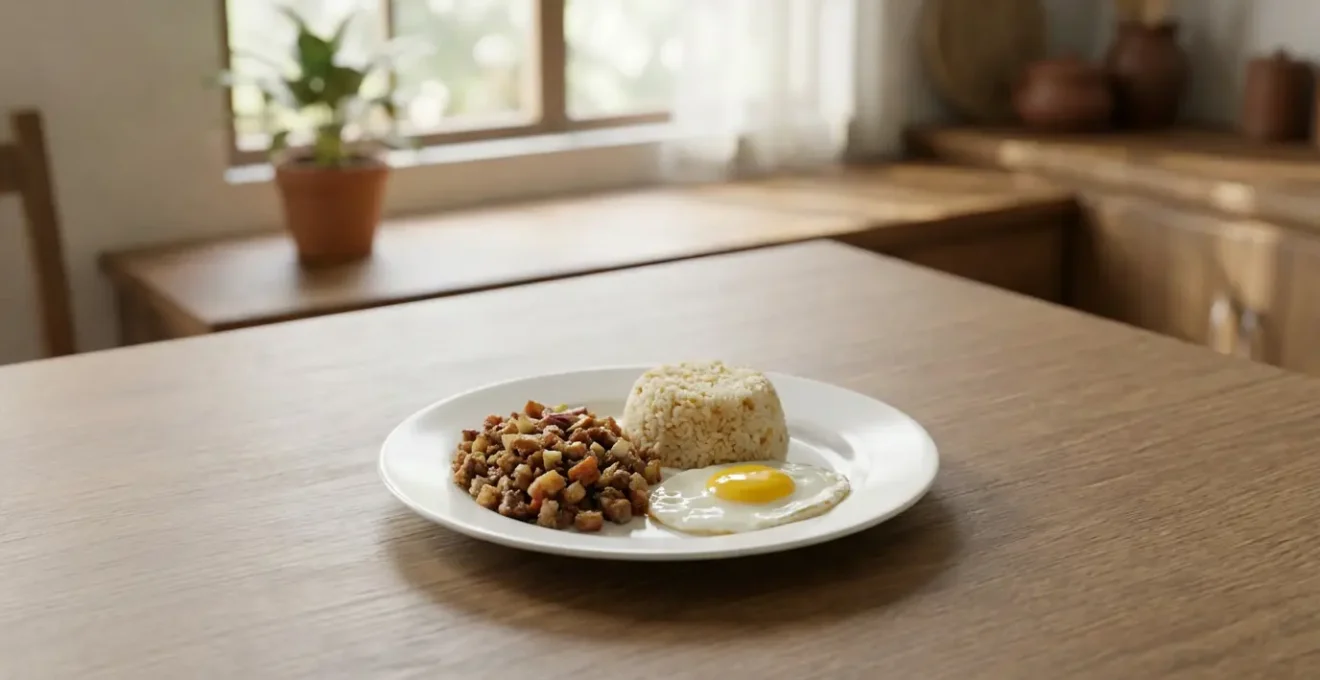
The silog format, as seen here, presents sisig as a complete, balanced meal. The garlic fried rice provides a hearty base, while the runny yolk of the sunny-side-up egg adds a rich sauce that coats the crispy pork. In this context, the egg serves the “creamy” function that some people mistakenly seek from mayonnaise. The difference is that the egg’s richness is natural and complementary, whereas mayonnaise is an artificial and overpowering addition that would completely ruin a breakfast plate.
The Mistake of skipping the “Soup #5” in Chinatown
In Manila’s Chinatown, one might encounter a mysterious dish called “Soup #5,” a euphemism for a soup made from a bull’s testicles and penis. Many tourists, and even some locals, shy away from it. The “mistake” is being squeamish and thereby missing out on a dish renowned for its unique properties. This exact principle applies to sisig. The mistake many modern cooks make is skipping the most essential, yet often intimidating, part of the animal: the pig’s head.
Authentic sisig is made from maskara ng baboy—the “mask” of the pig, which includes the cheeks, snout, and ears. These parts, often discarded in Western butchery, are prized in Filipino cuisine for their unique combination of textures, from gelatinous collagen to crunchy cartilage. Modern, “shortcut” sisig recipes often substitute pork belly or shoulder. While easier to find, this substitution completely changes the character of the dish. It lacks the complex mouthfeel and deep, porky flavor that only a pig’s head can provide. Some of the most traditional versions even include the pig’s brain, which is boiled and mashed to provide a natural, creamy binder that is far superior to any mayonnaise.
This practice is a core tenet of Filipino cooking: nothing goes to waste. A study of the cuisine’s philosophy highlights how the dish exemplifies Filipino resourcefulness in using every part of the animal. This nose-to-tail approach is not just about economics; it’s a philosophy of respect for the animal and a commitment to extracting the maximum amount of flavor from every part. Skipping the pig’s head is like trying to make a classic Beef Bourguignon with ground beef instead of chuck roast. You might end up with something edible, but you have lost the soul of the dish.
Lodi, Petmalu, and Werpa: Which Slang Words Will Impress Your Local Friends?
Filipino culture has a playful, inventive streak, which is vividly expressed in its slang. Words are often reversed: Lodi is “idol” spelled backwards, petmalu is a reversal of malupit (fierce or amazing), and werpa is a play on “power.” This linguistic creativity is the same innovative spirit that takes humble ingredients and transforms them into a culinary masterpiece like sisig. Understanding this connection is a way to show deeper cultural fluency.
When you taste an exceptional sisig, you could say it’s masarap (delicious). This is correct and polite. But if you want to truly impress your Filipino friends and show genuine appreciation, you would call it petmalu. This signals that you understand it’s not just good; it’s fiercely, amazingly good. You could praise the chef by calling them lodi. Using these terms shows you’re not just a tourist consuming a product; you’re a participant engaging with the culture. For instance, you could confidently say, “Lodi, pa-order ng isang petmalu na sisig!” which translates to, “Idol, I’d like to order one amazing sisig!”
The evolution of the word “sisig” itself mirrors this linguistic playfulness. The term’s origin can be traced back to “manisig,” a verb still used today that refers to the act of eating something sour, like green mangoes dipped in vinegar. It began as a word describing a process—souring—and evolved to become the name of one of the nation’s most iconic dishes. This journey from a simple verb to a celebrated noun demonstrates the dynamic and creative nature inherent in both Filipino language and its cuisine. Using slang is a small way to tap into that same creative energy.
Key Takeaways
- Mayonnaise is forbidden because it mutes flavor and destroys the crunchy texture, violating sisig’s core principles of sourness and textural contrast.
- The sizzling plate is not for show; it is a cooking tool essential for creating crispy bits (tutong) and safely cooking the raw egg through residual heat.
- Sisig’s signature sourness from calamansi or vinegar is a deliberate acidic counterpoint designed to cut the richness of pork fat, a delicate balance that creaminess disrupts.
Why Is Filipino Food So Sour Compared to Other Asian Cuisines?
A defining characteristic of Filipino cuisine, and the final nail in the coffin for the pro-mayonnaise argument, is its pronounced love for sourness (asim). From adobo to sinigang to kinilaw, acid is a fundamental building block, not just a final flourish. This preference has deep historical roots. In a tropical archipelago with no refrigeration for most of its history, sourness became essential for food safety in tropical climates. Vinegar and citrus juices were powerful, natural preservatives that inhibited bacterial growth, making meat and seafood last longer. What began as a survival technique evolved into a sophisticated culinary preference.
This is perfectly encapsulated in the very name of the dish. The word ‘sisig’ comes from ‘sisigan,’ an old Tagalog word that literally means ‘to make it sour.’ The original 17th-century dish was essentially a sour salad of fruit or fish. The acidic profile is not an afterthought; it is the dish’s foundational principle. In modern sisig, the use of calamansi or vinegar serves multiple crucial functions. As a detailed analysis of its ingredients shows, the acid chemically “cooks” the proteins, tenderizing the meat. More importantly, it provides a sharp, bright acidic counterpoint that cuts through the rich pork fat, cleansing the palate and preventing the feeling of umay (flavor fatigue).
Mayonnaise, being a rich, fatty emulsion itself, works directly against this principle. It adds more richness instead of cutting through it, creating a one-dimensional, heavy dish. Filipino cuisine has a vast and nuanced arsenal of souring agents, each used for a specific purpose, demonstrating the complexity of this flavor profile.
| Souring Agent | Common Use | Function in Dish |
|---|---|---|
| Calamansi | Sisig, Pancit | Cuts fat, adds brightness |
| Vinegar (Sukang Iloko) | Adobo, Kilawin | Preserves, tenderizes meat |
| Tamarind | Sinigang | Creates sour broth base |
| Green Mango | Ensalada, Sisig origins | Adds crunch and tartness |
Ultimately, the sourness in sisig is its soul. It is its history, its science, and its identity. To smother it with mayonnaise is to fundamentally misunderstand and disrespect the entire philosophy of Filipino cuisine.
Now that you grasp the principles of texture, acidity, and tradition, the path is clear. The next logical step is not to find a better recipe for a creamy version, but to seek out the authentic experience. Find a true Kapampangan eatery, listen for the sizzle, and order it the right way: no mayonnaise, with extra calamansi on the side, and a cold beer to complete the ritual.