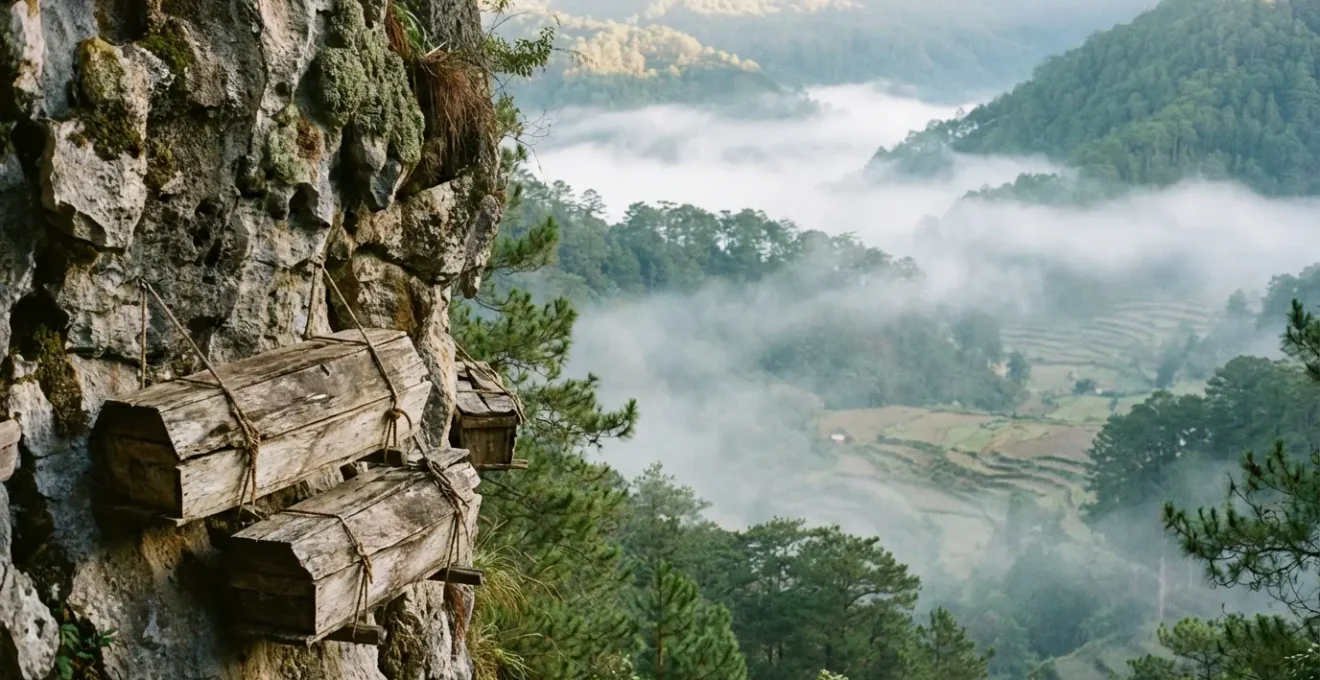
Many come to the Cordillera for the mystery of its hanging coffins, believing it’s a relic of the past. This guide reveals it’s part of a living, breathing culture where nature and spirit are one. The true journey isn’t just seeing the sights; it’s learning to navigate the mountain’s physical and spiritual rules, from its bone-chilling humid cold to the unspoken taboos of its ancient villages. It’s an invitation to travel deeper, not just further.
The image is as haunting as it is profound: ancient coffins, carved from single logs, clinging to the sheer limestone cliffs of Sagada. For generations, travelers have made the long journey into the Philippine Cordillera mountains, drawn by this singular, powerful question. Why hang the dead from a cliff face? The simple answers often speak of bringing the departed closer to the heavens or protecting them from animals and rival tribes. But these are just whispers on the wind.
The truth is not a simple fact but a feeling, an understanding that you can only grasp when you are here, breathing the crisp mountain air. The hanging coffins are not a spectacle; they are the most visible pulse of a living culture, deeply woven into the fabric of this land. To understand them is to understand the mountains themselves—their power, their demands, and their secrets. This is not a typical tropical destination. It’s a spiritual ecosystem where the physical and the mystical are one.
This guide, from one who has walked these paths for years, will not just show you the way to the cliffs. It will teach you to read the signs: the meaning of the biting, humid cold, the spiritual toll of the winding roads, the silent language of the rice terraces, and the sacred protocols for entering a village. The coffins are not the destination; they are the gateway. They ask not just for your curiosity, but for your respect and preparation.
For those seeking a different kind of spiritual journey, the following visual presentation offers a timeless message that has captivated millions.
This article is structured to guide you through the essential knowledge needed to explore these highlands not as a tourist, but as a respectful guest. From practical preparations to deep cultural insights, each section is a step on your journey of understanding.
Summary: A Journey into the Heart of the Cordillera’s Living Traditions
- How to Pack for 10°C Nights in a Tropical Country?
- The Risk of Motion Sickness on the Halsema Highway: How to Survive the Trip?
- Banaue vs. Batad: Which Rice Terraces Are Worth the Trek?
- Sumaguing Cave: Is It Safe for Non-Swimmers?
- When to Visit Banaue to See the Terraces Green Instead of Muddy?
- The “It’s Tropical” Mistake That Causes Hypothermia on Mountain Peaks
- How to Enter an Ifugao Village Without Offending the Elders?
- Mt. Pulag or Mt. Ulap: Which Cloud Sea Hike Fits Beginners?
How to Pack for 10°C Nights in a Tropical Country?
The first lesson the mountain teaches is humility, and it often begins with the cold. Travelers arrive expecting the familiar warmth of the tropics, but the Cordillera highlands operate under their own rules. Here, the air carries the mountain’s breath: a damp, pervasive chill that seeps into your bones, especially at night when temperatures can drop to as low as 4°C. This is not the dry, crisp cold of other climates; it is a humid cold that makes 10°C feel like freezing.
Cotton, the staple of tropical travel, becomes your enemy here. It absorbs moisture from the air and your body, clinging to your skin and accelerating heat loss. The key is not to pack one thick jacket, but to master the art of layering with technical fabrics. Think like a mountaineer, not a beachgoer. Your base layer should be a moisture-wicking material like merino wool, which pulls sweat away from your skin. Your mid-layer provides insulation—a fleece or a packable down jacket is perfect. Finally, an outer shell protects you from wind and the sudden mountain rain.
This approach gives you the flexibility to adapt as the day changes, from a cool, sunny morning to a frigid, misty evening. It is about respecting the environment’s power to shift without warning. Proper packing is the first sign of respect you show the mountain, proving you are not there to conquer it, but to coexist with it.
Your Action Plan: Packing for the Mountain’s Breath
- Layering System: Pack moisture-wicking fabrics like merino wool, not cotton. Include a fleece or down jacket for insulation and a waterproof outer shell.
- Extremities Protection: Bring thermal socks and a beanie for sleeping, as this is where most body heat is lost. Lip balm and moisturizer are crucial for the cold, dry wind.
- Water Protection: A waterproof bag or pack cover is non-negotiable for hikes to protect your electronics and dry clothes from sudden downpours.
- Sustenance & Comfort: Carry a small thermos for hot drinks to combat the chill internally. Quick-dry towels are essential as the damp air prevents normal towels from drying.
- Footwear: Ensure you have sturdy, waterproof hiking shoes with good grip. The trails can be muddy and slippery, even when it’s not actively raining.
By dressing for the reality of the environment, you transform a potentially miserable experience into a comfortable and profound one, ready to receive the other lessons the highlands have to offer.
The Risk of Motion Sickness on the Halsema Highway: How to Survive the Trip?
The journey to Sagada is a pilgrimage, and its primary path is the Halsema Highway, known locally as the Serpent’s Spine. It is not merely a road but a rite of passage, winding perilously through the highest altitudes in the Philippine highway system. To travel it is to understand the immense scale of the Cordillera. The breathtaking views of cloud-filled valleys come at a cost: a constant, dizzying dance of sharp turns, steep inclines, and sudden drops that tests the stomach and the spirit of even seasoned travelers.
Motion sickness here is not just a possibility; it’s a probability. However, focusing solely on medication is a rookie mistake. Surviving Halsema is a mental and strategic challenge. As one local guide grimly puts it, on this road, “one mistake you make is to fall into the cliff.” While the road has improved, the inherent dangers remain, and a recent study found that human error was the primary factor contributing to accidents, comprising 76.77% of cases. This underscores the need for you, the passenger, to be prepared.
Choose your seat wisely: a spot near the front of the bus or van offers a clearer view of the road ahead, helping your brain sync with the vehicle’s motion. Avoid heavy meals before the trip, stay hydrated, and keep your gaze fixed on the horizon, not on your phone. See the journey not as an ordeal to be endured, but as the first part of your immersion into the highlands’ raw, untamed beauty. The road demands your attention and respect, just as the culture does.
To make an informed decision, it’s crucial to weigh the Halsema route against its alternatives, as each offers a different balance of scenery, comfort, and time.
| Route | Travel Time | Road Conditions | Motion Sickness Risk | Scenic Value |
|---|---|---|---|---|
| Manila-Baguio-Sagada (Halsema) | 10-12 hours | Winding mountain roads, highest highway | High | Breathtaking mountain views |
| Manila-Banaue-Sagada | 12-13 hours | Through Nueva Ecija lowlands first | Moderate | Rice terraces viewpoints |
| Direct bus from Manila (Coda Lines) | 10-11 hours | Night travel, less scenic | Moderate | Limited (night travel) |
When you finally step off the bus in Sagada, you will have earned your place here, having traversed the Serpent’s Spine and understood its formidable power.
Banaue vs. Batad: Which Rice Terraces Are Worth the Trek?
The rice terraces of the Ifugao are often called the “Eighth Wonder of the World,” but this single title belies their diversity. For the traveler, the choice often boils down to two iconic sites: Banaue and Batad. To choose between them is to choose between two different ways of experiencing this monumental landscape. It’s the difference between witnessing a masterpiece from a grand balcony and stepping directly into the painting itself.
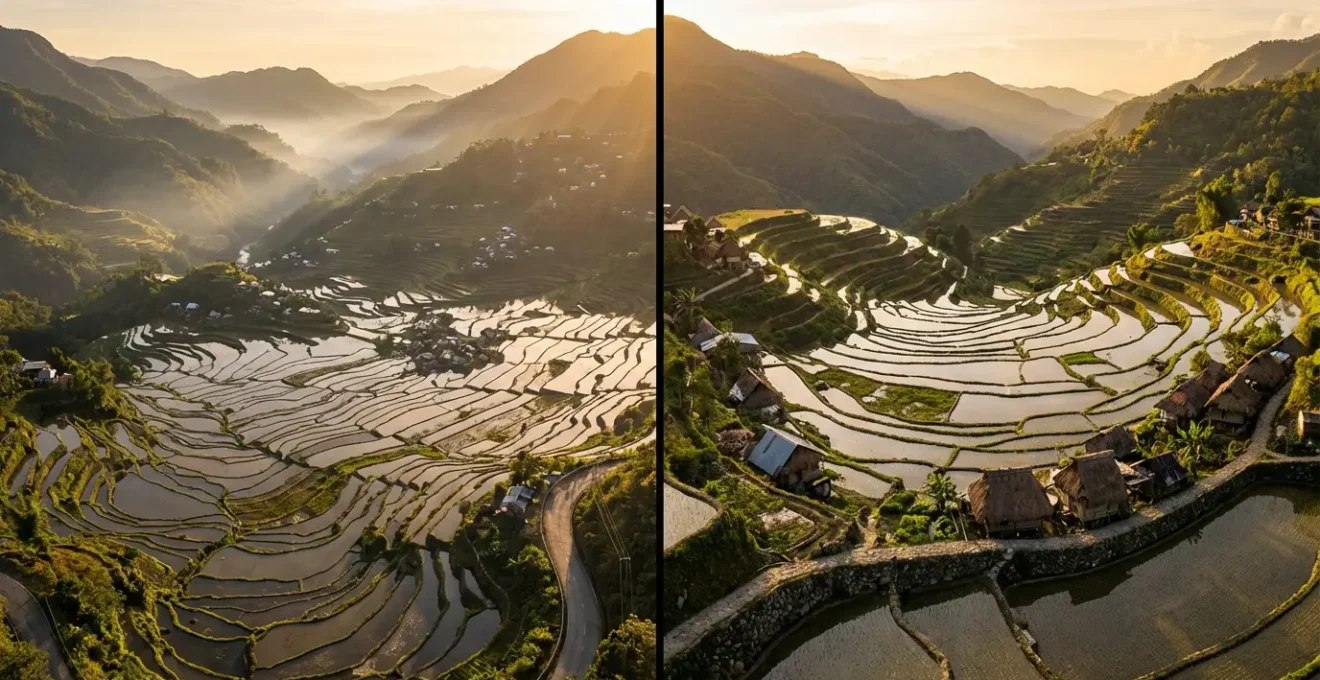
As the visual contrast shows, the Banaue Rice Terraces, a UNESCO World Heritage Site, offer grandeur on a panoramic scale. They are easily accessible, with numerous viewpoints right along the main road. This is the place for those with limited time or mobility, offering awe-inspiring vistas without a strenuous trek. You see the terraces as a magnificent, sprawling tapestry laid out before you. It is a spectacle of human ingenuity against the vastness of the mountains.
Batad, on the other hand, demands effort and rewards it with intimacy. Reaching it requires a challenging hike down a steep valley. But once there, you are not looking *at* the terraces; you are *in* them. The landscape forms a stunning natural amphitheater, encircling you completely. You walk its narrow stone walls, feel the cool water on your hands, and hear the sounds of village life echoing around you. Batad is not a viewpoint; it is an immersion. It’s for the trekker who wants to feel the texture of the terraces, not just see their shape.
Banaue shows you the scale of the Ifugao’s achievement. Batad lets you walk in their footsteps. Both are profound, but only one will match the journey your soul seeks.
Sumaguing Cave: Is It Safe for Non-Swimmers?
Deep beneath Sagada’s pine-clad hills lies another world, a subterranean kingdom of glistening rock formations and icy pools. This is Sumaguing Cave, often called the “Big Cave,” and entering it is like a journey to the center of the earth. The question of safety, especially for those who cannot swim, is a primary concern. The short answer is yes, the standard tour is generally safe for non-swimmers, but this safety is conditional. It depends entirely on your guide, your preparedness, and your respect for the cave’s power.
The standard spelunking tour does not require swimming skills. You will wade through water that is mostly ankle-to-waist deep, guided by ropes and the steady hand of your local guide. These guides are masters of their domain; they know every slippery stone and hidden foothold. However, the cave is an unpredictable environment. The Sumaguing Cave has a depth of more than 500+ feet, a testament to the vast, unseen spaces beneath you. Your safety is an active partnership between you and your guide.
It is crucial to distinguish this from the “Cave Connection,” a much more strenuous 4-5 hour traverse from Lumiang Cave to Sumaguing. This advanced route involves rappelling, squeezing through tight passages, and navigating deep water. It is absolutely not recommended for non-swimmers or those with claustrophobia. For the standard Sumaguing tour, trust is your most important piece of equipment. Trust your guide, trust the ropes, and trust your own two feet. This underground world demands a different kind of bravery, one rooted in careful steps and a healthy respect for the darkness.
Emerging from the cool darkness of Sumaguing back into the sunlight is a form of rebirth, a powerful reminder of the hidden depths that lie just beneath the surface of this mystical land.
When to Visit Banaue to See the Terraces Green Instead of Muddy?
The Ifugao rice terraces are a living monument, and their appearance is dictated by an ancient agricultural rhythm, not the tourist calendar. Arriving with the wrong expectations can lead to disappointment, as travelers hoping for a sea of green find muddy, mirrored pools instead. While beautiful in their own right, the iconic, vibrant green is a specific phase in a year-long cycle. Timing your visit is key to witnessing the landscape in its most celebrated form.
The most reliable window to see the terraces at their most lush and verdant is during the growing season. Generally, the rice terraces in Sagada are at their greenest from March to April, with this period extending through June and August in many parts of the Cordillera. This is when the young rice stalks are mature, blanketing the mountainsides in a breathtaking carpet of emerald green. It is a time of vibrant life and palpable growth.
However, the beauty of the terraces is not limited to one color. Understanding the full cycle reveals a different kind of magic in each phase:
- December – February (Planting Season): The terraces are filled with water, transforming them into magnificent, muddy mirrors that reflect the sky. This is a time of quiet potential and stark, graphic beauty.
- March – May (Growing Season): The landscape erupts in a vibrant, almost fluorescent green as the rice plants shoot up.
- June – August (Peak Green Period): The green deepens into a rich emerald hue. The terraces are at their fullest and most photogenic.
- September – November (Harvest Season): The fields turn a stunning gold as the rice ripens. This is a time of community activity and cultural rituals, offering a different but equally fascinating experience.
It’s also vital to remember that due to varying elevations and local traditions, the cycle is not perfectly synchronized across all villages. A single trip can often reveal terraces in multiple phases, a beautiful testament to the region’s diversity.
By timing your visit with intention, you are not just seeing a sight; you are witnessing a specific chapter in the timeless story of the people and their land.
The “It’s Tropical” Mistake That Causes Hypothermia on Mountain Peaks
The most dangerous belief a traveler can bring to the Cordillera is the phrase, “It’s a tropical country.” This single thought is the root of a critical mistake that can lead to genuine danger: hypothermia. On the peaks of Mt. Pulag or Mt. Ulap, as you wait for the sun to rise over a sea of clouds, the cold is not just a discomfort; it’s an active force. It’s a humid, penetrating cold that behaves very differently from the dry cold many are used to.

The air at this altitude is saturated with moisture. Instead of your sweat evaporating and cooling you down, it condenses on your skin and clothes, as shown in the image above. Your damp clothing then becomes a conductor, rapidly pulling heat away from your body. This is why a simple cotton shirt and a generic jacket are woefully inadequate. You can be shivering uncontrollably even at a temperature of 10°C because your body is losing heat at an alarming rate. It’s a classic underestimation of the environment’s power.
Locals and seasoned hikers understand this. They speak of the mountain’s embrace, a feeling that is both beautiful and potentially deadly if disrespected. As one travel description poetically notes, “The cool temperature while hiking to the top and the trail walled with pine trees will take away your tiredness especially when you reach its highest point,” but this same cool air can turn against you if you are not prepared. The key is to stay dry, both from the inside (sweat) and the outside (rain and mist), by using the layering system of technical, moisture-wicking fabrics discussed earlier.
Forgetting you are in the tropics is the first step. Remembering you are a guest in the powerful domain of the mountain is the path to a safe and awe-inspiring experience.
How to Enter an Ifugao Village Without Offending the Elders?
Entering an Ifugao village in the heart of the rice terraces is like stepping across an invisible threshold into a sacred space. Here, the rules are not written on signs but are etched into the daily lives and spiritual beliefs of the people. The common tourist advice to “be respectful” is meaningless without understanding *what* respect looks like in this specific cultural context. It goes far beyond simply asking for permission before taking a photo, although that is a fundamental starting point.
The core concept to grasp is ‘Paniyaw’, a set of cultural taboos that govern behavior. These are not mere superstitions; they are the spiritual immune system of the community, protecting sacred sites and maintaining harmony between the human and spirit worlds. Offending an elder is not just a social faux pas; it can be seen as a disruption of this delicate balance. The Igorots of Sagada and the surrounding regions have a worldview where certain places, objects, and actions hold immense spiritual weight.
Understanding ‘Paniyaw’ means learning a new set of rules:
- Never point directly at sacred sites. This includes burial caves, ceremonial grounds, or specific rock formations. Use an open hand to gesture if you must.
- Do not touch the ‘bulul’. These carved rice guardians found in granaries are considered sacred effigies holding ancestral spirits.
- Maintain a quiet demeanor near burial sites. Loud noises and boisterous behavior are deeply offensive. You are in the presence of the ancestors.
- Always ask your guide. If you are unsure about anything, from entering a hut to crossing a particular field, ask your local guide. They are your cultural interpreters.
As travel writer King Tolentino emphasizes, one of the most basic rules is to “avoid taking pictures of the locals without permission.” This simple act acknowledges their humanity over their photogenic quality. By learning and observing these protocols, you are no longer a passive observer but an active participant in cultural preservation.
Your respect is the most valuable currency you can bring, and it will be returned tenfold in the form of genuine connection and a deeper understanding of this incredible culture.
Key Takeaways
- The Cordillera’s cold is humid and penetrating; dress in technical, moisture-wicking layers, not cotton, to avoid hypothermia.
- The journey is part of the experience; prepare for the winding Halsema Highway mentally and physically, not just with medication.
- Respect for the Ifugao culture goes beyond simple politeness; learn and observe specific taboos (‘Paniyaw’) to avoid offending elders and disrupting spiritual balance.
Mt. Pulag or Mt. Ulap: Which Cloud Sea Hike Fits Beginners?
For many, the ultimate prize of a Cordillera journey is to stand on a summit at dawn and watch the sun rise over a fabled sea of clouds. Two mountains, Mt. Pulag and Mt. Ulap, are the most famous stages for this celestial drama. While both offer the potential for this magical experience, they present very different challenges and are suited to different types of hikers, especially beginners. Choosing the right one is crucial for a successful and enjoyable climb.
The most important thing to understand, as any honest guide will tell you, is that “the famous sea of clouds is a weather-dependent phenomenon, not a guarantee.” Your choice of mountain should be based on the journey itself, not just the potential reward. Mt. Ulap is often considered the more accessible of the two for a first-timer. It’s a day trip that can be completed in 5-7 hours, with a trail that winds along dramatic ridges and features the iconic “Gungal Rock.” While physically demanding, the logistics are simpler, requiring only a straightforward registration on-site.
Mt. Pulag, as the highest peak in Luzon and the third highest in the Philippines, is a much more serious undertaking. The climb typically requires an overnight stay and involves complex logistics, including securing permits well in advance and presenting a medical certificate. The altitude is significantly higher, and the weather can be more extreme. However, the reward is a unique landscape of “dwarf bamboo grasslands” at the summit that feels like another planet. While the chance of seeing a perfect sea of clouds might be slightly higher due to the altitude, the commitment required is far greater.
This comparative table breaks down the key factors to help you decide which trail aligns with your fitness, budget, and appetite for adventure.
| Factor | Mt. Ulap | Mt. Pulag |
|---|---|---|
| Duration | Day trip (5-7 hours) | 2-3 days (overnight required) |
| Permit Complexity | Simple registration | Complex: medical certificate, advance booking |
| Physical Difficulty | Moderate (can be strenuous) | Moderate to Difficult |
| Altitude | 1,846m | 2,926m (3rd highest in Philippines) |
| Best Features | Gungal Rock, dramatic ridges | Dwarf bamboo grasslands, highest peak in Luzon |
| Cloud Sea Guarantee | Weather-dependent | Weather-dependent, higher chance at summit |
| Cost | Lower (day trip only) | Higher (overnight, guides, permits) |
Ultimately, whether you choose the dramatic ridges of Ulap or the otherworldly summit of Pulag, the real journey is the climb itself. The mountain will grant you the views you are meant to see.
Frequent Questions About Exploring the Cordillera
Do I need to know how to swim for the standard Sumaguing Cave tour?
No, the standard Sumaguing tour is beginner-friendly with mostly ankle-deep to waist-deep water sections. Guides provide assistance and ropes are available for support.
What’s the difference between Sumaguing tour and Cave Connection?
The Cave Connection tour (Lumiang to Sumaguing) involves much more challenging water-filled routes, rappelling down waterfalls, and squeezing through tiny openings. This is not recommended for non-swimmers.
How can I assess if my guide is experienced with non-swimmers?
Ask specific questions before the tour: ‘How do you assist non-swimmers in the deep pool sections?’, ‘What safety equipment do you provide?’, ‘How many non-swimmers have you guided?’