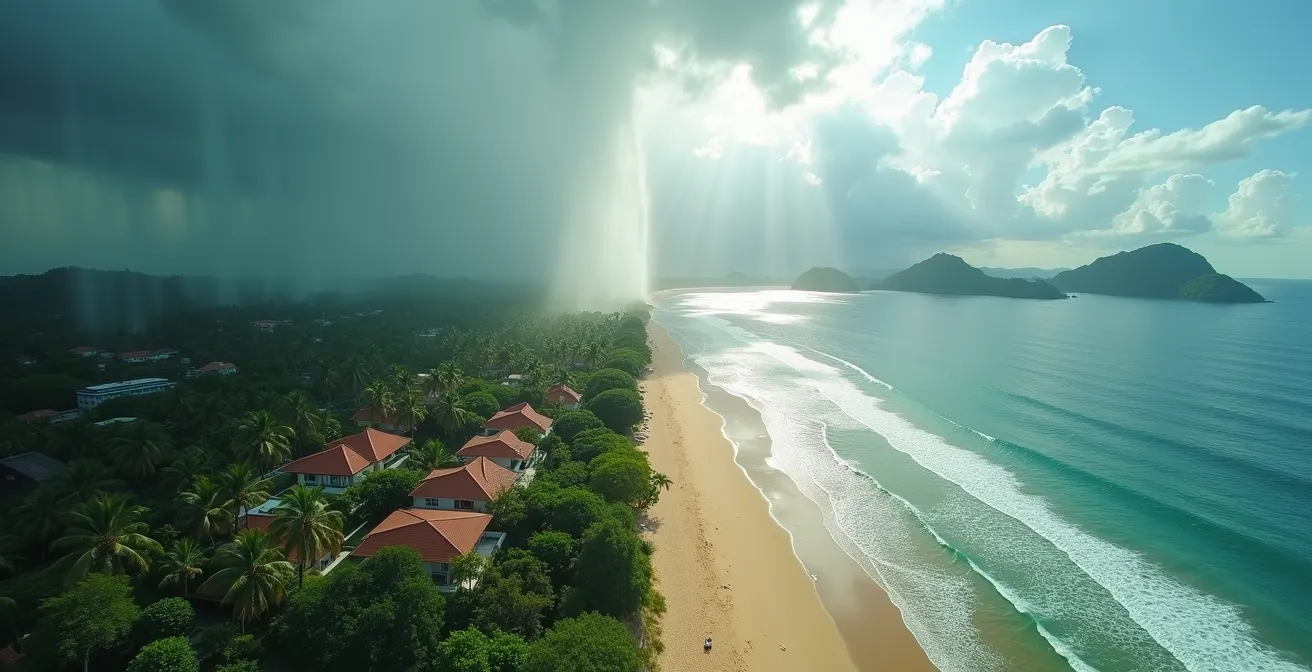
The concept of a single, nationwide “dry season” in the Philippines is a misleading oversimplification for travelers.
- The country is governed by two opposing monsoons (Amihan and Habagat) that create different “dry” periods on the east and west coasts.
- Sudden, intense rainfall can occur even during peak dry months due to localized thunderstorms and the indirect effects of distant tropical depressions.
Recommendation: Instead of trying to find a perfect “dry” window for the entire country, build a resilient itinerary by understanding which coast is sheltered during your travel dates.
For many travelers, the Philippines conjures images of pristine white-sand beaches under a perpetually sunny sky. Guidebooks and travel blogs often reinforce this by neatly dividing the climate into two simple categories: a wet season and a dry season. The common advice is to book your trip between November and May to enjoy the archipelago’s celebrated sunshine. Yet, countless visitors arrive during these “perfect” months only to be met with baffling downpours that can disrupt ferry schedules, ground island-hopping tours, and turn a beach day into a washout. This frustrating experience stems from a fundamental misunderstanding of the region’s complex atmospheric dynamics.
The reality is far more nuanced than a simple binary split. The Philippines, an archipelago of over 7,000 islands, doesn’t operate under a single, monolithic weather system. Its climate is a dynamic battleground between two major seasonal wind patterns—the Amihan (Northeast Monsoon) and the Habagat (Southwest Monsoon)—each creating distinct microclimates across the country. A “dry” and calm day in Palawan on the west might coincide with a “wet” and windy day in Siargao on the east. This article moves beyond the simplistic wet/dry narrative to give you a meteorologist’s perspective. Our goal isn’t just to tell you when to go, but to explain the *why* behind the weather.
By understanding the interplay of these monsoon systems, the logic of typhoon signals, and the unforgiving nature of the equatorial sun, you can stop trying to predict the unpredictable. Instead, you’ll learn to build a smarter, more resilient itinerary that adapts to the Philippines’ true climate, ensuring that a little rain doesn’t ruin your entire adventure.
To navigate these climatic nuances effectively, this guide breaks down the essential knowledge every traveler needs. We will explore the geographical differences in weather patterns, provide practical advice for packing and planning, and reveal how to turn the rainy season to your advantage.
Summary: Understanding the Philippines’ True Climate for Smarter Travel
- East Coast vs. West Coast: How Monsoon Seasons Differ by Region?
- How to Pack for 90% Humidity Without Overloading Your Backpack?
- The Mistake of Ignoring “Signal No. 1” Warnings During Your Trip
- Surfing or Diving: Which Activity Actually Improves During the Rainy Season?
- When to Reapply Sunscreen: The Rules for Equatorial UV Indexes
- The Error of Booking Remote Islands During Amihan Season
- When to Visit the East Coast to Avoid the Specific Pacific Monsoon?
- The “Too Many Airports” Mistake That Ruins 10-Day Itineraries
East Coast vs. West Coast: How Monsoon Seasons Differ by Region?
The primary reason the “dry season” is an unreliable concept is that the Philippines is simultaneously influenced by two opposing monsoon systems. These are not just “winds”; they are large-scale seasonal weather engines. From approximately November to May, the Amihan (Northeast Monsoon) brings cool, dry air from Siberia and China. This creates the classic dry season for the western parts of the country, like Palawan and Batangas, resulting in calm seas and sunny skies. However, this same wind picks up moisture as it crosses the Pacific, dumping that rainfall onto the eastern seaboard, affecting islands like Siargao and Samar.
Conversely, from roughly June to October, the Habagat (Southwest Monsoon) dominates. This system pulls warm, extremely moist air from the Indian Ocean, blanketing the western coast with heavy monsoon rains. During this same period, the eastern coast is relatively sheltered from the Habagat, experiencing drier weather, though it remains exposed to typhoons forming in the Pacific. This creates a “weather seesaw” where one side of the country is generally wet while the other is generally dry. Understanding which monsoon is active during your trip is the first step to choosing the right destinations.
The table below, based on an analysis of regional monsoon impacts, illustrates this crucial duality. It highlights how the same season brings completely different conditions depending on whether you are on the east or west coast.
| Region | Amihan Season (Nov-May) | Habagat Season (Jun-Oct) | Best Travel Window |
|---|---|---|---|
| East Coast (Siargao, Samar) | Heavy rains, rough seas | World-class surf swells | March-May |
| West Coast (Palawan) | Calmer seas, dry weather | Heavy monsoon rains | November-April |
| Central Visayas | Sheltered, moderate conditions | Less rainfall than outer islands | Year-round viable |
How to Pack for 90% Humidity Without Overloading Your Backpack?
Even during the “dry” season, one atmospheric constant in the Philippines is humidity. With levels frequently soaring above 80-90%, moisture gets into everything. It makes clothes feel perpetually damp, encourages mildew, and can be a nightmare for electronics. The common mistake is to overpack, bringing too many cotton items that absorb moisture and take days to dry. The correct strategy is not to pack more, but to pack smarter with materials and organization designed for a tropical environment.
Your primary weapon against humidity is fabric choice. Opt for quick-dry synthetic materials like polyester, nylon, or merino wool. These fabrics wick moisture away from your skin and, crucially, will air-dry in a few hours after a quick hand wash, allowing you to pack fewer items. Secondly, a compartmentalized packing system is essential. Use waterproof packing cubes and dry bags not just for organization, but to create sealed-off environments within your luggage. One cube can be for clean, dry clothes, while another can quarantine damp swimwear or a rain-soaked jacket, preventing moisture from spreading to the rest of your gear.

As the image above illustrates, technical fabrics are designed to repel moisture. This principle should guide your entire packing list. Small additions like silica gel packets tossed into your electronics bag and a few large ziplock bags for your passport and cash can save you from costly damage. The goal is to create a multi-layered defense against ambient moisture, keeping your essentials dry and functional without weighing you down.
The Mistake of Ignoring “Signal No. 1” Warnings During Your Trip
Many travelers mistakenly believe that a typhoon is only a threat if it makes a direct landfall on their location. This leads to a dangerous complacency when PAGASA (the Philippine Atmospheric, Geophysical and Astronomical Services Administration) issues a “Tropical Cyclone Wind Signal No. 1.” A Signal No. 1 is the lowest warning level, indicating that a tropical cyclone is expected to affect an area within 36 hours. While winds may only be 39-61 km/h, the real danger often comes from the storm’s indirect effects, especially its ability to enhance the prevailing monsoon.
This phenomenon, known as monsoon enhancement, is a critical concept. A distant typhoon, even hundreds of kilometers away, can act like a massive atmospheric engine, pulling in and intensifying the moisture-laden Habagat winds. This can trigger days of relentless, widespread rainfall and flash floods in areas far from the cyclone’s direct path. The case of Typhoon Gaemi in July 2024 serves as a stark reminder. Despite not making landfall in the Philippines, it amplified the Southwest Monsoon, causing 471mm of rain to fall on Quezon City in a single 24-hour period—nearly the city’s entire average for the month—leading to catastrophic flooding and dozens of fatalities.
Case Study: The Cascading Effect of Typhoon Gaemi (2024)
Typhoon Gaemi perfectly illustrates the cascading cancellation effect. Though the storm itself remained far offshore, its enhancement of the Habagat monsoon led to intense rainfall across Luzon. For travelers, a Signal No. 1 warning immediately triggered the Philippine Coast Guard to suspend all ferry services in the affected areas for safety. This stranded thousands of tourists, leading to a domino effect of missed flights, forfeited hotel bookings, and completely derailed itineraries, even for those in areas that experienced no strong winds.
Therefore, a Signal No. 1 is not a suggestion to be taken lightly; it is an official warning that the country’s transportation and safety protocols are being activated. With the Philippines experiencing an average of 28 storms and typhoons entering its area of responsibility annually, ignoring the first signal is a gamble that can easily leave you stranded.
Surfing or Diving: Which Activity Actually Improves During the Rainy Season?
While the rainy season (typically June to October) is often seen as a deterrent for general tourism, it can be the absolute best time for certain adventure sports. Travelers who understand the weather patterns can unlock unique opportunities that are unavailable during the peak dry season. The key is to match your activity to the prevailing monsoon. The powerful Habagat monsoon, which brings rain to the west coast, simultaneously creates ideal conditions on the east coast.
Surfing is the prime example. The Habagat season generates consistent, powerful swells that travel across the Pacific, transforming the eastern seaboard into a world-class surfing destination. Siargao’s famous “Cloud 9” break, for instance, comes alive between August and November, attracting surfers from around the globe. During the Amihan (dry) season, these same waters are often flat and unsuitable for surfing. Therefore, planning a surf trip during the “rainy” season is not a compromise; it’s a strategic choice for the best possible conditions.

Other activities also thrive. The increased rainfall swells rivers, making canyoning and whitewater rafting more thrilling. Waterfalls, which can be underwhelming trickles at the end of the dry season, become spectacular, thundering cascades. Even some diving can be better. While heavy rains can reduce visibility at shallow reefs due to runoff, wreck diving in locations like Coron Bay is less affected, as the deeper sites are not as impacted by surface conditions. Furthermore, the rainy season means fewer crowds and often lower prices, offering a more intimate and budget-friendly experience.
When to Reapply Sunscreen: The Rules for Equatorial UV Indexes
A common mistake travelers make in the Philippines, especially on overcast days, is underestimating the power of the sun. Due to its proximity to the equator, the Philippines experiences extremely high Ultraviolet (UV) radiation levels year-round. Even when clouds block the visible light and heat, a significant amount of damaging UVA and UVB rays still penetrates the atmosphere. It is not uncommon for the UV Index to reach 9 or higher, which is rated as “very high” to “extreme” and can cause sunburn in as little as 15 minutes for unprotected skin.
The standard “apply once in the morning” approach is dangerously insufficient here. The rules for sun protection in an equatorial climate are far more rigorous. Sunscreen must be reapplied every two hours, without fail. This interval should be shortened to every 60-90 minutes if you are swimming, sweating, or have toweled off, as these activities remove the protective layer. Choosing the right product is equally important. It must be “broad-spectrum” to protect against both types of harmful rays.
A local dermatology expert, Dr. Omangayon, emphasized this point in a consultation with PhilSTAR Life, explaining the distinct roles of UV radiation:
Broad-Spectrum Protection protects against UVA rays that accelerate skin ageing and UVB rays that cause sunburn and increase the risk of skin cancer.
– Dr. Omangayon, PhilSTAR Life dermatology consultation
This dual threat means that protection is not just about avoiding a painful burn; it’s about preventing long-term skin damage. Don’t be fooled by a cool breeze or a cloudy sky. The UV rays are intense and relentless. Treat sunscreen application not as an option, but as a critical and continuous safety procedure throughout your day.
The Error of Booking Remote Islands During Amihan Season
The allure of a secluded, off-the-beaten-path island is powerful, but booking one without understanding monsoon exposure is a classic travel blunder. This mistake is most common during the Amihan (Northeast Monsoon) season, from November to May. While this period brings beautiful, dry weather to the sheltered western side of the country, it can render exposed eastern islands inaccessible.
The cool, dry winds of the Amihan travel a long distance across the Pacific Ocean. By the time they reach the Philippines’ eastern shores, they have picked up significant moisture and energy, creating rough seas and strong winds. Small, remote islands that lack large, sheltered ports are particularly vulnerable. The Philippine Coast Guard has a low threshold for canceling boat trips in these conditions, especially for the smaller *banca* boats that service many of these routes. A seemingly perfect booking can evaporate overnight when all transport is grounded for days on end.
Case Study: Amihan’s Impact on Island Accessibility
During the peak Amihan season, a traveler might book a boutique resort on a small island off the coast of Eastern Samar. While their weather app for Manila shows perfect sun, the reality on the east coast is choppy seas and high winds. The Coast Guard will have suspended all small boat traffic, making it physically impossible to reach the island. Meanwhile, a traveler who chose a destination on the west coast of Palawan would be enjoying calm, glassy seas and ideal conditions for island hopping. This illustrates that the “dry season” is not a national phenomenon but a highly regional one.
The strategic error is failing to consider an island’s geography in relation to the prevailing monsoon. During Amihan season, it is far safer to book destinations on the western coasts or in the more sheltered central Visayas region (like Bohol or parts of Cebu), which are protected from the harshest winds. Save the eastern-facing island adventures for the transitional months of March to May, when the Amihan has weakened.
When to Visit the East Coast to Avoid the Specific Pacific Monsoon?
The eastern coast of the Philippines, home to gems like Siargao, Catanduanes, and Samar, operates on a weather calendar that is often the reverse of the more frequented western destinations. Attempting to visit during the national “dry season” of December or January can lead to disappointment, with heavy rains and rough seas typical of the Amihan monsoon. To experience this region at its best, timing is critical, and it involves targeting specific windows between monsoon seasons.
The absolute prime window for general tourism, diving, and beach activities on the east coast is the transitional period from March to May. During these months, the Amihan (Northeast Monsoon) has significantly weakened, leading to calmer seas and less rainfall. At the same time, the Habagat (Southwest Monsoon) has not yet fully established itself. This creates a brief, golden period of hot, dry weather and excellent water visibility before the Habagat and the main typhoon season begin in earnest around June. As PAGASA officially notes, the onset of the Southwest Monsoon and the rainy season is a formally declared event, typically occurring between May and June.
However, if your goal is surfing, this advice is flipped. The best waves are generated by the Habagat and the distant passage of typhoons, making the period from August to November the peak season for surfers, despite being the height of the rainy season. This highlights the importance of aligning your travel dates with your primary activity.
The following table, using data from an analysis of Philippine climate patterns, provides a simplified guide for planning a trip to the east coast based on your priorities.
| Period | Weather Pattern | Best For | Avoid For |
|---|---|---|---|
| March-May | Transition period, increasing heat | Beach tourism, diving | Temperature-sensitive travelers |
| June-October | Southwest monsoon (Habagat) | Surfing, reduced crowds | General tourism, boat trips |
| November-February | Northeast monsoon (Amihan) | Budget travel | Beach activities, island hopping |
Key Takeaways
- The “dry season” is a regional, not national, concept. The west is dry during Amihan (Nov-May), while the east is dry during Habagat (Jun-Oct).
- Humidity is a constant; pack quick-dry clothing and use waterproof organizers to protect your gear.
- A “Signal No. 1” typhoon warning is a serious logistical red flag that can ground all transport, even if the storm is far away.
The “Too Many Airports” Mistake That Ruins 10-Day Itineraries
A common mistake fueled by a desire to see everything is cramming too many geographically distinct islands into a short trip. An itinerary that involves flying from Luzon to Palawan, then to the Visayas, and finally to Siargao within 10 days is a logistical house of cards, ready to collapse at the first sign of bad weather. In the Philippines, every flight and every ferry crossing is a potential point of failure, especially during the July-October typhoon season when weather data shows that 8-9 tropical cyclones can make landfall, causing widespread disruption.
The “too many airports” approach ignores the significant time lost to travel itself—packing, checking out, airport transfers, security lines, and potential delays. More importantly, it leaves zero buffer for the inevitable weather-related disruptions. A single canceled flight due to a nearby tropical depression can trigger a domino effect, causing you to miss your next connection and forfeit non-refundable bookings. This turns a relaxing vacation into a stressful race against time.
A much more resilient strategy is to adopt a “hub-and-spoke” model or to focus on one or two island groups at most. Base yourself in a major hub like Cebu or Manila and take shorter ferry trips or day tours to nearby islands. Or, dedicate your 10 days to thoroughly exploring a single region, like the islands of Palawan (Coron, El Nido, Puerto Princesa) or the Central Visayas (Cebu, Bohol, Siquijor). This reduces your exposure to transport cancellations, minimizes travel time, and allows you to build a more flexible and enjoyable itinerary.
Action Plan: Auditing Your Itinerary for Weather Resilience
- Apply the “Rule of Three”: For a 10-14 day trip, limit your plan to a maximum of three distinct and geographically close island destinations. Tally up every planned flight or long-distance ferry.
- Identify Disruption Points: Treat each flight or ferry crossing as a potential point of failure. Does your itinerary have more than three such points in 10 days? If so, it’s likely too fragile.
- Check for a “Hub-and-Spoke” Alternative: Could you base yourself in a central hub (like Cebu) and explore nearby islands via shorter, more frequent boat trips instead of multiple flights?
- Assess Your Weather Hedging: Does your itinerary include backup destinations or activities? For example, if you plan to visit an east-coast island, have you researched an alternative on the west coast in case of an Amihan surge?
- Review Your Flexibility: Check your bookings. Are your flights and hotels flexible or non-refundable? During the main typhoon season (July-October), booking flexible tickets is a crucial form of travel insurance.
By embracing a “less is more” philosophy and building buffers into your schedule, you trade a frantic, checklist-driven trip for a deeper, more relaxed, and weather-proofed exploration of the Philippines.