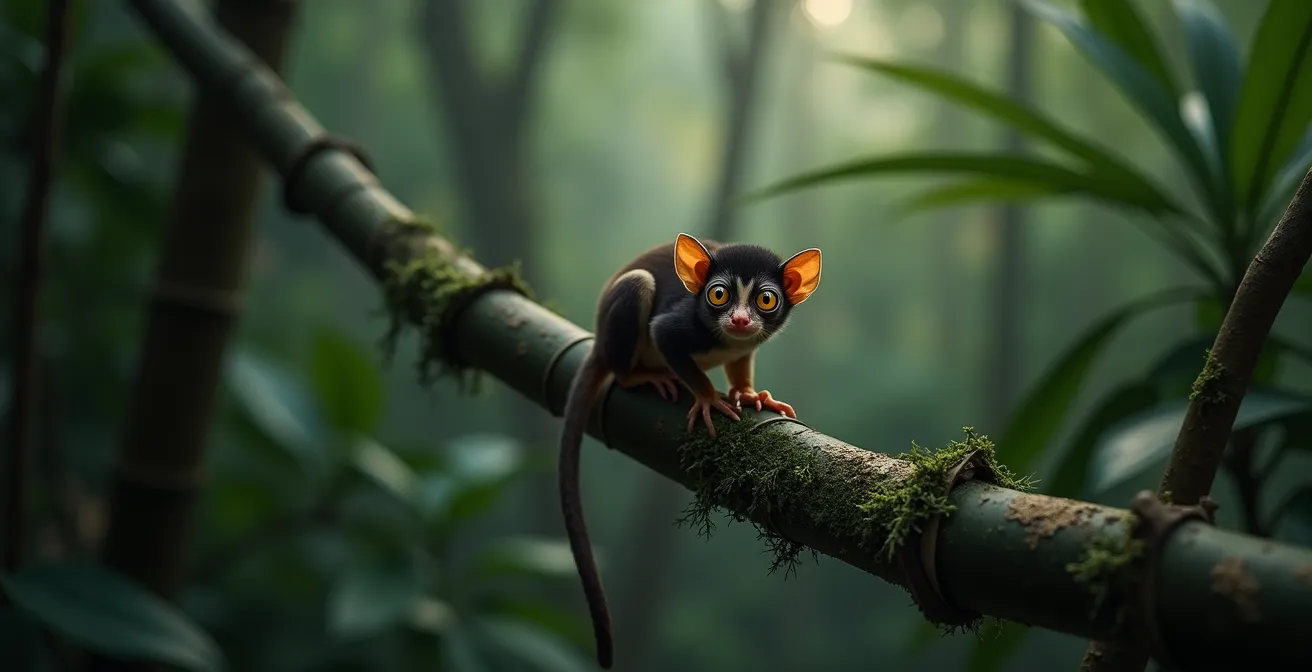
The Philippine Tarsier’s extreme sensitivity isn’t a weakness, but a hyper-evolved predatory tool that makes it fatally vulnerable to human disturbance.
- Their enormous eyes and acute hearing are precision instruments for hunting in total darkness, rendering them defenseless against the sensory overload of camera flashes and loud noises.
- Stress from this overload triggers a very real and fatal physiological response, a fact often obscured by myths of the animal committing “suicide.”
Recommendation: Ethical viewing requires moving beyond simply following rules to actively understanding the tarsier’s biology and minimizing your sensory footprint—a principle that should guide all wildlife encounters.
The image is iconic: a creature so small it fits in a human hand, with eyes so large they seem to hold the secrets of the nocturnal world. This is the Philippine Tarsier, a primate whose otherworldly appearance draws animal lovers from across the globe. The immediate impulse is to capture this encounter, to take a photo that proves you were there. Consequently, the most common piece of advice given at sanctuaries is a simple, firm command: “No flash photography.”
Many visitors follow this rule without question, alongside the request for silence, assuming it’s merely a guideline to avoid startling a shy animal. But this common understanding barely scratches the surface. The tarsier’s reaction to light and sound is not about shyness; it’s a profound biological crisis. What we perceive as a minor disturbance is, to the tarsier, a cataclysmic sensory assault on the very tools that define its existence.
This is the predator’s paradox: the same hyper-acute senses that make the tarsier an astonishingly effective nocturnal hunter are precisely what make it so fragile in our presence. To truly appreciate and protect this species, we must move beyond the platitudes. The real key isn’t just following rules, but understanding the deep physiological reasons behind them. This is not about managing tourist behavior; it’s about respecting a biological imperative for survival.
This guide will delve into the science of the tarsier’s unique sensory world. But it will also zoom out, using the tarsier as a case study for a broader philosophy of responsible tourism. From the geological wonders of Bohol to the highest peaks, we will explore how an informed, conservation-first mindset is essential for protecting the incredible, and often fragile, biodiversity of the Philippines.
To navigate this journey from broad ecological principles to the specific needs of its most delicate inhabitants, this article is structured to guide your understanding of what it means to be a responsible traveler in the archipelago.
Summary: A Guide to Responsible Ecotourism in the Philippines
- Chocolate Hills vs. Taal Volcano: Which Geological Wonder is More Accessible?
- How to Obtain a Permit for Mt. Apo Before Your Trip Starts?
- The Mosquito Repellent Mistake Travelers Make in Palawan Jungles
- Sandals vs. Hiking Boots: What Works Best for Philippine Mud?
- When to Visit Donsol to See Whale Sharks Naturally Migrating?
- The Risk of Joining “Nature Tours” That Feed Wildlife
- The Mistake of Riding Horse Carriages in Intramuros in High Heat
- Mt. Pulag or Mt. Ulap: Which Cloud Sea Hike Fits Beginners?
Chocolate Hills vs. Taal Volcano: Which Geological Wonder is More Accessible?
When considering the Philippines’ geological marvels, accessibility often dictates a traveler’s choice. While Taal Volcano’s proximity to Manila makes it an easy day trip, the Chocolate Hills in Bohol represent a different kind of tourism ecosystem, one deeply intertwined with local conservation challenges. Bohol is a major destination, with data showing that 1,010,248 tourists visited Bohol in 2023 alone. This volume of visitors places immense pressure on protected landscapes, highlighting a nationwide struggle.
The core issue is not just physical access, but the ethical and environmental consequences of that access. When tourism development outpaces conservation enforcement, even legally protected sites are put at risk. A zoologist or any conservation-minded traveler must look beyond the travel time and consider the health of the ecosystem they plan to visit. The accessibility of a site is meaningless if the visit contributes to its degradation.
Case Study: The 2024 Chocolate Hills Resort Controversy
The widespread public anger over a resort built within the protected zone of the Chocolate Hills serves as a powerful reminder of this conflict. As CNN reported, the uproar became a lightning rod for balancing tourism with preservation. The hills were declared a protected area in 1997, legally binding authorities to maintain their natural state and prevent “inappropriate exploitation.” This incident proves that legal status alone is not enough; it requires vigilant oversight and, crucially, responsible choices from tourists who can vote with their wallets by supporting sustainable operators and questioning intrusive developments.
Therefore, the question of accessibility shifts from “Which is easier to get to?” to “Which can I visit with the least negative impact?” This requires research into tour operators, local regulations, and the current state of conservation efforts at the destination.
How to Obtain a Permit for Mt. Apo Before Your Trip Starts?
Securing a permit for a protected area like Mt. Apo is more than a bureaucratic step; it is your first act as a conservation partner. These permits are a critical tool for managing human impact on some of the world’s most vulnerable ecosystems. The process typically involves contacting the local DENR (Department of Environment and Natural Resources) office or a city/municipal tourism office well in advance, as they regulate the number of climbers to prevent overcrowding and environmental strain. You’ll often need to book with an accredited guide, submit your itinerary, and sometimes attend a mandatory orientation.
This process is not designed to be a barrier, but a filter. It ensures that those who enter the park are prepared, informed, and committed to its preservation. For a zoologist, this system is the frontline defense for biodiversity. The Philippines is a global hotspot, where an incredible 5% of the world’s plant species can be found, with nearly half existing nowhere else on Earth. Mt. Apo itself is a sanctuary for the critically endangered Philippine Eagle and countless other endemic species.
Viewing the permit not as a ticket, but as a contract of stewardship, fundamentally changes a traveler’s mindset. It shifts the focus from the personal achievement of reaching the summit to the collective responsibility of leaving the environment as pristine as you found it. It’s an acknowledgment that you are a guest in a fragile, vital home for countless species.
The Mosquito Repellent Mistake Travelers Make in Palawan Jungles
In the lush jungles of Palawan, a common mistake travelers make goes far beyond choosing the wrong mosquito repellent. It’s a failure to perceive the environment’s profound sensitivity. While tourists worry about DEET concentrations, they remain oblivious to the sensory pollution they create—loud voices, rustling gear, and the blinding flash of a camera. These disturbances are infinitely more damaging to local wildlife than any mosquito bite.
This brings us to the Philippine Tarsier. While more famously associated with Bohol, the principle of its fragility applies to sensitive species everywhere. The tarsier’s entire biology is an evolutionary masterpiece of nocturnal adaptation. Its massive eyes are fixed in their sockets, unable to handle abrupt changes in light. Its ears can rotate 180 degrees, tuned to the faintest whisper of an insect’s wings. This is not a creature designed for the daytime world of human interaction.
The “no flash” rule is a biological imperative. A camera flash is not just a bright light; it’s a crippling sensory blow that can cause temporary or even permanent blindness, destroying the tarsier’s ability to hunt. Likewise, loud noises overwhelm its acoustic niche, causing extreme physiological stress. A 2019 conservation study found that tarsiers have incredibly specific habitat needs, requiring an average daily temperature of 24.3°C with 95.2% humidity for survival. This highlights how finely tuned they are to their environment and how easily thrown off balance.
As zoologist Milada Řeháková, a leading expert on the species, explains, this is a matter of life and death:
Stress was the highest contributor to the tarsiers’ mortality rate and offspring survival. If the mother were stressed, she could give birth to a stillborn.
– Milada Řeháková, Student Conservation Corner – Medium
The real mistake, therefore, is not understanding that your presence in a wild space has consequences. The goal is to minimize your sensory footprint, moving quietly, speaking in whispers, and putting the camera away to truly observe.
Sandals vs. Hiking Boots: What Works Best for Philippine Mud?
The choice of footwear for trekking in the Philippines is a practical one, but it also has significant ecological implications. The country’s volcanic soil and frequent rains create a unique, thick mud that challenges hikers and trail ecosystems alike. While sturdy hiking boots offer superior ankle support and protection, they can also contribute more to soil compaction and trail widening. Trail sandals, favored by some for their lightness and quick-drying properties, offer little protection and can increase biosecurity risks.
From a conservation perspective, the ideal footwear is a compromise: lightweight hiking shoes. They offer a balance of support and reduced environmental impact. Heavy, deep-lugged boots act like pistons, compacting wet soil and damaging the delicate root systems of trailside flora. This compaction also reduces water absorption, increasing runoff and erosion. Your footprint is more than just a temporary mark; it’s a long-term alteration of the terrain.
The following table, based on principles of trail ecosystem management, breaks down the impact of different footwear choices.
This comparison, based on an analysis of tourism impacts on geological sites, shows a clear trade-off between personal comfort and ecological responsibility.
| Footwear Type | Ecological Impact | Trail Preservation | Biosecurity Risk |
|---|---|---|---|
| Heavy Lug Boots | High soil compaction | Trail widening risk | High seed transport |
| Lightweight Hiking | Moderate impact | Better trail adherence | Moderate risk |
| Trail Sandals | Low compaction | Mud avoidance issues | Direct pathogen exposure |

Ultimately, the best choice is not just about keeping your feet dry. It’s about being a conscientious guest in a sensitive environment. It means staying on the designated path, treading lightly, and understanding that every step you take has a lasting effect. The question isn’t just what works for the mud, but what works for the fragile ecosystem that the mud supports.
When to Visit Donsol to See Whale Sharks Naturally Migrating?
The best time to visit Donsol for natural whale shark encounters is typically between November and June, with peak season from February to April. This window corresponds with the plankton-rich waters that draw these gentle giants to the area. Donsol is celebrated globally as a model for sustainable wildlife tourism because interactions are strictly regulated: no feeding, no touching, and a respectful distance is always maintained. It’s observation in its purest form.
This ethical framework provides a perfect blueprint for how we should approach all wildlife, especially creatures as delicate as the Philippine Tarsier. The principles that protect whale sharks in Donsol are the very same that should protect tarsiers in Bohol. The focus must shift from commercialized interaction to conservation-led observation. This is embodied by organizations dedicated to creating authentic, non-invasive experiences.
A prime example is the Philippine Tarsier Sanctuary in Corella, Bohol. This 134-hectare forest reserve is an active conservation site, not a zoo. Here, tarsiers live and breed in their natural habitat. The sanctuary, established by the Philippine Tarsier Foundation, prioritizes the animals’ welfare above all else, operating with strict ethical guidelines that allow for meaningful yet distant visitor encounters. This model demonstrates that it’s possible for tourism to directly fund conservation, rather than exploitation.
The success of such sanctuaries proves that the most profound wildlife experience is not about holding or feeding an animal, but about seeing it thrive in its own environment. It’s about the quiet thrill of a guide pointing to a tiny, furry ball curled up on a branch, sleeping peacefully, oblivious and—most importantly—unstressed by your presence.
The Risk of Joining “Nature Tours” That Feed Wildlife
One of the most damaging trends in ecotourism is the proliferation of “tours” that promise close encounters through the feeding of wild animals. This practice, often marketed as a way to get closer to nature, is profoundly unnatural and harmful. It creates a dangerous dependency, alters natural behaviors, and can lead to increased aggression and disease transmission. For a species as sensitive as the tarsier, such interactions are a death sentence.
Captivity and forced interaction are devastating for tarsiers. Research indicates that their life expectancy plummets when they are caged, handled, or subjected to the constant stress of a tourist attraction. The popular roadside attractions where tarsiers are kept in small, brightly lit cages are antithetical to their biological needs. They are often malnourished, as their diet of live insects is difficult to replicate, and they are in a constant state of sensory overload.
As research on their conservation status highlights, the environment of captivity itself is the primary threat.
Because the tarsier is often shy and nervous, many activities associated with captivity (such as camera flashes, being touched, and being kept in an enclosure) stresses the animal.
– Wikipedia – Philippine Tarsier Conservation Research, Philippine Tarsier Wikipedia Entry
Joining a tour that involves feeding or direct handling of tarsiers—or any wild animal—directly supports an industry of exploitation. It places a fleeting moment of tourist amusement over the long-term health and survival of the animal. A truly “natural” tour is one where the animal’s welfare is the absolute priority, and observation happens on the animal’s terms, from a respectful distance, without lure or inducement.
The Mistake of Riding Horse Carriages in Intramuros in High Heat
The principle of ethical animal tourism extends beyond wild species to the domestic animals that work in the industry. A common sight in historic districts like Intramuros in Manila is the kalesa, or horse-drawn carriage. While a charming way to see the sights, it’s crucial to consider the welfare of the horses, especially during the sweltering heat and humidity of a Philippine midday.
Choosing to ride a kalesa in extreme heat contributes directly to the animal’s exhaustion and potential for heatstroke. A responsible tourist asks critical questions: Does the horse look healthy and well-fed? Is it being forced to work during the hottest part of the day without adequate water or rest? Are there signs of injury or fatigue? A tourist’s patronage is a vote, and supporting operators who neglect their animals perpetuates a cycle of welfare abuse.
This mindset—of questioning the ethics behind an animal-based attraction—is the same one we must apply to tarsier sanctuaries, whale shark tours, and any other form of animal tourism. The responsibility lies with the consumer to choose ethical operators and reject those that prioritize profit over animal welfare. Making this choice requires a conscious effort to research and observe before participating.
To aid in this, a simple checklist can help you identify truly responsible animal tourism ventures and avoid the pitfalls of exploitative ones.
Your Ethical Animal Tourism Checklist
- Observe the conditions: Choose recognized sanctuaries like the Philippine Tarsier Sanctuary in Corella that prioritize natural forest conditions over cages.
- Check for “red flags”: Avoid any attractions that cage, handle, or allow direct contact with wild animals, or that offer guaranteed interactions and feeding opportunities.
- Support genuine conservation: Look for organizations that lead habitat protection and public education efforts, not just tourist entertainment.
- Follow the money: Research whether entrance fees directly fund conservation and animal welfare rather than pure commercial exploitation.
- Assess animal well-being: For working animals, check for signs of good health, proper care, and reasonable working hours, avoiding activities during extreme heat.
By applying this critical lens, a traveler transforms from a passive consumer into an active advocate for animal welfare, ensuring their tourism dollars support protection, not harm.
Key Takeaways
- The tarsier’s sensitivity is an advanced predatory adaptation, not a weakness; our disturbances are a direct assault on its survival tools.
- Ethical tourism is an active mindset, not a passive activity. It requires researching operators, questioning practices, and prioritizing animal welfare over personal experience.
- Your impact is multifaceted, from the sensory noise you create to the physical footprint you leave on a trail. Minimizing it is a core responsibility.
Mt. Pulag or Mt. Ulap: Which Cloud Sea Hike Fits Beginners?
For hikers seeking the breathtaking “sea of clouds” phenomenon, both Mt. Pulag and Mt. Ulap offer spectacular rewards. Mt. Ulap is generally considered more beginner-friendly, with a shorter, more direct trail. Mt. Pulag, the third highest peak in the Philippines, presents a greater challenge but offers an unparalleled expanse of high-altitude grasslands. The choice, however, should not be based solely on difficulty but on the understanding of the responsibility that comes with entering these unique, high-altitude ecosystems.
These mountains are not just hiking destinations; they are fragile habitats, cradles of biodiversity. As you ascend into the clouds, you are entering a world home to species found nowhere else. It is a world of immense beauty and profound fragility. As National Geographic Explorer Gab Mejia eloquently puts it, “The Philippines’ 7,600-plus islands are the cradle for a mind-boggling number of diverse species.” This diversity is what you are walking through.
This brings our journey full circle, back to the small creatures that depend on these vast, interconnected habitats. A tarsier may not live at these altitudes, but the principle of habitat integrity is universal. Studies show a male tarsier’s home range can span up to two hectares, and it may travel over 1.6 kilometers in a single night searching for food. This illustrates how crucial large, undisturbed tracts of forest are for the survival of just one small primate. Every ecosystem, from the lowland forests to the mossy peaks of Mt. Pulag, is a piece of a larger, interdependent puzzle.
Choosing a hike, therefore, is also choosing to be a guardian of that space. It means packing out everything you pack in, staying on the trail to prevent erosion, and moving with a quiet respect that honors the wildness around you. It’s about finding the deep satisfaction that comes not from conquering a peak, but from passing through it with the lightest touch possible.
The future of the Philippines’ unique biodiversity, from the smallest primate to the largest fish, rests in the choices we make as visitors. Your journey as a protector of these fragile worlds begins not when you arrive, but when you decide to travel with awareness, empathy, and respect. Begin by applying these principles on your next adventure, starting with a conscious choice to protect, not just to see.
Frequent Questions About Philippine Tarsier Conservation
Why is maintaining silence crucial when viewing tarsiers?
Tarsiers are highly sensitive to bright light and loud noise. Guests must follow strict eco-tourism guidelines, maintaining absolute silence to avoid causing stress that could lead to cardiac arrest in these delicate primates.
What is the minimum safe distance for observing tarsiers?
Visitors must maintain a 1-meter minimum distance at all times, with no touching, holding, or attempting contact with tarsiers allowed.
When are tarsiers most likely to be active for viewing?
While tarsiers are nocturnal, sanctuary guides know their favorite resting areas and have excellent success rates for meaningful sightings during daylight hours when they’re sleeping.