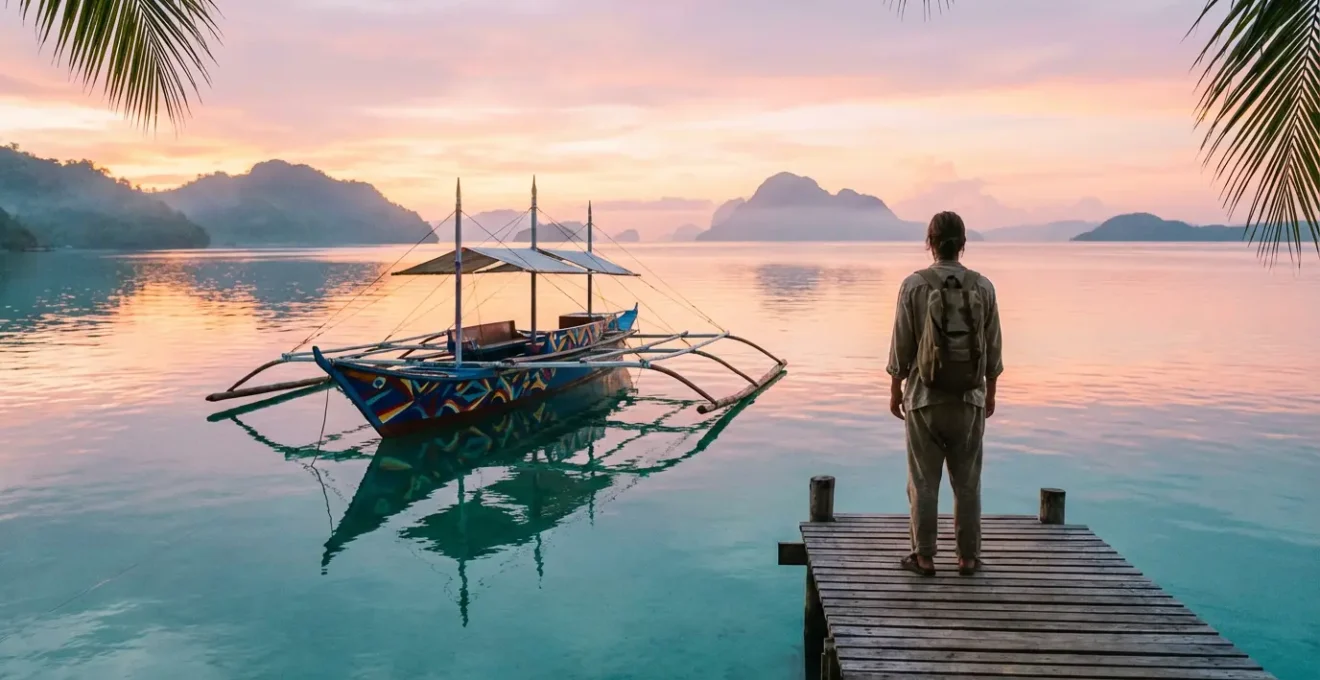
The grueling 24-hour journey to a remote Philippine beach isn’t a flaw in the system; it’s a ‘travel filter’ that actively preserves paradise and guarantees you’ll have it all to yourself.
- Mastering the journey’s logistics—the ferries, buses, and boats—is more critical than just picking a destination on a map.
- The psychological principle of ‘Effort Justification’ means the struggle to get there makes the final reward feel infinitely more profound and memorable.
Recommendation: Stop seeing travel time as a cost to be minimized and start treating it as the first, most crucial stage of your adventure.
You know the image. It’s the one that haunts your daydreams: a sliver of incandescent white sand, kissed by water so clear it looks like liquid glass, and not a single soul in sight. You’ve scrolled past it a thousand times, tagged it, saved it. This is the promise of the Philippines, an archipelago of over 7,000 islands. But there’s a catch, a detail the brochures and influencers conveniently omit. That perfect, empty beach? It’s probably going to take you a full 24 hours of grueling, non-stop travel to reach. Many will tell you to find easier alternatives, to stick to the more accessible spots in Palawan or Cebu.
They’ll give you generic advice about booking flights in advance or packing light. But what if that advice is wrong? What if the secret to finding true, untouched paradise isn’t about avoiding the difficult journey, but embracing it? The brutal reality of multi-leg bus rides, overnight ferries, and dawn-patrol outrigger boats isn’t a bug in the system; it’s a feature. It’s a natural, glorious travel filter. This journey is a rite of passage that weeds out the casual tourist, leaving the archipelago’s best-kept secrets to those willing to earn them. This guide isn’t about the easy way. It’s about the right way. It’s about mastering the “Art of the Transfer” and understanding why the price of paradise is paid in time, patience, and a little bit of logistical genius.
This article breaks down why these long journeys are necessary and how to master every leg of the trip. From the psychology of the journey itself to the practical skills needed for boat safety, freshwater management, and even avoiding sandfly bites, we’ll cover the real-world logistics that turn a challenging trip into the adventure of a lifetime.
Summary: The Art of the Transfer: A Guide to Earning Your Philippine Paradise
- Why Getting to the Most Beautiful Islands Takes More Than Just a Flight?
- Why Transferring to Caramoan Takes Half a Day From the Airport?
- How to Camp on Calaguas Island Without Ruining the Environment?
- The Itchy Mistake of Sleeping on the Sand Without a Mat at Dusk
- Boat Rental vs. Group Tour: How to Explore Balabac Safely?
- Freshwater Shower Hacks: How to Rinse Off When Island Hopping for Days?
- When to Visit Manjuyod Sandbar to Actually See the Sand?
- How to Plan a Private Island Hopping Tour in Coron for the Price of a Joiner?
Why Getting to the Most Beautiful Islands Takes More Than Just a Flight?
The first truth any serious beach bum must accept is this: a direct flight is the enemy of solitude. The world’s most stunning, empty beaches are protected by a formidable barrier—not of rock or reef, but of inconvenience. This is the “Travel Filter” in action. Think of the Philippines’ infrastructure not as lacking, but as a deliberately selective system. While the nation is a magnet for tourism, the fact that the Philippines welcomed only 5.45 million international tourists in 2023, a fraction of its regional neighbors, is partly due to this logistical challenge. This isn’t a failure; it’s the very thing that preserves the magic.
There’s a psychological principle at play here called Effort Justification. In essence, we place a higher value on outcomes that we’ve had to struggle to achieve. A beach you simply Uber to from a luxury hotel is a commodity. A beach you reach after a 12-hour bus ride, a 6-hour ferry, and a 2-hour bangka journey is a trophy. It’s an achievement. The journey itself imbues the destination with a significance that easy access can never replicate. The chaotic symphony of a local port, the shared stories on an overnight ferry, the pre-dawn chill on a small boat cutting through the waves—these aren’t obstacles. They are the narrative threads of a real adventure.
As one travel study wisely notes, the process of reaching some of the best beaches can involve inter-island flights, overland bus journeys and multiple sea crossings by public ferry, but this is part of the charm of travel in the Philippines. This journey strips away the casual tourist and leaves a community of the dedicated. It filters for patience, resilience, and a genuine love for the raw, unpolished beauty of the world. The long journey isn’t the path to paradise; the journey *is* the paradise tax.
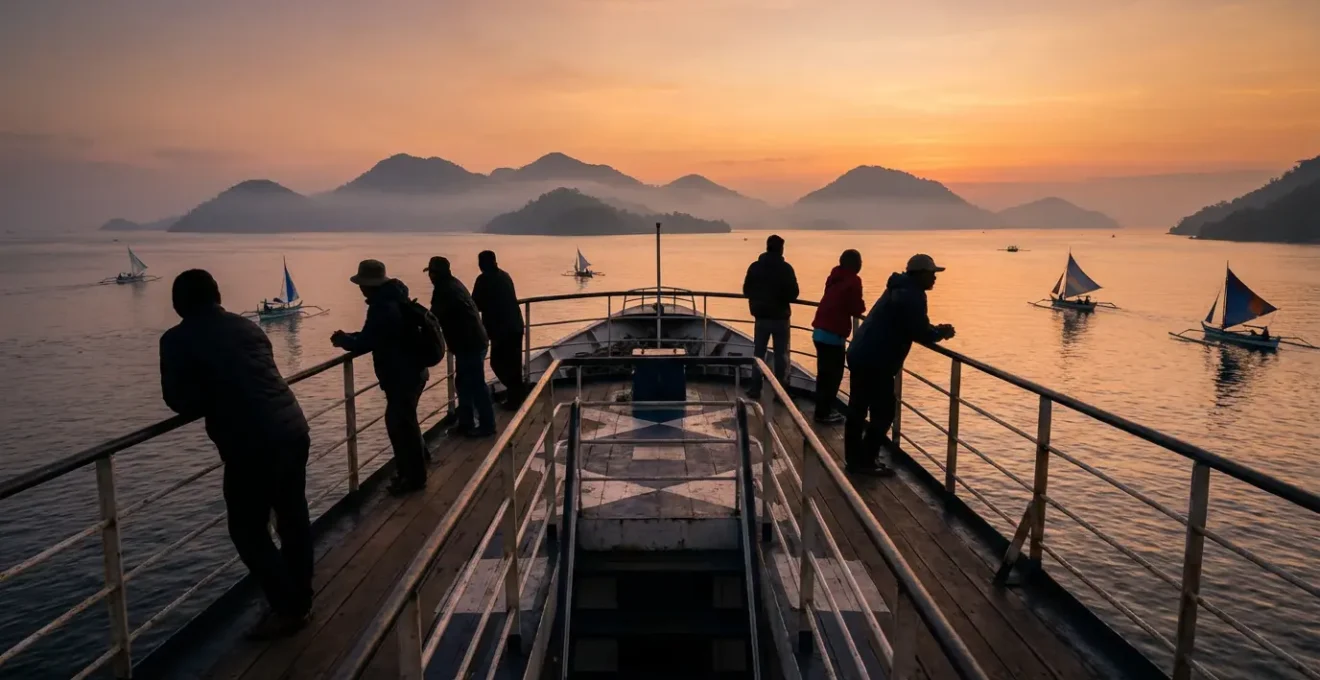
This scene, watching distant islands slip by from the deck of a ferry at sunset, isn’t a delay in your vacation; it’s a core part of it. It’s the quiet moment of reflection that a quick flight steals from you. It’s the understanding that you are truly moving from one world to another, slowly and deliberately.
Why Transferring to Caramoan Takes Half a Day From the Airport?
Caramoan is a perfect case study in the “Travel Filter.” Made famous globally as a filming location for the TV show ‘Survivor,’ it was thrust onto the world stage. You’d expect, then, that a decade later, getting there would be a breeze. But a flight to the nearest major airport, Naga, is only the first, easy step. The real journey—a multi-hour odyssey by van, ferry, and jeepney or tricycle—still takes the better part of a day. This isn’t an oversight; it’s a saving grace. The very fact that infrastructure development hasn’t kept pace with the peninsula’s fame is what has preserved its raw, untamed character.
The half-day transfer is Caramoan’s gatekeeper. It deters the large-scale resort developers and the tour bus crowds that have overwhelmed other, more accessible destinations. It ensures that those who arrive on its shores have made a conscious, deliberate choice. They have paid the “Paradise Tax.” But here is where you shift from tourist to explorer: you don’t just endure the transfer; you master it. You embrace the Art of the Transfer, turning a long travel day into a highlight of the trip itself.
Instead of staring at your phone in a cramped van, you can make that journey an integral part of your experience. The long road to the coast is an opportunity, not a chore. Here’s how to reframe that travel time:
- Taste the Region: The stop in Naga City isn’t a delay. It’s your chance to dive into the public market and try authentic Bicol Express right at the source or stock up on local pili nuts.
- Embrace the Scenery: The winding roads cut through the beautiful Caramoan National Park. Ask your driver for a quick photo stop at one of the viewpoints overlooking the jagged coastline.
- Strategize Your Crossings: Locals know to book the early morning departures from Sabang Port to avoid the notoriously choppy afternoon seas. This isn’t just about comfort; it’s about demonstrating travel savvy.
- Connect and Prepare: The 2-hour land journey followed by a 2-hour boat ride is the perfect time to connect with other dedicated travelers or simply prepare mentally for the days of island solitude ahead.
By treating the journey with this level of intention, you’re no longer just a passenger. You’re an active participant in your own adventure, collecting experiences, not just destinations.
How to Camp on Calaguas Island Without Ruining the Environment?
If the journey is the first test, arriving is the second. After 10-12 hours of travel to reach the shores of Calaguas, its legendary Mahabang Buhangin (Long Beach) can feel like a personal reward. But with reward comes responsibility. This isn’t Boracay; there are no waste management services or municipal plumbing. The island’s pristine state is maintained by a fragile pact between nature and the visitor. Honoring this pact is the first rule of logistical mastery. According to recent environmental assessments, Calaguas Island hosts one of the cleanest beaches in the Philippines, with unique tidal pool ecosystems that are incredibly sensitive to human impact.
To camp here is to agree to leave no trace—not just in the poetic sense, but in the most brutally literal way. This means adopting a “Pack-In, Pack-Out” mentality that is absolute and uncompromising. Every single item you bring, from a plastic bottle to a banana peel, must leave with you. This isn’t a suggestion; it’s the price of admission. The island’s beauty is directly proportional to the effort its visitors put into protecting it. Forget this rule, and you become part of the problem that will inevitably erase this paradise from the map.
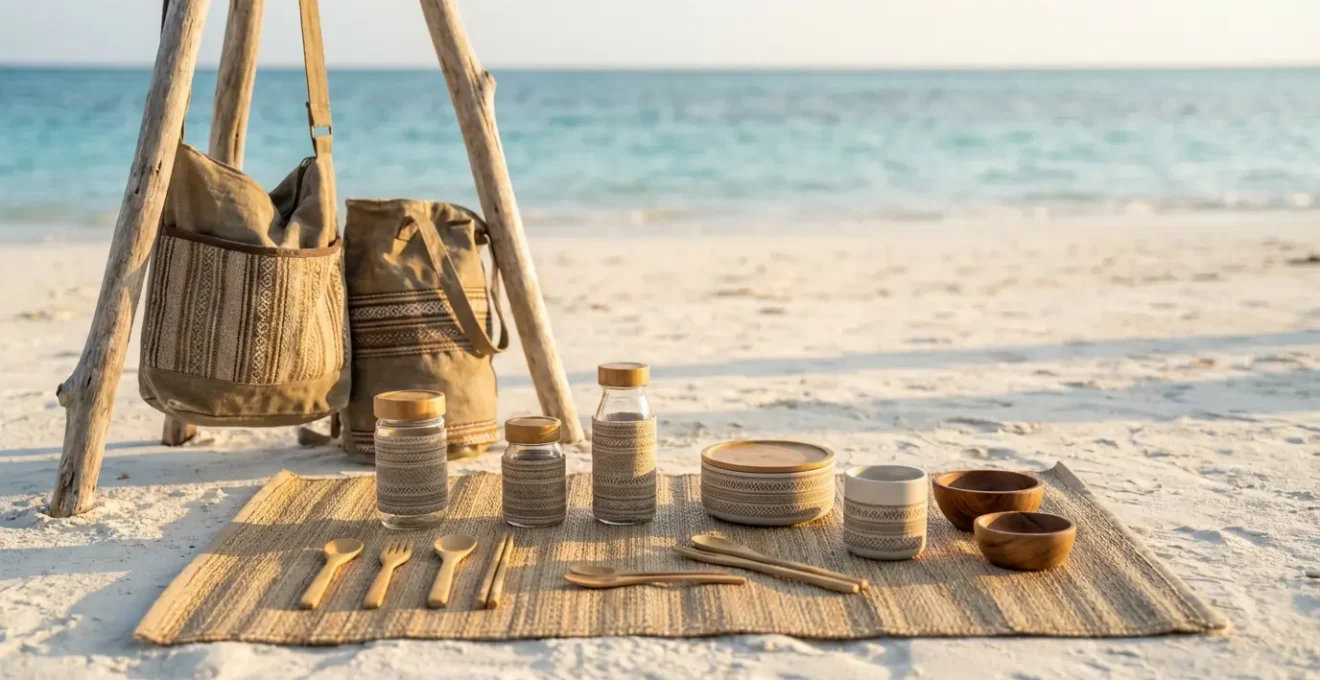
Your campsite should look like this: a minimalist, thoughtful setup that respects the environment. This means using reusable containers, carrying your own waste bags, and choosing biodegradable products. The goal is to make your presence as temporary as a footprint at the water’s edge, destined to be washed away by the next tide.
Here’s a simple, non-negotiable system for responsible camping:
- Total Waste Containment: Bring multiple heavy-duty waterproof dry bags. Dedicate one for organic waste (yes, even fruit peels), one for plastics, and a smaller one for anything hazardous like used batteries.
- Soap and Water Discipline: Pack biodegradable soap bars, not liquid soaps in plastic bottles. Any water used for washing should be collected and disposed of properly back on the mainland, not dumped on the island.
- Reef-Safe Sunscreen Only: This is crucial. Your sunscreen must be mineral-based, using zinc oxide or titanium dioxide. Chemical sunscreens (containing oxybenzone) are toxic to coral reefs and the island’s delicate tidal pools.
- Camp Placement: Never create a new clearing. Set up your tent only on existing sandy areas, well away from any vegetation or the fragile coral rubble found higher up the beach.
- The Golden Rule: Carry every single piece of your trash back to the mainland port of Daet for disposal. There are no exceptions. Leaving “biodegradable” food scraps behind attracts pests and disrupts the local ecosystem.
The Itchy Mistake of Sleeping on the Sand Without a Mat at Dusk
You’ve survived the journey. You’ve set up your eco-friendly camp. As the sun begins to dip below the horizon, painting the sky in fiery hues, the temptation is overwhelming: to lie back directly on the cool, soft sand and soak it all in. This is a rookie mistake, and you’ll pay for it with a week of maddening, incessant itching. Welcome to the world of the “nik-nik,” or the sandfly. These tiny, almost invisible insects are the bane of the unprepared beach camper, and they are most active at dusk and dawn.
This is another layer of the Travel Filter: the small, maddening discomforts that test your preparation and resolve. For the unprepared, a sandfly encounter can ruin a trip. For the seasoned explorer, it’s a predictable variable that has already been accounted for. Logistical mastery isn’t just about the big picture of boats and buses; it’s about acing the micro-details, like knowing that sandflies can’t bite through tightly woven clothing and struggle to fly in a breeze. It’s about choosing your campsite not just for the view, but for its exposure to the wind.
Your defense is a multi-layered strategy. Repellent is a start, but physical barriers and smart timing are your true allies. Elevating your sleeping system on a cot or in a hammock is the ultimate solution, as it puts you completely out of their limited flight range. A good groundsheet or a thick mat is the next best thing, creating a crucial barrier between you and the sand where they live.
The choice of protection involves a trade-off between effectiveness, environmental impact, and portability. The best solution is often a combination of methods.
| Protection Method | Effectiveness | Environmental Impact | Portability |
|---|---|---|---|
| Picaridin 20% | 8-10 hours | Low | Excellent |
| DEET 30% | 10-12 hours | Moderate | Excellent |
| Coconut Oil Infusion | 2-3 hours | None | Good |
| Hammock with Bug Net | 100% physical barrier | None | Moderate |
| Tightly-woven clothing | 95% coverage areas | None | Excellent |
Outsmarting the sandflies is a rite of passage. It’s a small but significant victory that separates those who have truly adapted to the environment from those who are merely visiting. It’s proof that you’ve done your homework and are prepared for the realities of paradise, not just the postcard version.
Boat Rental vs. Group Tour: How to Explore Balabac Safely?
Now we enter the final frontier of Philippine travel: the remote, untamed islands of Balabac in southern Palawan. This is as far off the beaten path as it gets, a place of almost mythical beauty, with sandbars that stretch for miles and water teeming with life. It is also a region with real, tangible risks. The currents are treacherous, the weather is unpredictable, and access to emergency services is virtually nonexistent. Here, the choice between a cheap private boat and a more expensive, established group tour is not a matter of budget—it’s a matter of life and death.
This is where the seasoned explorer’s prudence shines. The temptation for a dedicated traveler is always to go private, to charter a boat and dictate your own itinerary. In Balabac, this is a gamble you should think twice about. The allure of a cheap deal from a local fisherman can be strong, but you must ask what corners are being cut to offer that price. Is it fuel? Safety equipment? Radio communications? The answer is usually “all of the above.”
A case study on safety in the region is telling. As TourRadar travelers report, established operators maintain higher safety standards with insurance, experienced crews, and proper gear, making the 20-30% higher price a worthwhile investment for remote exploration. This premium isn’t for luxury; it’s for a properly maintained engine, sufficient reserve fuel, and a captain who has a specific, practiced plan for when things go wrong. If you do decide to hire privately, your questioning must be relentless and specific. You are not a passenger; you are the safety auditor.
Before you even step on the boat, you need to be asking critical questions:
- Backup Communications: “What is your backup communication method if mobile signal fails?” The only acceptable answers are a VHF radio or a satellite phone. “I’ll get a signal later” is a red flag.
- Life Vests: “Show me the life vests. Do you have child sizes?” Don’t just take their word for it. Physically inspect them. Look for proper certification (like SOLAS approval) and check for rips or damage.
- Contingency Plan: “What is our specific Plan B route if the weather turns dangerous?” A good captain will have designated safe harbors and alternative routes already identified, not just a vague “we’ll go back.”
- Fuel Reserves: “How much extra fuel do you carry beyond the planned route?” The industry standard for safety is a minimum of 30% reserve fuel. Anything less is cutting it too close.
- Inspection Records: “When was your boat’s last coast guard safety inspection?” In the Philippines, this should have been within the last 6 months. A hesitant answer tells you everything you need to know.
In the most remote corners of the world, paying a little extra for a reputable operator isn’t selling out. It’s the smartest, most experienced decision you can make.
Freshwater Shower Hacks: How to Rinse Off When Island Hopping for Days?
After several days of island hopping, coated in a salty, sandy crust, the fantasy is no longer about empty beaches. It’s about a simple, glorious freshwater shower. In the remote archipelagos, where you might be sleeping on boats or camping on islands with no infrastructure, this basic comfort becomes the ultimate luxury. For the unprepared, this can become a major source of misery, leading to skin irritation and a general feeling of grime that wears you down. But for the master of logistics, it’s just another problem with a clever, portable solution.
Forgetting to plan for freshwater is a classic amateur move. It’s assuming that “paradise” comes with plumbing. The reality is that you are your own water supply. This means planning not just your drinking water, but your rinsing water too. The feeling of rinsing the salt off your skin and hair at the end of a long day in the ocean cannot be overstated. It’s a psychological reset that allows you to fully relax and prepare for the next day’s adventure. It’s the difference between merely surviving off-grid and thriving there.
The solutions are simple, cheap, and brilliantly effective, ranging from basic jugs to more sophisticated portable systems. The key is choosing the right system for your travel style, balancing capacity, weight, and cost. A solo backpacker has different needs than a family or a group sharing a chartered boat.

The beauty of these systems is their simplicity. A gravity shower bag, hung from a palm tree at sunset, can transform a patch of sand into a private spa. It’s a small piece of gear that delivers an outsized return in comfort and morale.
Here’s a breakdown of your options to ensure you’re never left salty and sandy for days on end:
| System Type | Capacity | Weight | Cost | Best For |
|---|---|---|---|---|
| 5-Gallon Jug | 19L | 500g empty | $5-10 | Budget travelers |
| Gravity Shower Bag | 10-20L | 200-300g | $15-25 | Solo/couples |
| Portable Pressure Shower | 11L | 1.5kg | $40-60 | Families/groups |
| Collapsible Water Container | 10-20L | 100-150g | $10-20 | Ultralight camping |
Key Takeaways
- The Travel Filter is Real: Embrace long journeys as a mechanism that preserves the authenticity and solitude of a destination.
- Master the Logistics: True exploration is less about courage and more about preparation—from boat safety and eco-camping to sandfly prevention and freshwater management.
- Data is Your Ally: Use tools like tide charts not just to visit a place, but to experience it at the perfect, magical moment that 99% of other visitors will miss.
When to Visit Manjuyod Sandbar to Actually See the Sand?
We now arrive at the master class in logistical planning: timing your visit to a tidal wonder like the Manjuyod Sandbar. Often dubbed the “Maldives of the Philippines,” Manjuyod’s magic is ephemeral. It’s a 7-kilometer stretch of pristine white sand that appears and disappears with the tide. Arrive at the wrong time, and you’ll find nothing but a collection of stilt cottages seemingly floating in the middle of the sea. You’ll have traveled for hours only to miss the main event. It’s a costly, frustrating mistake, and it’s one that hundreds of tourists make every single day.
This is where the dedicated explorer separates themselves from the crowd—not by spending more money, but by spending more time on research. The secret to Manjuyod, and countless other tidal beaches and sandbars, lies in understanding and respecting the rhythm of the ocean. Specifically, it’s about learning to read a tide chart like a pro. This one skill can unlock experiences that seem reserved for a lucky few, but are, in fact, available to anyone who does their homework. The science is simple: according to tidal monitoring data, sandbars emerge most dramatically during spring tides (which occur during new and full moons) when water levels can drop a staggering 1.5 to 2 meters below the mean sea level. This is the window you’re aiming for.
Visiting during a “negative tide” (when the low tide level is below the average) is the ultimate goal. This is when the sandbar reveals its full, magnificent glory, offering vast expanses of rippled sand to explore. Getting this right feels like cracking a code. It’s the pinnacle of the “Art of the Transfer,” where your journey is not just across space, but also timed perfectly across the fourth dimension.
Action Plan: Professional Tide Chart Reading for Sandbar Visits
- Advance Reconnaissance: Check online tide tables for your destination (e.g., Bais City for Manjuyod) at least two weeks in advance. Target dates that show a predicted low tide level below 0.3 meters.
- Pinpoint the Window: The best viewing window is typically from two hours before the absolute low tide to one hour after. This is when the sandbar is most exposed and least crowded.
- Monitor the Weather: Be aware that strong onshore winds can “push” water onto the coast, raising the actual water level by as much as 0.5 meters and hiding the sandbar even during a predicted low tide.
- Early Arrival: Plan to arrive at the location 30 minutes *before* the predicted low tide time. This allows you to witness the magical moment of the sandbar emerging from the water.
- Aim for Negative Tides: For the best possible experience and photography, look for dates with “negative tides” (e.g., -0.1m). This provides the maximum exposed sand area and is a sign of a true spring tide.
How to Plan a Private Island Hopping Tour in Coron for the Price of a Joiner?
So, you’ve mastered the philosophy of the Travel Filter and the practical skills of logistical mastery. Now it’s time for the ultimate payoff: using that knowledge to beat the system. Nowhere is this more possible than in Coron, Palawan. It’s a world-famous destination, and its key sites like Kayangan Lake and Twin Lagoon are notoriously packed with joiner tours following the same predictable, 9-to-5 itinerary. The common belief is that you have two choices: suffer the crowds on a cheap joiner tour or pay a fortune for a private boat. This is a false dichotomy.
The truly savvy explorer knows there’s a third option: orchestrate a private tour for the price of a joiner tour by leveraging timing and local knowledge. This is the grand finale of the “Art of the Transfer,” applying your hard-won experience to manipulate time and space in your favor. Instead of following the herd, you will do the exact opposite. While hundreds of boats are rushing to the same first stop, you’ll be heading to the last stop, enjoying it in blissful solitude.
This requires an early start and direct negotiation. Forget the tour agencies in town. Wake up before dawn and head directly to the Coron Public Market dock, where the boat captains gather. Here, you can negotiate directly, cutting out the middleman. You can also team up with other independent travelers you meet in hostels or via social media groups like ‘Backpacking Philippines’ to split the cost of a private charter, effectively bringing the per-person price down to the level of a crowded joiner tour.
This is the “Reverse Tour Strategy,” and it’s brilliantly simple:
- Start at Dawn: Be on the water by 6:00 AM, while the joiner tours are still serving breakfast. Head directly to the furthest destination on the standard tour, like Barracuda Lake. You’ll be the first and only boat there.
- Hit Remote Spots Mid-Morning: While the masses are finally descending on Barracuda Lake, you’ll be exploring the more remote, less-famous beaches that joiner tours skip.
- Lunchtime Lagoon: Visit the popular Twin Lagoon between 12:00 PM and 2:00 PM. This is when all the standard tours herd their guests to a beach for a pre-cooked lunch. You will have the lagoon almost to yourself.
- Save the Best for Last: The iconic Kayangan Lake is the first stop for most, and a zoo by 10 AM. You will make it your final stop, arriving between 3:30 PM and 5:00 PM, just as the last of the day tours are reluctantly departing. You’ll witness the golden hour light up the cliffs in peace.
This strategy is the culmination of everything we’ve discussed. It requires effort, planning, and a willingness to go against the grain. But the reward is an experience that money alone cannot buy: the world’s most beautiful sights, enjoyed in the solitude you have so skillfully earned.
So, the next time you’re planning a trip and see a daunting 24-hour travel time, don’t be discouraged. See it as an invitation. See it as the gatekeeper to an authentic experience. Plan the transfer, master the logistics, embrace the discomfort, and earn your piece of paradise. The real adventure doesn’t start when you arrive; it begins the moment you commit to the journey.