
In summary:
- Building a sub-1kg zero-waste kit for the Philippines requires a strategic system, not just a collection of eco-gadgets.
- Prioritize items with the highest impact-to-weight ratio, focusing on water purification, a versatile food kit, and a “pack-out” pouch.
- Complement your kit with conscious choices on the ground: support local artisans, choose farm-to-table establishments, and select certified eco-lodges.
- Understand the real impact of your choices, from avoiding wildlife feeding tours to timing your visit to support post-typhoon economic recovery.
The vision is alluring: pristine white-sand beaches, crystal-clear turquoise waters, and lush green islands. This is the promise of the Philippines. Yet, for the eco-conscious traveler, this paradise is shadowed by a sobering reality—the pervasive issue of plastic pollution and waste. The common advice is to pack a reusable bottle and a tote bag, but when you’re island hopping with a 1kg weight limit, every single item must justify its existence. This isn’t just about reducing trash; it’s a logistical and ethical challenge.
The conventional approach of simply accumulating “zero-waste” products often fails in the face of practical constraints like luggage weight, water safety, and the lack of disposal infrastructure on remote islands. Many well-intentioned travelers end up with heavy, unused gadgets, ultimately reverting to convenience and creating the waste they sought to avoid. The problem isn’t a lack of good intentions; it’s the lack of a good system.
But what if the key wasn’t simply what you pack, but the strategic framework you use to choose? This guide introduces a different perspective: a minimalist triage system for building your sub-1kg kit. It’s about prioritizing items based on their impact-to-weight ratio and understanding the unique challenges of the Philippines. We will move beyond a simple packing list to create an integrated approach that combines your essential kit with conscious decisions on the ground.
This article will first deconstruct the core principles of mass tourism’s threat to the archipelago. It will then provide a detailed blueprint for your strategic travel kit before expanding into how to make more sustainable choices regarding accommodation, food, souvenirs, and activities. By the end, you will have a comprehensive strategy to travel light and leave a positive footprint.
Summary: A Strategic Guide to Zero-Waste Travel in the Philippines
- Why Does Mass Tourism Threaten the Philippine Ecosystems More Than You Think?
- How to Maintain a Zero-Waste Routine While Island Hopping for 10 Days?
- Why Is Buying Local Souvenirs More Sustainable Than Donating Money?
- Bohol Bee Farm vs. Commercial Resort: Why Food Sourcing Matters?
- Eco-Lodge vs. Green Hotel: Which Certification Is Actually Reliable?
- The Risk of Joining “Nature Tours” That Feed Wildlife
- Carbon Offsetting: Is It Worth Paying Extra for Your Inter-Island Flights?
- When to Visit Locations Recovering from Typhoons to Aid Their Economy?
Why Does Mass Tourism Threaten the Philippine Ecosystems More Than You Think?
The term “mass tourism” often conjures images of crowded beaches, but its impact on the fragile ecosystems of the Philippines runs much deeper and is often invisible to the average visitor. The sheer volume of people concentrating in specific hotspots places an unsustainable burden on local resources. For instance, scientific research documents that tourist numbers in Oslob increased from 98,000 in 2012 to a staggering 508,000 in 2018, an explosion driven by a single attraction. This rapid influx is not just a number; it represents a cascade of environmental pressures.
The most famous example of this breaking point is Boracay Island. Its immense popularity led to such severe environmental degradation that officials were forced to close the island entirely to outsiders for six months in 2018 for rehabilitation. There is now a strict limit on the number of daily visitors to protect the recovering ecosystem. This drastic measure highlights a critical truth: even the most beautiful destinations have a finite carrying capacity.
Beyond the visible plastic waste, the hidden strains of mass tourism are what truly threaten the long-term health of the islands. These “invisible loads” create a perfect storm of degradation:
- Freshwater Depletion: Thousands of resort swimming pools, long showers, and laundry services drain local aquifers far faster than they can be naturally replenished, creating water shortages for local communities.
- Wastewater Overload: Aging or non-existent sewage treatment facilities are overwhelmed, leading to untreated or poorly treated wastewater flowing directly into the sea, damaging coral reefs and marine life.
- Power Grid Strain: The collective demand for air conditioning from hotels and resorts can cause frequent power outages, or “brownouts,” impacting the daily lives of residents.
- Economic Monoculture: When an entire local economy becomes dependent on tourism, traditional and often more sustainable livelihoods like fishing and farming are abandoned, making the community highly vulnerable to disruptions.
Understanding these deep-seated issues is the first step. It transforms the goal from simply “traveling zero-waste” to actively participating in a more mindful, regenerative form of tourism that supports and preserves the destinations we love.
How to Maintain a Zero-Waste Routine While Island Hopping for 10 Days?
Maintaining a zero-waste routine while hopping between remote Philippine islands seems daunting. The key is to shift your mindset from “packing everything” to a strategic “impact-to-weight” analysis. Your sub-1kg kit should not be a collection of gadgets, but a lean, integrated system designed to tackle the biggest waste sources: single-use water bottles, plastic food containers, and unavoidable packaging. The reality is that the Philippines generates a massive amount of waste; according to Asian Development Bank data, 35,000 tons of solid waste daily, so your personal reduction has a real, tangible purpose.
The most critical principle for island hopping is the “Pack-Out Mandate.” Many small islands lack any formal waste management. Whatever you bring onto the island, you must be prepared to carry back out with you to a larger town with proper disposal facilities. This forces a radical minimalism and makes you acutely aware of every piece of potential trash.
The second principle is the “Hub Strategy.” Instead of carrying all your belongings everywhere, establish a base in a larger town like El Nido or Coron. From there, make shorter 2-3 day trips to more remote islands, carrying only your hyper-minimalist kit. This makes the sub-1kg goal achievable and practical.
Your Action Plan: The Zero-Waste Island Hopping Trinity Kit
- The Water Purifier Bottle (approx. 400g): This is your heaviest but most vital item. Choose a purifier like LifeStraw or Grayl, not just a filter. This is non-negotiable for water safety across the Philippines and eliminates the number one source of plastic waste.
- The Versatile Food Kit (approx. 200g): A collapsible silicone container, a bamboo spork, and a reusable cloth napkin. This allows you to buy food from local markets (‘carinderias’) and avoid styrofoam or plastic takeaway containers.
- The Pack-Out Pouch (approx. 100g): A dedicated, lightweight dry bag. Its sole purpose is to store any unavoidable waste (like medicine wrappers or snack packaging) cleanly and odor-free until you return to your “hub” for disposal.
- Ultralight Toiletries (approx. 300g total): Focus on solids to save weight and avoid leaks. A solid shampoo bar, a conditioner bar, a soap bar, a bamboo toothbrush, and reef-safe solid sunscreen are all you need.
- Strategic Sourcing: Don’t pack what you can ethically source. Many local shops sell bamboo utensils or locally made soaps, supporting the community and lightening your load further.
This trinity—purification, food containment, and waste pack-out—forms the backbone of your routine. It’s a system that empowers you to refuse single-use items confidently, knowing you have a reliable and lightweight alternative for every key situation.
Why Is Buying Local Souvenirs More Sustainable Than Donating Money?
When faced with economic disparity, many travelers feel a strong urge to help, often defaulting to giving cash donations to individuals or organizations. While well-intentioned, this can create dependency and may not address the root causes of poverty. A far more empowering and sustainable approach is to channel that desire to help into conscious, direct-from-the-maker purchasing. Buying a handwoven basket, a piece of local art, or even a bag of locally grown coffee does more than just provide a one-time handout; it validates a craft, sustains a livelihood, and injects money directly into the local economy with dignity.
This act of “economic solidarity” ensures your money supports skills and traditions rather than potentially fueling cycles of begging. It provides a craftsman with business, not charity. Furthermore, choosing functional or consumable souvenirs aligns perfectly with a zero-waste philosophy, ensuring your purchase will be used and enjoyed, not become future clutter in your home. The key is to buy directly from the artisan in their workshop or a reputable local cooperative, cutting out middlemen who often take the largest cut.
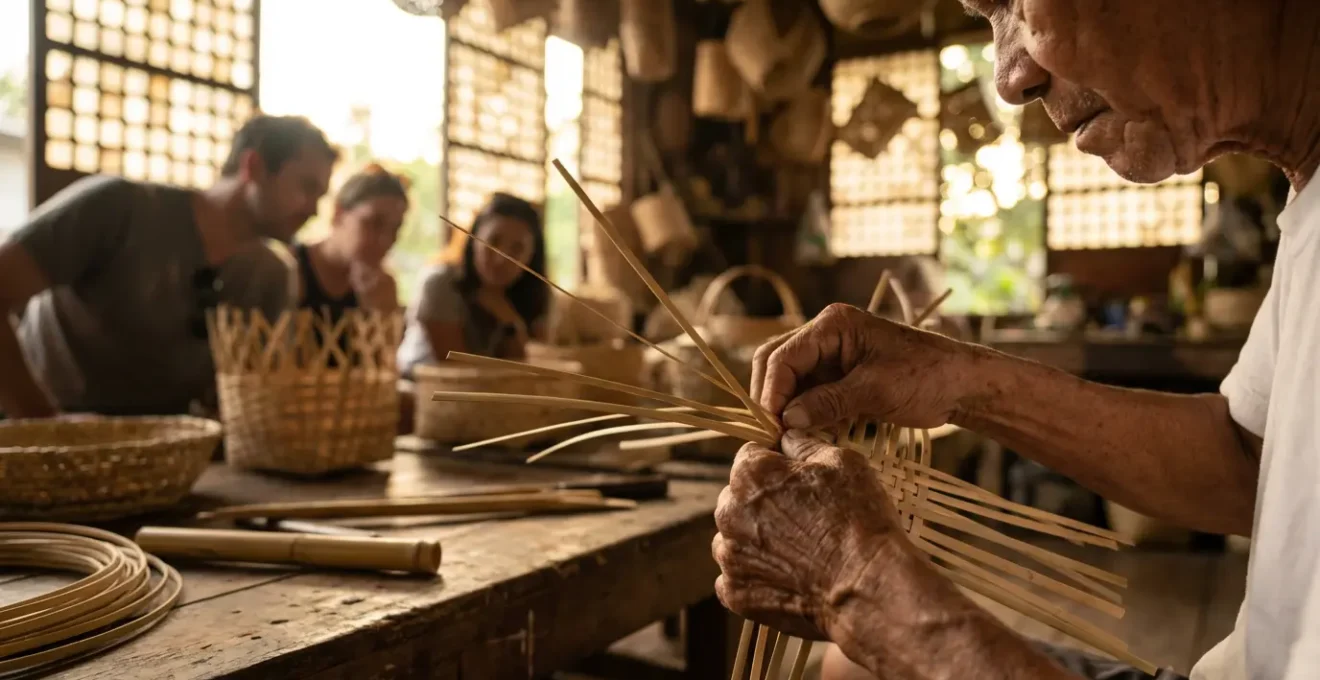
To navigate the world of souvenirs responsibly, it’s helpful to think in terms of a hierarchy. This framework guides you from the most impactful to the least desirable choices, ensuring your spending has a positive effect:
- Priority 1: Experiences. The most sustainable souvenir is a new skill. Book a class with a local community, such as a traditional weaving workshop in Ifugao or a cooking class. This is a direct investment in cultural preservation.
- Priority 2: Consumables. Purchase items that you will use up, leaving no trace. This includes local coffee from Benguet, world-famous dried mangoes from Cebu, or traditional spices and condiments.
- Priority 3: Functional Items. Select beautiful items that serve a purpose. Handwoven baskets from Banaue can be used for storage, while bamboo utensils or hand-carved bowls from Palawan can be used in your daily life.
- Priority 4: Art. If you choose decorative pieces, buy them directly from the artists themselves. Supporting indigenous Mindoro Mangyan weavers or a painter in a local gallery ensures the creator receives the full benefit.
- Avoid: Mass-produced trinkets like plastic keychains or generic t-shirts. These are often imported, have a high environmental cost, and offer little economic benefit to the local community.
Bohol Bee Farm vs. Commercial Resort: Why Food Sourcing Matters?
Your choice of where to eat and sleep has a profound, often hidden, impact on the local environment and economy. The difference is starkly illustrated when comparing a farm-to-table model, like Bohol Bee Farm, with a typical import-dependent commercial resort. On the surface, both offer a bed and a meal, but underneath, they represent two opposing philosophies of tourism. Food sourcing is not just about freshness; it’s a critical indicator of a resort’s commitment to sustainability.
Import-dependent resorts often fly in the majority of their food and supplies, creating a massive carbon footprint and contributing to “economic leakage,” where a large percentage of tourist dollars leaves the local community to pay foreign suppliers. Conversely, establishments that prioritize local sourcing create a virtuous cycle. They provide a stable market for local farmers and fishermen, reduce transport emissions to near zero, and offer guests a more authentic, fresher culinary experience.
Case Study: Bohol Bee Farm’s Circular Economy Model
Bohol Bee Farm is a pioneering example of this philosophy in action. The resort is famous for its on-site organic gardens that supply its restaurant, eliminating food miles and ensuring peak freshness. But their commitment goes deeper. The farm has successfully implemented a comprehensive water recycling system that has reduced its water consumption by 57%. This achievement in efficiency and sustainability earned them the first-ever Excellence in Design for Greater Efficiencies (EDGE) certification from the Philippine Green Building Initiative, setting a new standard for eco-conscious hospitality in the country.
The following table breaks down the key differences between these two models, highlighting why choosing a farm-to-table establishment is a powerful act of sustainable travel.
| Impact Factor | Farm-to-Table Model | Import-Dependent Resort |
|---|---|---|
| Carbon Footprint | Near-zero transport emissions | High shipping/aviation emissions |
| Economic Leakage | <10% leaves local economy | >60% to external suppliers |
| Food Freshness | Harvest to table <24 hours | 3-14 days supply chain |
| Community Impact | Direct employment & sourcing | Limited local engagement |
| Resilience | Supply chain independent | Vulnerable to disruptions |
By actively seeking out hotels and restaurants that champion local sourcing, you are voting with your wallet for a more resilient, equitable, and environmentally friendly form of tourism.
Eco-Lodge vs. Green Hotel: Which Certification Is Actually Reliable?
In a world where “eco-friendly” has become a powerful marketing buzzword, navigating the claims of hotels and resorts can be a minefield of “greenwashing.” Many establishments boast of their green credentials, but these claims often lack substance and verification. The crucial question for a conscious traveler is: how do you separate genuine commitment from clever marketing? The answer lies in looking beyond self-proclaimed titles and seeking out credible, third-party certifications.
The scale of this issue in the Philippines is significant. A revealing report highlights the gap between claims and reality: while 78% of surveyed Philippines hotels claim carbon reduction initiatives, only a mere 30% have verifiable green infrastructure to back it up. This means over two-thirds of “green” claims may be superficial at best. Terms like “eco-lodge” or “green hotel” are not legally protected and can be used by anyone, making them unreliable indicators of true sustainability.
So, what should you look for? The most reliable path is to seek out properties that have undergone the rigorous process of obtaining a respected third-party certification. These programs use standardized, measurable criteria to audit a hotel’s performance in areas like energy and water consumption, waste management, and community engagement. They provide the proof that a hotel is walking the talk.
A prime example of a trustworthy certification is EarthCheck. As the world’s leading scientific benchmarking and certification group for the travel and tourism industry, its standards are globally recognized and highly respected. When a hotel like the Hotel Okura Manila achieves an EarthCheck Silver Certification, it signifies a proven commitment. It means they have implemented verifiable systems for water conservation, waste reduction protocols, and other sustainable practices, all audited by an independent body. Other reputable certifications to look for include Green Globe and LEED (Leadership in Energy and Environmental Design).
Instead of being swayed by vague marketing language, make it a habit to check a hotel’s website for logos of these certification bodies. It’s the most effective way to ensure your stay supports a business genuinely dedicated to preserving the environment.
The Risk of Joining “Nature Tours” That Feed Wildlife
The chance to see majestic creatures like whale sharks up close is a powerful draw for many visitors to the Philippines. However, a popular form of tourism known as “provisioning”—the practice of feeding wild animals to guarantee sightings for tourists—poses a severe threat to the animals and their environment. While these tours are often marketed as “eco-tours,” the reality is a far cry from ethical wildlife interaction. The infamous whale shark feeding in Oslob, Cebu, serves as a stark case study of good intentions leading to devastating consequences.
The practice attracts enormous crowds; the location sees over 300,000 visitors annually. To ensure the sharks stay, tour operators dump up to 50 tons of feed into the water each year. This unnatural concentration of activity has had a catastrophic impact on the local marine ecosystem. Alarming research published in Environmental Management reveals this has led to a 36% degradation of the surrounding coral reef. Furthermore, the animals themselves suffer. Studies show that 95% of the whale sharks in Oslob exhibit anthropogenic scars from boat propellers and contact, compared to just 27% in a non-provisioned population in Australia. The feeding alters their natural diving and migration patterns, creating a dependency that could be fatal in the long run.
An ethical wildlife encounter is one that observes animals in their natural habitat without altering their behavior. The goal is to be a passive observer, not an active participant. True eco-tourism contributes to conservation efforts and prioritizes the well-being of the wildlife above the entertainment of tourists. When choosing a tour, you must be able to distinguish between practices that help and those that harm.
This comparative table offers clear guidelines for identifying an ethical tour versus a harmful, provisioned one.
| Criteria | Ethical Wildlife Encounters | Harmful Provisioned Tours |
|---|---|---|
| Minimum Distance | 3+ meters maintained | Direct contact allowed |
| Group Size | Max 6-8 people | 40+ boats average (Oslob) |
| Wildlife Behavior | Natural foraging patterns | Modified feeding behavior |
| Conservation Contribution | Funds research/protection | Primarily profit-driven |
| Long-term Impact | Sustainable populations | Dependency and scarring |
By choosing tour operators who adhere to strict no-contact, no-feeding policies and use their profits to fund conservation, you help protect these magnificent creatures for generations to come.
Carbon Offsetting: Is It Worth Paying Extra for Your Inter-Island Flights?
Island hopping in the Philippines almost inevitably involves short domestic flights, each contributing to your carbon footprint. Many airlines now offer the option to “offset” these emissions for a small extra fee, promising to neutralize your impact. But is this a meaningful climate action or just a way to ease traveler guilt? The answer is complex: the value of carbon offsetting depends entirely on the quality and integrity of the offset project you are funding.
A cheap, unverified offset is often worse than doing nothing at all, as it creates a false sense of accomplishment. Many low-cost projects lack “additionality”—meaning the positive action, like protecting a forest, would have happened anyway, with or without your money. A high-quality offset, on the other hand, funds projects that are permanent, verifiable, and would not exist without this specific funding stream. These are often more expensive but represent a real, measurable climate benefit.
The most impactful offsets are those that are local and community-focused. Instead of funding a distant project in another country, look for opportunities to support initiatives within the Philippines, such as mangrove reforestation or renewable energy projects that benefit local communities. Mangroves are particularly powerful, as they sequester vast amounts of carbon while also protecting coastlines from storms—a critical service in the typhoon-prone Philippines.
Rather than blindly ticking the box on an airline website, a responsible traveler should take a more hands-on approach. If you choose to offset, do it through a reputable, third-party organization that allows you to choose high-quality, certified projects. To ensure your money is making a real difference, use the following checklist based on the highest industry standards.
- Verify ‘Additionality’: Ask the hard question. Would this mangrove restoration project in Palawan genuinely not happen without offset payments? The project must be a direct result of the funding.
- Check for ‘Permanence’: How long is the impact guaranteed? For a reforestation project, ensure the planted trees are legally protected from being cut down for at least 20-30 years.
- Confirm ‘Local Impact’: Prioritize projects located within the Philippines, ideally in a province you are visiting. This connects your travel directly to the solution.
- Request a ‘Third-Party Audit’: Look for projects certified by internationally recognized standards like the Gold Standard or Verra (VCS). These logos are a seal of quality and verification.
- Calculate the ‘True Cost’: Be skeptical of cheap offsets. A quality mangrove restoration project in the Philippines can cost between $15-25 per ton of CO2. An offer to offset a flight for $2 is a major red flag.
Ultimately, the first and best steps are to reduce emissions wherever possible—by choosing ferries over flights when practical. If you must fly, offsetting through a high-quality, verified local project is a meaningful secondary action.
Key Takeaways
- Mass tourism’s impact goes beyond visible waste, straining local water, power, and social structures.
- An effective zero-waste kit prioritizes a water purifier, a food kit, and a pack-out pouch over numerous gadgets.
- Support local economies more effectively by buying souvenirs directly from artisans rather than giving cash donations.
- Choose accommodations and restaurants with transparent, locally-sourced supply chains to minimize your carbon footprint and support the community.
- Avoid “greenwashing” by looking for credible third-party certifications like EarthCheck instead of vague marketing terms.
When to Visit Locations Recovering from Typhoons to Aid Their Economy?
The Philippines is one of the most typhoon-prone countries in the world, and the aftermath of a major storm can be devastating for coastal communities that depend on tourism. For the compassionate traveler, the instinct is often to rush in and help, but the timing and nature of your visit are absolutely critical. Arriving at the wrong time can make you a liability rather than a help, consuming scarce resources like clean water, food, and medical supplies needed by locals.
However, arriving at the right time, with the right mindset, can be a powerful force for economic recovery. Post-disaster tourism, when done responsibly, provides a vital injection of cash directly into the hands of families and small business owners who need it most. It sends a message of hope and signals to the world that the destination is back on its feet and open for business. The key is understanding the distinct phases of recovery and the appropriate role for a tourist in each one.
Navigating this sensitive situation requires careful planning and a commitment to being a completely self-sufficient and low-impact visitor. The goal is to bring in money without taking out resources. The following timeline provides a general framework for making a responsible decision.
| Phase | Timeline | Tourist Status | Recommended Actions |
|---|---|---|---|
| Emergency Response | 0-1 month | Stay Away – You’re a Liability | Donate to verified, on-the-ground relief organizations. |
| Infrastructure Rebuild | 1-6 months | Only if 100% Self-Sufficient | Bring your own water purifier, solar charger, and even some food. |
| Economic Relaunch | 6+ months | Sweet Spot for Impact | Book family-run homestays, eat at local carinderias, hire local guides. |
The “sweet spot” for impactful tourism is the Economic Relaunch phase. During this period, basic infrastructure is typically restored, but the local economy is still fragile. This is when your tourist dollars have the most significant positive effect. Prioritize spending your money at small, locally-owned businesses—book a room in a family homestay, eat at neighborhood restaurants, and hire independent boatmen and guides. This ensures your money flows directly to those who are rebuilding their lives and livelihoods.
Now that you have a complete framework, from your personal kit to your large-scale economic impact, you are equipped to be a truly conscious traveler. Start planning your next journey to the Philippines not just by destination, but by the positive footprint you can leave behind. Adopt this minimalist, strategic approach and become part of the solution for preserving the archipelago’s incredible natural wonders for years to come.