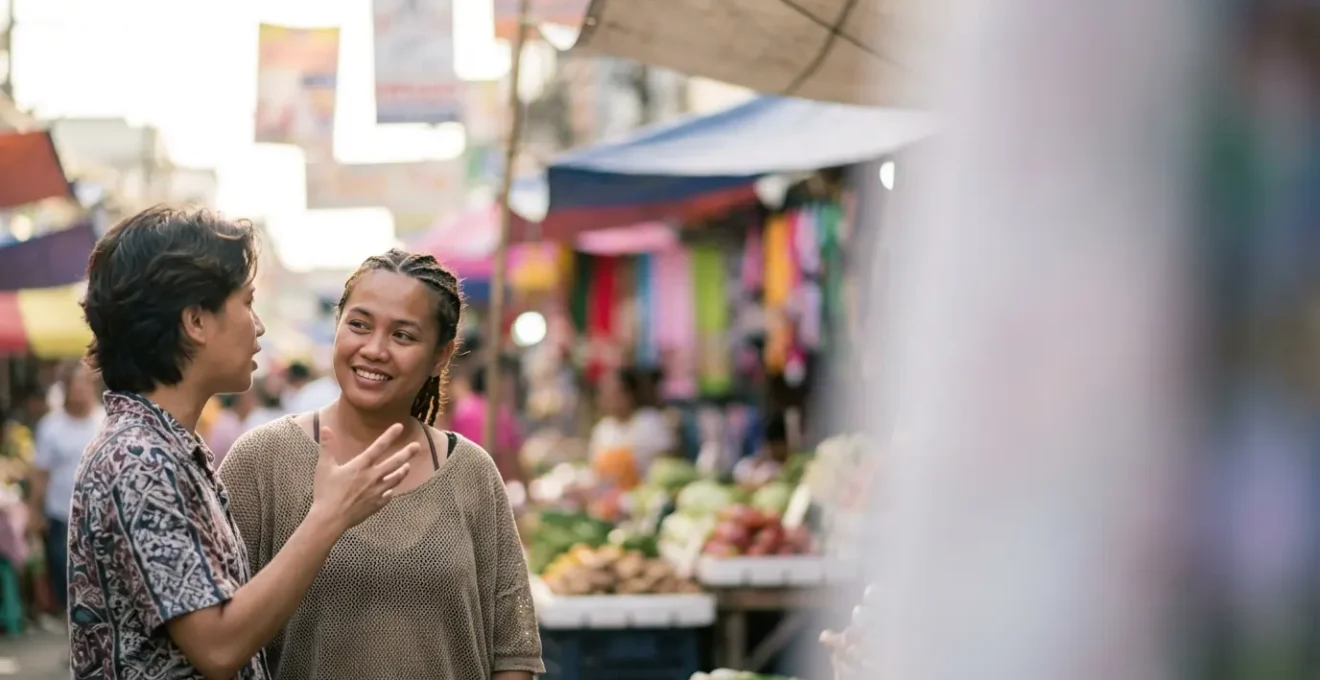
The use of American English in the Philippines is a direct historical legacy, but understanding this is only the first step; effective communication requires decoding a unique system of cultural and social rules.
- Filipino communication is deeply influenced by the core value of Pakikisama (smooth interpersonal relationships), which often prioritizes harmony over directness.
- Language choice (formal English, Taglish, or regional dialects) is highly contextual and signals social rapport.
Recommendation: Instead of focusing only on vocabulary, travelers should prioritize learning the non-verbal cues and social etiquette that govern conversation to build genuine connections.
For any linguistically curious traveler, the Philippines presents a fascinating paradox. The English spoken is fluent, widespread, and instantly recognizable, yet it’s distinctly American in its accent and vocabulary, a stark contrast to the British English found in neighboring Malaysia or Hong Kong. The immediate answer, of course, lies in history: the American colonial period from 1898 to 1946 established a public education system with English as the medium of instruction. Historical data reveals that even before the mid-20th century, more than 20% of the Philippine population could understand and speak English, a foundation that solidified its role in the nation’s identity. Today, English remains one of the two official languages, alongside Filipino.
However, attributing Filipino English solely to this historical legacy is to miss the vibrant, complex, and nuanced reality of how the language lives and breathes today. Simply knowing the “why” of its origin is not enough to navigate the “how” of daily communication. The English used in the Philippines is not a mere carbon copy of American English; it has evolved into its own distinct variant, deeply interwoven with local culture, social values, and a rich tapestry of over 170 indigenous languages. Understanding this unique linguistic hybridity is the true key to moving beyond simple transactions and forging genuine connections with the Filipino people.
This guide moves beyond the historical footnote to provide a practical framework for travelers. We will explore the art of code-switching between English and Taglish, decipher the subtle cultural cues that can lead to misunderstanding, and learn the gestures of respect that speak louder than words. The goal is not just to be understood, but to understand, connect, and communicate with cultural intelligence and respect.
To help you navigate this rich linguistic landscape, this article is structured to provide clear, actionable insights into the most common communication scenarios you’ll encounter. From the bustling streets of Manila to the serene rural provinces, you’ll learn how to adapt your language and behavior to build genuine rapport.
Summary: A Traveler’s Guide to Filipino English and Culture
- Taglish vs. English: When Is It Appropriate to Switch Codes?
- How to Communicate in Rural Areas Where English Is Limited?
- The Risk of Misinterpreting “Yes” When a Filipino Means “Maybe”
- Lodi, Petmalu, and Werpa: Which Slang Words Will Impress Your Local Friends?
- When to Stop Talking Business and Start “Chikahan” (Small Talk)?
- Tagalog vs. Bisaya: How to Adjust Your Language Expectations in Cebu?
- Basic Tagalog Phrases: Which Ones Actually Make Locals Smile?
- How to Perform “Mano Po” to Show Respect to Filipino Elders?
Taglish vs. English: When Is It Appropriate to Switch Codes?
One of the first things a traveler will notice is the fluid, seemingly effortless mixing of English and Tagalog within a single sentence. This phenomenon, known as “Taglish,” is not a sign of poor English proficiency but rather a sophisticated form of linguistic hybridity. It is a social tool used to convey tone, establish intimacy, and navigate different social contexts. For a foreigner, knowing when to stick to formal English and when it’s acceptable to mirror this code-switching is a crucial social skill. The default rule is to always start with clear, formal English, especially in professional or service environments like hotels, banks, or government offices.
The switch to Taglish is almost always initiated by the Filipino speaker and serves as an invitation to a more informal, friendly dynamic. It signals that you are moving from a transactional relationship to one based on rapport. Forcing Taglish prematurely can come across as condescending or unnatural. The key is to listen and observe. If your new friend or colleague begins to sprinkle their English with Tagalog words, it’s a sign that you can relax your own formality. This dynamic is rooted in the cultural value of pakikisama, or getting along, which prioritizes social harmony and a sense of shared camaraderie over rigid formality.
Mastering this back-and-forth is about reading the room. Pay attention to the communication style of your conversation partner. If they maintain formal English, you should too. If they shift to the more relaxed cadence of Taglish, you have been welcomed into a more personal space. It’s a subtle dance, but one that shows a deep respect for the unspoken rules of Filipino social interaction.
Your Action Plan: Navigating Code-Switching
- Listen first: Always identify the communication style being used by your Filipino conversation partner before adjusting your own.
- Use formal English: Maintain clear, formal English in professional settings (banks, hotels, government offices) as the default.
- Wait for the invitation: Gradually introduce more casual language only after establishing a friendly rapport in informal settings and hearing your partner switch first.
- Recognize the cultural root: Understand that this shift is often related to pakikisama, the value of ‘getting along’ and building companionship.
- Mirror the pattern: If locals you are comfortable with switch to Taglish, you can follow their lead in a natural, non-forced manner.
How to Communicate in Rural Areas Where English Is Limited?
While English is widely spoken in the Philippines, proficiency levels can vary significantly between urban centers and rural provinces. Official data suggests that while a vast majority of the population has some English knowledge, a smaller segment of approximately 14 million Filipinos speak English fluently or nearly fluently. This distinction is most apparent when traveling outside of major cities like Manila or Cebu. In rural barangays (villages), you are more likely to encounter individuals, especially among the older generation, who are more comfortable speaking their regional language and may have limited English vocabulary.
In these situations, communication becomes an exercise in patience, humility, and non-verbal expression. A friendly smile is the most powerful tool in your arsenal. Simple, universally understood hand gestures can bridge the language gap for basic needs like asking for directions or purchasing items from a local sari-sari store. Pointing, nodding, and using facial expressions to convey meaning are not seen as rude but as practical means of communication. It is crucial to speak slowly and use simple, basic English words rather than complex sentences. Avoid using slang or idioms, which are unlikely to be understood.
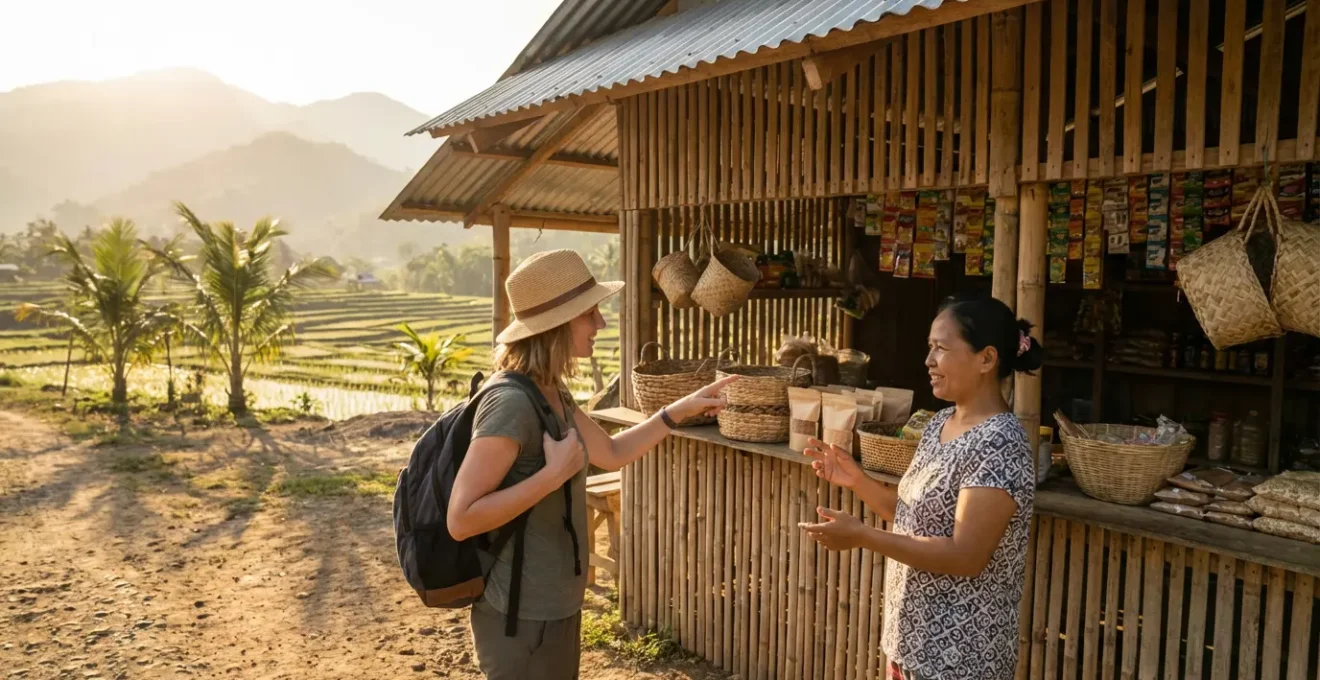
As the image above illustrates, these interactions are often warm and friendly. Carrying a small notebook and pen, or a translation app on your phone, can be incredibly helpful. Writing down numbers for prices or showing pictures of your destination can prevent confusion. More importantly, attempting to use even one or two basic Tagalog or local dialect phrases (like “Salamat po” for “Thank you”) will be met with immense appreciation. It shows effort and respect, transforming a potentially frustrating language barrier into a moment of positive human connection.
The Risk of Misinterpreting “Yes” When a Filipino Means “Maybe”
One of the most significant cultural hurdles for Western visitors is navigating the Filipino concept of “yes.” In many Western cultures, “yes” is a direct confirmation. In the Philippines, “yes” (or “oo”) can often mean “I hear you,” “I will try,” or, most frequently, “I don’t want to disappoint you by saying no.” This indirectness is not meant to be deceptive; it is a fundamental expression of pakikisama, the cultural imperative to maintain smooth interpersonal relationships and avoid conflict or causing “hiya” (shame or loss of face) to another person.
Saying a direct “no” can be perceived as confrontational or uncooperative. To preserve harmony, a Filipino might agree to a request they are unsure they can fulfill. This cultural trait is deeply ingrained; a study on workplace communication highlighted that 54% of Filipino employees felt uncomfortable receiving direct criticism from managers, underscoring a societal preference for non-confrontational styles. As business culture expert Jordan Imutan notes, this value has two sides:
Pakikisama, which translates to camaraderie or getting along with others, helps build strong team relationships but can also lead to a tendency to avoid conflict at all costs.
– Jordan Imutan, Medium
To avoid misinterpretation, a traveler must learn to listen for the “how” and not just the “what.” A hesitant “yes,” a “yes” followed by a long pause, or a vague answer like “We’ll see” or “I’ll try my best” should be interpreted as a polite “maybe” or even a “no.” Instead of asking closed yes/no questions (“Can you be here by 9 AM?”), try open-ended questions that allow for a more nuanced answer (“What time do you think you can arrive?”). This gives the other person a way to provide a realistic answer without having to issue a direct negative, thus preserving harmony for everyone involved.
Lodi, Petmalu, and Werpa: Which Slang Words Will Impress Your Local Friends?
Filipino slang is a constantly evolving and playful aspect of the language, often incorporating reversed words (Lodi from idol, Petmalu from malupet/cool, Werpa from power) or terms borrowed from pop culture. For a traveler, attempting to use slang can be a double-edged sword. Used correctly and in the right context, it can be a fantastic icebreaker and a way to show you’ve made an effort to connect with the local culture. However, used incorrectly or with the wrong crowd, it can sound awkward or even patronizing.
The safest strategy is to be a listener first. Wait to hear slang used naturally by your Filipino friends before attempting it yourself. This will give you a feel for which terms are current and how they are used. Rather than focusing on trendy but fleeting internet slang, it’s more practical to learn Filipino English’s unique but stable vocabulary. For example, knowing that a ‘bathroom’ or ‘toilet’ is almost universally called a ‘comfort room’ (CR) is far more useful than knowing a meme-based phrase. Similarly, ‘carry-on luggage’ is referred to as ‘hand carry’, and a polite way to say ‘go ahead’ is ‘please proceed’. Mastering these small but consistent differences in vocabulary shows a deeper level of observation.
If you do want to try some conversational slang, start with universally understood and practical terms. Simple words like ‘chibog’ (food or eating time) or ‘tara!’ (let’s go!) are casual, friendly, and hard to misuse among peers. A well-timed ‘gets?’ (understand?) can also show a friendly, informal rapport. The cardinal rule is to never use casual slang with elders or in any formal setting. Reserve it strictly for informal interactions with people your age or younger who have already established a relaxed dynamic with you.
When to Stop Talking Business and Start “Chikahan” (Small Talk)?
In the Philippines, business and personal relationships are often deeply intertwined. The Western concept of getting straight down to business is frequently seen as cold or overly aggressive. Instead, a period of informal conversation, known as ‘chikahan’ (small talk or light-hearted gossip), is an essential prelude to any serious discussion. This is not wasted time; it is the crucial process of relationship-building. As noted by business analysts, core Filipino values like ‘Bayanihan’ (community spirit) and ‘Pakikisama’ (smooth interpersonal relationships) heavily influence how business is conducted. Chikahan is the primary tool for nurturing these values.
Recognizing the invitation to switch from formal talk to chikahan is a key skill. Here are some common signals:
- Offering of Refreshments: When your host offers you coffee, juice, or a snack, it’s a clear signal to pause the business agenda and engage in personal conversation. Accepting is a must.
- Personal Questions: Being asked about your family, your trip, or your home country is not being nosy; it’s a direct attempt to build rapport. Respond warmly and be prepared to ask similar questions in return.
- Sharing of Anecdotes: If your Filipino counterpart shares a personal story or a joke, it is an invitation to reciprocate. Share an appropriate, light-hearted story of your own.
A good rule of thumb is to allocate the first 10-15 minutes of any meeting to genuine small talk. Rushing this process can jeopardize the entire relationship. Pay close attention to non-verbal cues like smiling, laughter, and relaxed posture, which indicate that the chikahan phase is going well. Only after this foundation of personal connection has been laid should you gently transition to the business at hand. This investment in relationship-building will pay dividends in trust and cooperation.
Tagalog vs. Bisaya: How to Adjust Your Language Expectations in Cebu?
While Filipino (which is largely based on Tagalog) and English are the official languages, the Philippines is a mosaic of over 170 distinct languages. A common mistake for travelers is assuming that Tagalog is spoken everywhere. When you travel to the Visayas region, particularly to Cebu, you will find that the primary local language is Cebuano (also known as Bisaya). While most Cebuanos in urban areas will speak English and likely understand Tagalog due to media and education, their mother tongue remains the language of the home and heart.
In this context, English often serves a crucial role as a neutral, unifying language. Between a native Tagalog speaker from Manila and a native Cebuano speaker, English can become the most comfortable and equitable medium of communication, avoiding any perception of linguistic imposition. This is why you will often hear flawless English in regions where it is not the first language; it is the practical lingua franca that bridges the gaps between different Filipino ethnolinguistic groups. You should not assume that speaking Tagalog in Cebu will be seen as an advantage; while appreciated as an effort, sticking to English is often the most respectful and effective approach.
Therefore, your language expectations should be adjusted regionally. In Manila and the surrounding Luzon provinces, learning a few Tagalog phrases is highly effective. In Cebu and other parts of the Visayas and Mindanao, learning a basic Cebuano greeting like “Maayong buntag” (Good morning) will be far more impressive and appreciated. In all regions, however, English remains your most reliable and universally accepted tool for clear communication, serving as the common ground upon which interregional conversations are built.
Basic Tagalog Phrases: Which Ones Actually Make Locals Smile?
While English will get you by in almost any situation, making the effort to learn a few basic Tagalog phrases demonstrates respect and a genuine interest in the culture. The key is to focus on phrases that convey politeness and appreciation, as these resonate most deeply. The single most important particle to learn is “po” (or “opo” for “yes”). This is a marker of respect used when speaking to elders, authority figures, or anyone you’ve just met. Sprinkling “po” into your English or Tagalog sentences is a guaranteed way to make a positive impression.
Beyond “po,” focus on phrases that build rapport and show gratitude. Locals don’t expect you to be fluent, but a few well-chosen words can go a long way. Here are some essential phrases that are guaranteed to elicit a warm smile:
- Levels of “Thank You”: “Salamat” is the basic thank you. “Salamat po” is more respectful. “Maraming salamat po” (Thank you very much, respectfully) is the gold standard for showing deep appreciation.
- Humble Apologies: Instead of a simple “sorry,” using “Pasensya na po” is a humble way to apologize or say “excuse me,” acknowledging that you may have caused an inconvenience.
- The Ultimate Compliment: When enjoying a meal, telling your host or the chef “Ang sarap!” (It’s delicious!) is one of the highest compliments you can give.
- Polite Requests: “Pakiusap po” is a very polite way to say “please” when asking for a favor, though in many contexts, a simple “please” with “po” will suffice.
- Warm Farewells: Ending a conversation with “Ingat po” (Take care, respectfully) is a warm and caring way to say goodbye, leaving a lasting positive impression.
The goal is not to have a full conversation in Tagalog, but to show that you value the local culture enough to learn its words of respect. This small effort can transform you from just another tourist into a welcome guest.
Key takeaways
- The use of American English is a historical legacy, but Filipino English is a unique system governed by local culture.
- The cultural value of Pakikisama (social harmony) explains the preference for indirect communication and the nuanced meaning of “yes.”
- Mastering non-verbal cues and gestures of respect, like the Mano Po, is often more important than perfect grammar for building genuine connections.
How to Perform “Mano Po” to Show Respect to Filipino Elders?
Perhaps the most beautiful and profound gesture of respect in Filipino culture is the “Mano Po.” This non-verbal act transcends language and is a powerful way for a younger person to show deference and seek a blessing from an elder. For a foreign visitor, being invited to perform or correctly performing this gesture is a sign of deep cultural understanding and acceptance. It is a physical manifestation of the high regard Filipinos have for their elders and the importance of family and social hierarchy.
The gesture is simple yet deeply meaningful. It is typically performed when greeting an elder (grandparents, older relatives, family friends) or when saying goodbye. Understanding the proper etiquette is crucial to performing it with the sincerity it deserves.
- Identify the Recipient: This gesture is reserved for elders. In a host family, this would be the grandparents, parents, or older uncles and aunts.
- Perform the Gesture: You slightly bow, gently take the back of the elder’s right hand, and press it to your forehead. Your eyes should be lowered during the gesture as a sign of respect.
- Wait for the Blessing: The elder will then give their blessing, often by saying “God bless you” or “Kaawaan ka ng Diyos” (May God have mercy on you).
- Complete the Ritual: After the blessing, you release their hand, smile warmly, and say “Salamat po” (Thank you, respectfully).

For travelers who might feel uncomfortable with the physical touch, a respectful alternative is to simply bow your head slightly, make eye contact, and smile, while being extra diligent about using “po” and “opo” in your speech. However, embracing the Mano Po is an unparalleled way to honor Filipino tradition and will be seen as a profound sign of respect that will be deeply appreciated and long remembered by your hosts.
Understanding the nuances of Filipino English and communication etiquette is a journey that goes far beyond a history lesson. It requires observation, humility, and a genuine desire to connect with people by honoring their cultural values. By embracing the principles of pakikisama, learning a few words of respect, and understanding the unwritten social rules, you transform your travels from a simple visit into a rich, meaningful cultural exchange.