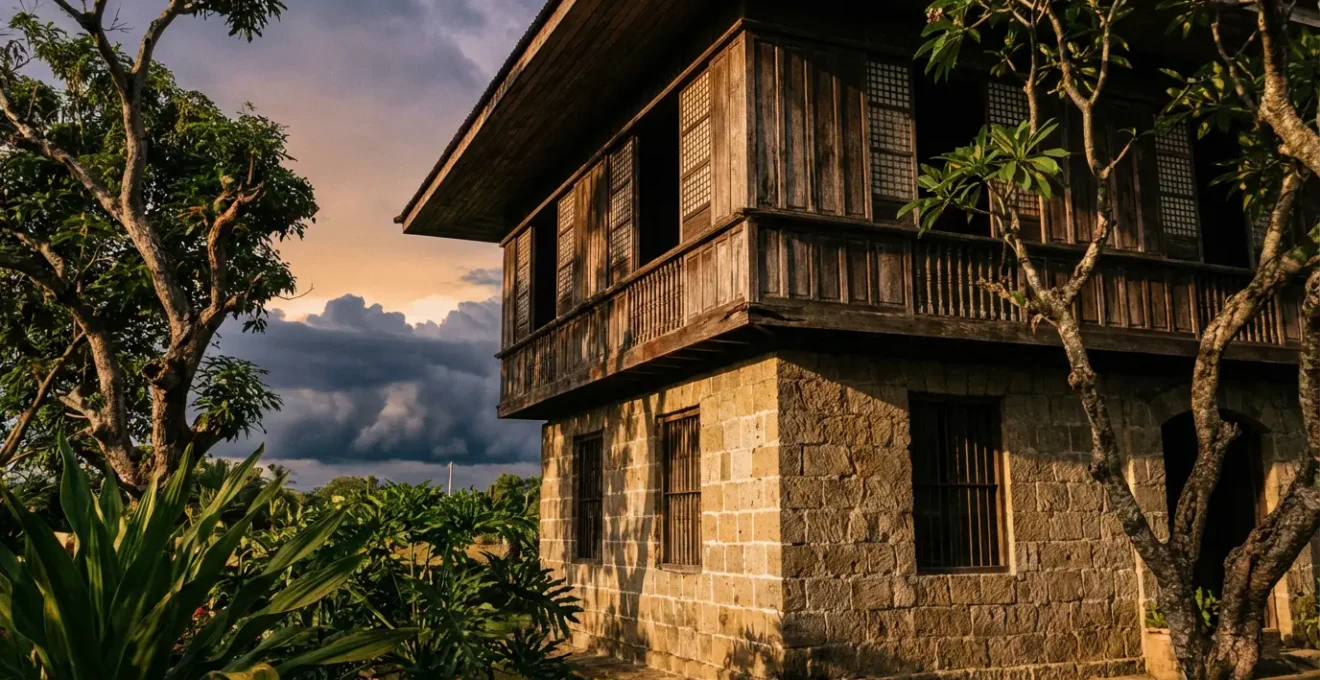
The Bahay na Bato’s resilience lies not in resisting natural forces, but in its engineered flexibility to move with them, making it a dynamic system rather than a static object.
- The combination of a heavy stone base for mass damping and a lightweight, flexible timber upper frame allows the structure to dissipate seismic energy.
- Its design represents a form of “material intelligence” where each component works in symbiosis to achieve structural integrity through movement, not rigidity.
Recommendation: Architecture students should analyze these structures not as historical artifacts, but as sophisticated examples of passive seismic and climatic adaptation to inform future resilient design.
As a tropical architect, one often looks to the past not for nostalgia, but for time-tested genius. The Philippine Bahay na Bato stands as a paramount example. When confronted with the archipelago’s twin threats—earthquakes from the Ring of Fire and typhoons from the Pacific—the typical response is to build with unyielding rigidity. We see this in modern reinforced concrete. Yet, the Bahay na Bato teaches a profound, counter-intuitive lesson. Its brilliance isn’t in how it stands firm against nature, but in how it gracefully dances with it. The common description of a “stone ground floor and a wooden upper floor” barely scratches the surface of this intricate structural philosophy.
The true marvel of the Bahay na Bato is its conception as a dynamic, integrated system. The heavy stone base provides a low center of gravity and a “mass damping” effect, while the lightweight, timber-framed upper story is designed to be flexible. The joinery is often not rigidly nailed but pegged, allowing for slight movement that dissipates seismic energy instead of absorbing it until failure. This is not merely a house; it is a meticulously engineered response to its environment. This article will deconstruct this structural wisdom, exploring how this principle of “flexible resilience” manifests in various heritage forms, the risks of losing this knowledge to superficial modernization, and how we can both appreciate and protect this invaluable architectural legacy.
To fully grasp the multifaceted genius of this design philosophy, this guide examines its principles through various lenses—from specific architectural styles and preservation challenges to practical advice for the modern observer. The following sections offer a comprehensive exploration for any student of adaptive design.
Summary: Deconstructing the Architectural Resilience of the Bahay na Bato
- Art Deco in Manila: Where to Find the Hidden Gems of the 1930s?
- How to Donate to Heritage Conservation Funds Instead of Buying Cheap Souvenirs?
- Iloilo vs. Vigan: Which City Offers a More Authentic Colonial Vibe?
- The Risk of “Facadism” in Modern Philippine Mall Design
- When to Avoid Visiting Old Churches After a Magnitude 5 Earthquake?
- Why Are Some UNESCO Heritage Churches Crumbling Despite Status?
- How to Visit a Privately Owned “Bahay na Bato” Without Trespassing?
- Vigan’s Calle Crisologo vs. Intramuros: Which Colonial Site Is More Authentic?
Art Deco in Manila: Where to Find the Hidden Gems of the 1930s?
The evolution of Philippine architecture reveals fascinating dialogues between local and international styles. The Art Deco movement of the 1930s, for instance, offered a vision of modernity that both embraced and departed from the principles of the Bahay na Bato. While Manila’s Art Deco treasures, like the Far Eastern University campus with its 5 Art Deco buildings preserved since 1939, showcase a unique Filipino take on the global style, they also mark a significant structural shift. Architects like Juan Arellano, a master of the form, used reinforced concrete to create the streamlined, geometric aesthetics of landmarks such as the Rizal Memorial Coliseum.
This transition from the flexible wood-and-stone of the Bahay na Bato to the rigid monolith of concrete represents a fundamental change in design philosophy. The original Bahay na Bato was designed for repair and adaptation; its flexible joints could be reset after a tremor. The Rizal Memorial Coliseum, conversely, demonstrated the new paradigm: built in 1934, it required complete reconstruction after the Battle of Manila. Art Deco’s rigidity, while stylistically powerful, abandoned the dynamic, dissipative strategy of its predecessor. Exploring these structures, from the theaters of Escolta to the aforementioned FEU campus, offers a lesson in the trade-offs between aesthetic ambition and inherent structural resilience.
How to Donate to Heritage Conservation Funds Instead of Buying Cheap Souvenirs?
The architectural marvels we study are not static museum pieces; they are vulnerable structures requiring constant care, a task made immensely difficult by the very forces they were designed to resist. The 2022 earthquake in Vigan was a harsh reminder of this, causing an estimated $27.3 million in damage to heritage structures. For the student or admirer of architecture, contributing to their preservation offers a far more meaningful engagement than purchasing mass-produced souvenirs. Supporting conservation is a direct investment in the continuity of this architectural knowledge.
Direct financial support, channeled correctly, can have a significant impact on safeguarding these irreplaceable assets. Instead of guesswork, one can follow established pathways to ensure funds are used effectively for structural assessments, craftsman training, and crucial documentation efforts. These actions help preserve not just the buildings, but the intangible skills required to maintain them. The following checklist provides concrete steps for anyone wishing to contribute directly to the longevity of Philippine heritage architecture, transforming admiration into tangible action.
Action Plan: Supporting Heritage Preservation
- Contact UNESCO’s Heritage Emergency Fund (HEF) for multi-donor opportunities supporting structural assessments.
- Partner with ICOMOS Philippines for capacity building workshops that train local craftsmen in traditional restoration techniques.
- Support documentation efforts – the most essential part of restoring historic structures according to heritage experts.
- Fund specific structural elements through ‘adopt a feature’ programs connecting donors to architectural components.
- Contribute to updating preservation manuals like the Vigan Heritage Homeowner’s Manual for disaster-resilient restoration.
Iloilo vs. Vigan: Which City Offers a More Authentic Colonial Vibe?
When seeking the “most authentic” colonial experience, architecture students often compare Vigan and Iloilo. From a structural historian’s perspective, authenticity is not just about aesthetics but about continuity and integrity. Vigan, a UNESCO World Heritage Site, offers an almost unparalleled example of an “unbroken survival.” Its streetscapes are a living library of the Bahay na Bato’s evolution and its proven resilience. Iloilo, while boasting magnificent individual heritage structures funded by the wealth of the sugar industry, presents a more fragmented narrative with a mix of original and reconstructed buildings.
This distinction is critical. Vigan’s architecture demonstrates the success of the original design philosophy in situ, having weathered centuries of environmental stress. The damage to about 100 ancestral homes in the 2022 quake, while devastating, also provides a real-world laboratory for studying failure points and refining traditional restoration techniques. Iloilo’s grand mansions, on the other hand, often showcase a greater variety of imported hardwoods and more ornate designs, reflecting a different kind of historical narrative centered on economic boom. The following table breaks down the key differences for the discerning architectural observer.
This comparative analysis highlights the different tales these two cities tell about architectural preservation and history.
| Aspect | Vigan | Iloilo |
|---|---|---|
| Preservation Status | UNESCO World Heritage Site since 1999 | Individual heritage buildings, no unified designation |
| Architectural Survival | Unbroken survival showcasing original resilience | Mix of original and reconstructed structures |
| Building Materials | Local hardwoods and brick construction | Varied hardwood types from sugar baron wealth |
| Current Use | Museum-like curated experience | Living structures with active commercial use |
| Earthquake Response | 100 ancestral homes damaged in 2022 M7.0 quake | Historical data limited but similar vulnerability |
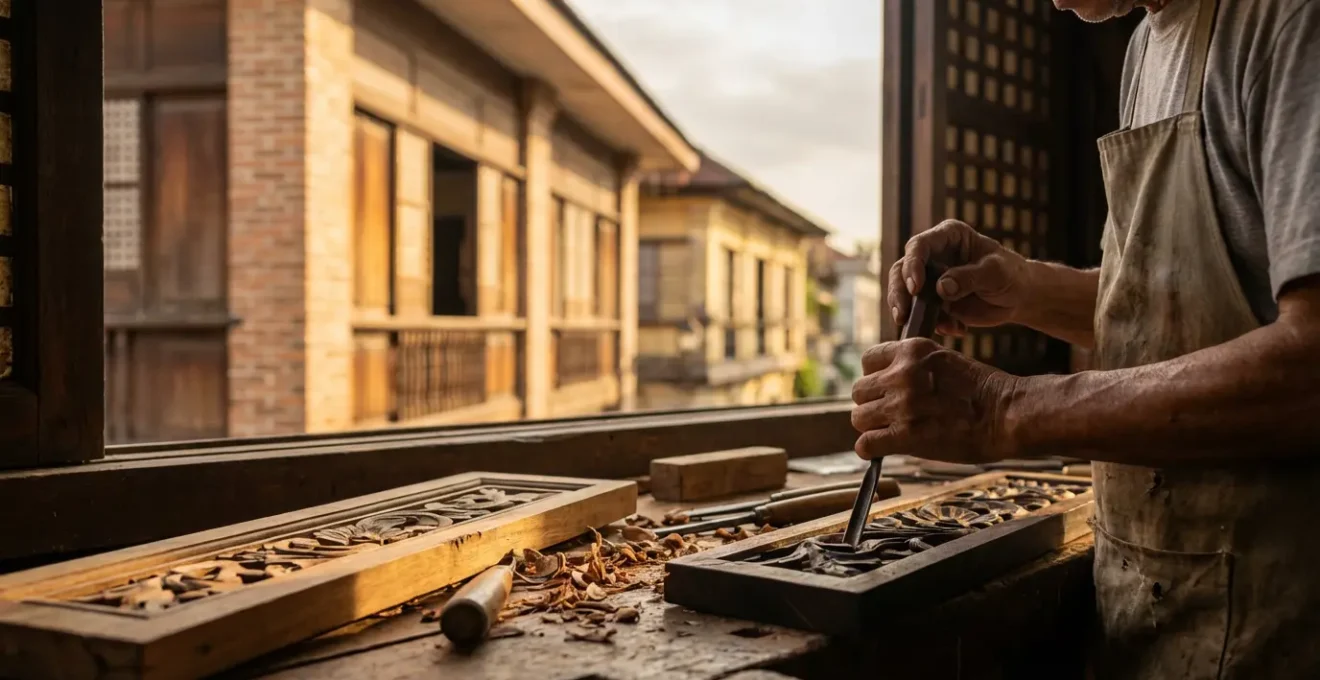
The visual continuity of Vigan’s Calle Crisologo, as seen above, provides tangible proof of the design’s long-term success. While Iloilo offers spectacular examples of colonial wealth, Vigan offers a more cohesive lesson in structural endurance and community-scale preservation, making it an essential case study in tropical adaptive architecture.
The Risk of “Facadism” in Modern Philippine Mall Design
One of the most alarming trends in modern commercial architecture is “facadism”—the practice of applying a historical aesthetic to a modern structure without integrating its underlying principles. This is particularly dangerous when applied to the Bahay na Bato. A mall designed to look like a collection of colonial houses may be commercially appealing, but it often betrays the very structural intelligence it seeks to imitate. The genius of the Bahay na Bato is its flexible, holistic system; facadism reduces it to a decorative, non-structural skin, creating a building that is ironically less resilient than its historical inspiration.
Modern interpretations often use reinforced concrete and steel frames to achieve the form, which fundamentally alters the building’s dynamic response. While these materials enhance rigidity, they eliminate the crucial flexibility that allows a true Bahay na Bato to dissipate seismic energy. This shift from a “flexible fortress” to a rigid box with a historical veneer is the very definition of structural facadism. It’s a misunderstanding of the core concept. True resilience, as experts like Rey Gabitan of the United Architects of the Philippines note, is about a holistic approach, not just isolated features. As he points out, “The problem with building houses on stilts is that it’s not necessarily earthquake-resilient except if additional braces are built. For disaster resilience, the ultimate solution is finding the right location.” This highlights that resilience is a system, where material, form, and location must work in concert.
When to Avoid Visiting Old Churches After a Magnitude 5 Earthquake?
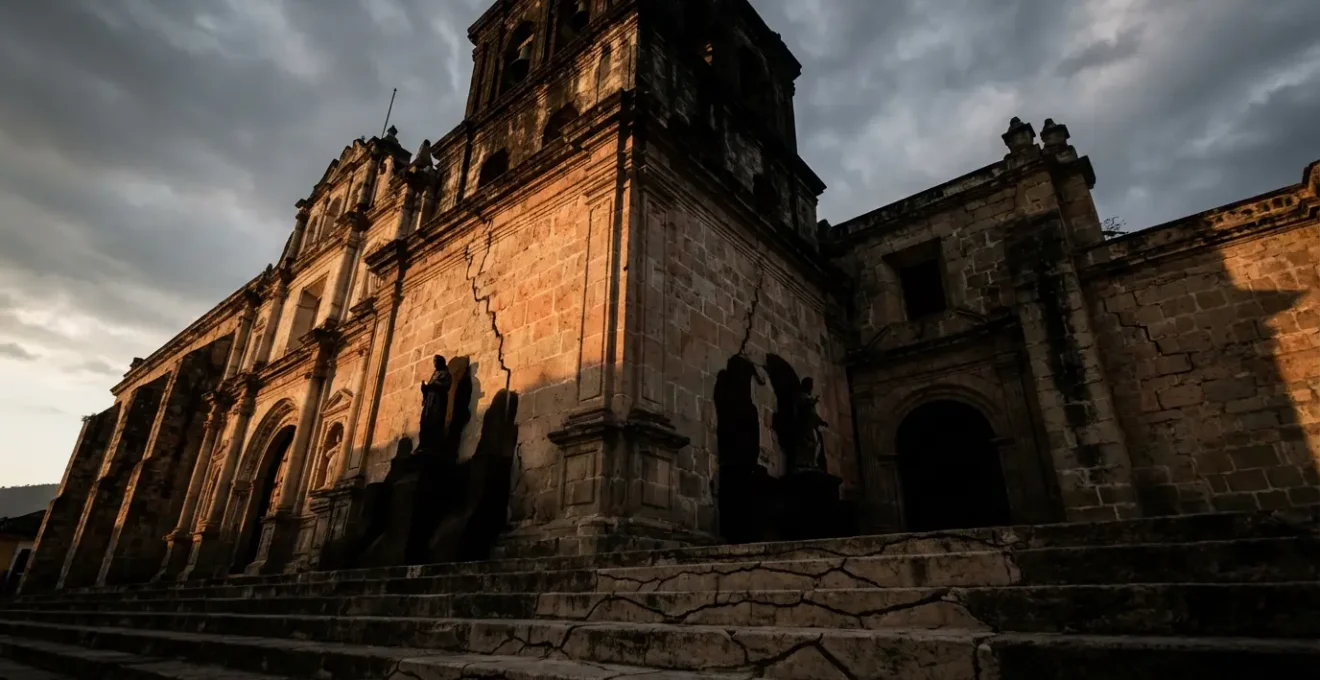
While the Bahay na Bato is a model of flexible resilience, the grand colonial churches of the Philippines represent a different structural paradigm: “Earthquake Baroque.” These magnificent structures, with their massive walls and detached bell towers, were also designed to withstand tremors, but through sheer mass and buttressing rather than flexibility. However, their age and material (often coral stone and brick) make them exceptionally vulnerable to damage. For architects and enthusiasts, inspecting these structures post-earthquake is tempting but extremely hazardous. With an 80 years average return period for destructive earthquakes in Metro Manila, this is a recurring and serious concern.
A magnitude 5 earthquake may seem moderate, but it is more than capable of creating unseen structural damage in centuries-old masonry. Aftershocks can, and often do, cause catastrophic failure in a structure weakened by the initial quake. Bell towers are particularly dangerous, as they can act as inverted pendulums, amplifying ground motion and collapsing. The primary rule is to allow certified structural engineers to conduct a thorough assessment before anyone enters the vicinity. Rushing to survey the damage not only puts you at risk but can also interfere with professional evaluation efforts. An architect’s first duty is to safety—their own and that of the public.
Post-Earthquake Safety Checklist for Heritage Churches
- Wait a minimum of 72 hours after the initial quake for a professional structural assessment.
- Avoid areas around bell towers, which act as inverted pendulums during aftershocks.
- Look for new diagonal cracks in walls—a key indicator of shear stress damage.
- Check if doors no longer fit their frames, a sign of structural shifting.
- Monitor for falling plaster or loosened decorative elements from a safe distance.
- Document any visible damage with photographs from outside the collapse zone for insurance and restoration purposes.
Why Are Some UNESCO Heritage Churches Crumbling Despite Status?
A UNESCO World Heritage designation is often seen as the ultimate protection for a historic structure. However, the reality on the ground can be far more complex and, at times, counter-intuitive. While the status brings global recognition and tourism, it can also introduce a layer of bureaucracy that ironically hinders timely and adaptive repairs. As Moe Chiba from the UNESCO Culture Unit in Jakarta has observed, the stringent regulations tied to the designation can be a double-edged sword: “UNESCO designation can slow down urgent, adaptive repairs due to strict regulations, while non-designated structures might be repaired more pragmatically.”
This creates a paradox where the very measures intended to preserve a site’s “outstanding universal value” can prevent the practical, on-the-ground maintenance needed to keep it from crumbling. Furthermore, the “Earthquake Baroque” style of many of these churches, while robust, is not infallible. The famed Paoay Church, for example, is a masterwork of this style, having survived 7 major earthquakes since its construction began in 1710. Yet, this resilience has limits. The immense weight and relative rigidity of these structures mean that when damage does occur, it is often significant and costly to repair. The combination of inherent material vulnerability, the sheer scale of the buildings, and the potential for bureaucratic delays creates a perfect storm where even the most celebrated sites remain at constant risk.
How to Visit a Privately Owned “Bahay na Bato” Without Trespassing?
Many of the most pristine and authentic examples of Bahay na Bato architecture are not museums but private homes, still lived in by families for generations. For the eager architecture student, this presents an ethical dilemma: how to study these magnificent structures up close without infringing on the owners’ privacy. The key is to approach these visits with respect, planning, and an understanding that access is a privilege, not a right. Trespassing or assuming a right to enter is the fastest way to create a negative relationship between locals and those interested in their heritage.
Fortunately, there are several ethical and effective ways to experience these homes. One successful model is the heritage resort concept, such as Las Casas Filipinas de Acuzar, where historic houses have been relocated and restored, making them accessible to the public through a managed tourism framework. While this provides unparalleled access, it removes the house from its original context. For observing homes *in situ*, the best approach is to go through official or community-sanctioned channels. This not only ensures a respectful visit but often provides a much richer experience, sometimes including interaction with homeowners who are passionate about their ancestral homes.
Ethical Guide for Visiting Heritage Homes
- Contact local tourism offices or ICOMOS Philippines for information on arranged architectural tours.
- Look for heritage houses that have been converted into museums or public spaces, like the Syquia Mansion in Vigan.
- Patronize businesses operating on the ground floor (zaguan) of active Bahay na Bato structures; this is often an invited form of access.
- Join university architecture department field studies that may be open to the public.
- Photograph architectural features from public streets, using a zoom lens for details while respecting the privacy of the occupants.
- Attend local heritage conservation workshops, where homeowners sometimes participate and share their experiences.
Key Takeaways
- The Bahay na Bato’s resilience is achieved through a dynamic system of a heavy base and a light, flexible upper frame that dissipates seismic energy.
- True heritage preservation goes beyond aesthetics (“facadism”) and requires understanding and maintaining the original structural principles of flexibility and material symbiosis.
- Authenticity in architecture is measured by “unbroken survival” and functional integrity, not just stylistic replication, as the comparison between Vigan and Intramuros demonstrates.
Vigan’s Calle Crisologo vs. Intramuros: Which Colonial Site Is More Authentic?
The question of authenticity is central to any architectural study, and the comparison between Vigan’s Calle Crisologo and Manila’s Intramuros provides the ultimate case study. From a purely structural and historical standpoint, they represent two vastly different narratives: survival versus reconstruction. Intramuros, the “Walled City,” was almost entirely obliterated during the Battle of Manila in 1945. What visitors see today is a heroic and often faithful reconstruction, a testament to a desire to reclaim a lost identity. However, it is fundamentally a 20th-century interpretation of a 17th-century ideal, often using modern materials and techniques.
Vigan, on the other hand, is a miracle of unbroken historical continuity. The merchant houses lining Calle Crisologo are largely the original structures, having survived centuries of seismic, climatic, and social upheaval. This is where the true genius of the Bahay na Bato design is proven beyond doubt. Its authenticity is not just visual; it is functional and time-tested. Walking through Vigan is to read a living textbook on resilience, where every weathered brick and hardwood plank tells a story of endurance. Intramuros tells a story of memory and revival; Vigan tells a story of survival.
This table summarizes the fundamental differences that define their respective claims to authenticity.
| Criteria | Vigan’s Calle Crisologo | Intramuros |
|---|---|---|
| Historical Continuity | Unbroken survival since Spanish era | Destroyed in WWII, reconstructed post-1945 |
| Building Materials | Original hardwoods and brick | Volcanic tuff (adobe) in originals, modern materials in reconstructions |
| UNESCO Status | World Heritage Site since 1999 | No UNESCO designation, Register of Styles law since 2022 |
| Architectural Authenticity | Original structures showing true resilience | Mix of few surviving originals and faithful reconstructions |
| Cultural Context | Provincial Ilocano merchant houses | Cosmopolitan capital architecture |
For any student of architecture, the lessons from the Bahay na Bato are not merely historical. They are a powerful and urgent call to design with wisdom, humility, and a deep respect for the forces of nature. To build for the future, we must first learn from the enduring genius of the past. The next step is to integrate these principles of flexibility, material intelligence, and dynamic response into our own contemporary designs.